Share This
All posts by Diane
Are you a REAL Leader? What Pinocchio can teach you about becoming one.
 Often when I tell people that I wrote a leadership book called The Pinocchio Principle, they assume it must have something to do with ethics. It’s understandable, since the first thing most of us think of when we hear “Pinocchio” is a puppet whose nose grew when he lied. Pinocchio could easily be used as a metaphor for people who lie through their teeth while their proverbial noses grow. I can see why some might think it is a commentary on the importance of honesty in leadership. And while being truthful to oneself and others is a vital part of being a “real” leader, the reason I picked Pinocchio as a metaphor goes much deeper than his nose.
Pinocchio is the story of a puppet who longs to become REAL.
Like Pinocchio, at our core we too have a burning desire to become real, to bring into creation the greatness that resides somewhere within us. We are born with these impulses — to give form to our distinctive blends of talent, energy, passion and style. We come into the world equipped with far more than we are immediately able to utilize or even comprehend. And though these rich parts of ourselves are always there, they have a way of becoming latent over time.
There are people among us who have found ways to tap that well.
They draw forth bits of the magic we are all capable of. These are the people we love to watch and be around — who do what they do so well that it is an art. As they tap their inner reserves and unleash their own greatness, they inspire each of us to do the same. In this way, they are true leaders.
In Walt Disney’s rendition of Pinocchio, the puppet encounters a blue fairy.
She tells him, “When you prove yourself to be brave, truthful, and unselfish, Pinocchio, then you will become a real boy.” One could imagine what Pinocchio might have been thinking upon hearing these words. What are these things this fairy speaks of? How do I get them? What must I do? How long will it take? Where do I start? With the promise of a dream fulfilled, he endeavors to do whatever is necessary. And the odyssey begins. The twists and turns it takes are trials we can all relate to, and challenges that I believe are a part of our human experience.
The qualities that the Blue Fairy encourages Pinocchio to demonstrate are not things he must acquire.
They are attributes he already possesses. But in order to activate them, he must endure a series of events that allow him to realize these qualities are there and to exercise them accordingly. In order to return to himself — his true self — Pinocchio must endure a journey of trials and tribulations that first lure him away from himself. And the same kind of drama seems to unfold in one way or another for each of us.
Every one of us has within us an animating genius.
This genius yearns to take different forms depending on who we are. Real leaders could be defined as those whose animating genius longs to create something for the greatest good, which is ultimately accomplished for, with and through others. It has a keen ability to look around, see possibilities and utilize resources in a way that brings something into existence that benefits others, whether that is a family, a community, a non-profit organization, a corporation, or the world at large. To accomplish this, leaders have the distinct charge of working with others in a way that brings out their best — that allows those we can impact to find the animating genius within them and apply it in service of accomplishing a common goal.
Before leaders can bring out animating genius in others, they must start with themselves.
Many of us associate the primary meaning of “to lead” as directing something on a given course, or being in charge, and this can be one of the functions of leadership. But the essence of leadership is much more than this. The Merriam Webster Dictionary has the following entry as the first definition listed for the word “lead”: “a: to guide on a way especially by going in advance.”
If one of the essential functions of a leader is to bring out the best in others, this definition would suggest doing so requires that leaders first bring out the best in themselves. This, in and of itself, is the very same odyssey our friend Pinocchio finds himself on: to discover and liberate within himself what is real — divinely inspired genius — and to courageously apply it in a way that is truthful and unselfish.
I wrote The Pinocchio Principle to serve as a roadmap for bringing out the best in yourself and others. My desire is to help people bring to fruition their greatest dreams and visions and better navigate through the perils and possibilities along the way. The book was written to help you:
- Better differentiate what is true within yourself from the conditioning that would have you acting in ways that are inauthentic and self-defeating
- Gain clarity on your unique call to leadership and leverage your experiences to prepare for something bigger
- Explore navigational tools that will help you determine the extent to which you are on or off course and the direction you need to take next on your journey to becoming a real leader
- Recognize and prevent assumptions and beliefs (your strings) that keep you from your greatest work so that you can utilize ego in service to Spirit
- Recognize and steer clear of the elusive promises (Pleasure Island) that divert you from your truest fulfillment
- Face your greatest fears (the belly of the whale) in a transformational way that will reunite you with your own determination, courage and heroism
- Rediscover the power that lies within us all (the fairy’s wand) to create and live our dreams
- Find ways to return to the quiet places within yourself that nurture and inform your greatest visions
The ultimate odyssey is always that of self-discovery. Every challenge, every opportunity gives us a chance to learn more about who we really are and to utilize our inherent gifts in service to something greater than ourselves. When we give ourselves completely to the journey and find meaning in each step along the way, we will truly live. And through our example and the unique contributions we all have to make in the world, we will truly lead.
Image courtesy of africa at FreeDigitalPhotos.net.
Lessons from my 3 year old mentor – and a question worth considering
 We stepped out into the crisp January air, her small, sweet hand wrapped in mine. She smiled with her whole body as we began our walk to the park. Each of my steps was two or three for her. We paused often to smell flowers and watch bugs zig zag across the sidewalk. The sun’s rays danced on the leaves of the elm trees above us and filtered softly onto our shoulders. The birds showered us with song.
It was a brand new day. A brand new year, for that matter. And we were seizing it.
My morning with my three year old niece was a liberating one. It took us twenty glorious minutes to make our way a few hundred yards from the house my husband grew up in to the old elementary school grounds down the street. When we got there, Lucy stretched her arms out like wings and ran joyfully across the playground as the wind playfully tossed her wavy blond locks and almost seemed to lift her off the ground. She was freedom personified. Sheer joy. Exuberance.
And I thought, this is what I want more of in my life.
Maybe it was the week of vacation that preceded our little walk that allowed me to forget about all the thoughts that had furiously competed for my attention before we left for our trip. Perhaps it was being a few hundred miles away from home and all the things that needed to be done – tasks yet to be finished and those yet to come. Or maybe it was the sheer inspiration of my beautiful little companion that allowed me to be fully and completely present, immersing myself in each moment and allowing it to unfold without any interference on my part. I felt alive. Vibrant. Happy.
We tottered on balance beams, skipped across hopscotch squares, and visited a coop of chickens, watching them peck at the ground and contemplating what each bird’s name should be. But the highlight of our little jaunt was the tall, spiraling slide that crowned the jungle gym. Lucy had decided she wanted to ride down on my lap. We got half way up and stopped. She looked up to our destination, and then down from where we had started and said, “That’s high.”
“Yes, it is sweetie,” I replied. “We don’t have to go up there if you don’t want to.”
She looked at me for a moment and then wrinkled her brow with determination and resolve. “I want to slide!”
“OK then. Here we go…” We climbed the last couple of steps and squatted onto the platform. Lucy sat tall on my lap, brimming with courage and delight. “One, two, three!” As we let go and spiraled down the slide, the squeal of her laughter brought a wild and uninhibited smile to my face.
And I thought again, this is what I need more of in my life. Maybe this is what we all need more of in our lives.
I know. It’s easy for a three year old to experience sheer joy and bliss at the very prospect of being alive. They have no responsibilities, no bills to pay, no people depending on them. They have yet to experience heartbreak, disappointment, and disillusionment. And let’s face it – our adult lives are a lot more complicated than a day at the park playing hopscotch and watching bugs and chickens. I still can’t help but think about it.
Now, back at my desk, staring at my Outlook calendar, I can still feel the childlike wonder and euphoria of that day. It begs the question, how can I bring more of that to my life? To my work? To the world?
This question has begun to deepen and grow roots. It has taken on a life of its own. It peeks out from my computer screen and beckons to me. It lands softly in my mind as I drive to and from appointments. It jumps out of file folders and onto my desk. It takes a seat at the table when I meet with my clients. And it brings with it more questions…
What if we could somehow strip our daily activities of the assumptions and heaviness they have accumulated over the years and approach things with the same sense of curiosity and delight that little Lucy did on that beautiful January morning?
Could we rediscover and ignite our passion for living in all the many areas of our lives – including the countless hours we spend at work?
Could we find a way to mute the thoughts that keep us from being totally present with people in our lives so that we could really be with them?
Could we let go of our preconceived ideas of how things are supposed to be and allow them to unfold the way they need to, trusting that we will summon whatever resources are necessary to deal with things as they come?
Could we respond to situations that push us out of our comfort zones with the fortitude and tenacity that Lucy displayed on the towering spiral slide?
Imagine what life would be like if we did… How much more joy we would experience. How creative we could be. How courageous and resilient. How our relationships would deepen and grow. How meaningful our work would become.
I, for one, think it’s a question worth considering. And just maybe, the very attention we put on the question will begin to illuminate the answers we need most.
I’d love to hear your thoughts.
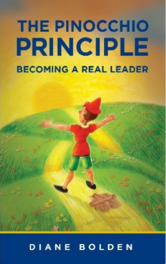 For more on reconnecting with your childlike sense of wonder and joy, check out my book The Pinocchio Principle: Becoming a Real Leader now available in both ebook and paperback formats on Amazon.
Why letting go of the old helps you succeed with the new (and how to do it)
What is it that you are longing to create in the coming year?
And what do you need to let go of in order to allow it to fully take root?
Every year, we are encouraged to set New Year’s resolutions. We are a goal driven society that is conditioned to seek more. Our egos desire more money, more fame and prestige, and more stuff. A deeper part of ourselves longs for more peace, more meaning, and more purpose in our lives. We want to move beyond our previous realizations of what we’ve already accomplished to master newer, better ways of doing things –whether that be what we create in our lives or in our organizations – and as leaders what we are able to inspire others to do as well.
Though it is tempting to occupy ourselves with thoughts of how we can go about achieving all of this and what we need to do more of, perhaps what we really need to start with is what we need to do less of – what we need to let go of in order to create the space for something new to come in. We are constantly evolving as human beings – and as communities of human beings. It is so easy to look to the past to define who we are though the things we’ve already done – goals we’ve achieved, titles we’ve acquired, creations we have built. Our previous experiences coagulate to form an identity that is easy to confuse with our true nature.
The fact of the matter is, you are not your accomplishments, your creations, or the sum total of the various roles you play in your life – manager, director, vice president, mother, father, friend, son, daughter, etc. You are much, much more than that. Your potential is limitless.
And yet, we limit ourselves by these definitions. They filter the experiences we allow ourselves to have and compel us to define the form that our deepest longings should take. In order to be happy, we reason – we must get that promotion, achieve this or that particular goal, hit that target. So we continue to go through the motions, doing the kinds of things we’ve always done – on a sort of auto pilot.
Some of this may bring satisfaction, and some may bring a growing source of discontentment. We need to attune ourselves to that which brings us the most of what we truly desire and open ourselves to the possibility that what we really want may need to come in a form that has previously been undefined for us. In short, we must allow ourselves to surrender what we think we know to open up to the mystery that is unfolding in each of our lives.
Easier said than done, right? How exactly do you go about letting go of the known when it is all you know?
We can take our cues from nature. Snakes and other reptiles shed their skin, trees drop their leaves, and caterpillars create cocoons in which their forms entirely dissolve before recreating themselves in the form of butterflies. Even a fish in a bowl cannot stay in water that contains its excrement – the waste must either be emptied and replaced with new water, or absorbed by something else that will remove it from the fish’s environment. Without engaging in these renewing processes, these creatures will die. And so it is of us. Many of us are already walking around encased in layers of old, dead stuff that needs to be released.
What are you holding onto in your life that has run its course? What are the old outmoded ways of doing things that no longer bring you energy? What are the things you’ve acquired that you no longer need? What beliefs are you holding onto that are no longer true for you?
Pay attention to the times that you feel constricted, anxious, or tired and in those moments ask what you can let go of. Don’t be afraid of the answer. Though it may frighten you because it introduces an element of the unknown, following these insights will always lead to freedom and liberation.
Your computer can only handle so much data. If you do not delete old email and get rid of files that have been accumulating over the years, and if you continue to add new programs without deleting old ones, you will find that it becomes sluggish and unresponsive. Just as freeing up space allows your computer to process things more quickly, so too will clearing your own personal space (whether of things or thoughts) allow you to access new levels of clarity and creativity.
You will breathe easier, be more present in every action and interaction you partake of, and bring more of who you really are to what you do. And you will open up the space of possibility that will allow something to come in that may surprise and delight you. Rather than being something you slave away for, it will simply emerge and reveal itself to you.
And of course, any work you do on yourself will serve as a form of leadership for others who, like you, seek their own answers and could benefit from your example of unearthing what is possible and allowing it to take form in new and unexpected ways.
Butterfly photo by wiangya.
Give Presence: Three steps for creating the gift that everyone needs most
 As we move through the holiday season and approach the end of the calendar year, people often find themselves in a bit of a frenzy racing from one activity to the next, their heads filled with chatter and a continually growing list of things to do. It is easy to lose ourselves in a flurry of activity and miss out on the purpose behind all the things we tend to do at this time of the year. If you have ever found yourself collapsing in a heap wondering where the time went and feeling depleted rather than filled by the holiday spirit, you know what I’m talking about.
When your pocketbook has reached the place where there just isn’t a lot more give, take comfort in the fact that there is a gift you can share that transcends all others and won’t cost you a thing. It is the gift of presence, a state that allows us to truly bring out the best in ourselves so that we can do the same for others.
The gift of presence is one that allows everyone to receive its benefits, and you can experience it wherever you are — whether in a meeting, running an errand, sitting at your desk, or in a conversation with someone important to you. This practice has the power to transform the way you experience your daily life and what it allows you to create for yourself and others — without really doing anything at all.
Can you recall the last time you felt totally and completely attended to?
Chances are it wasn’t when someone was giving you advice or telling you what to do. It may not have even been when someone was engaging in an activity on your behalf or watching you tear open a gift. And yet when we think of giving something to others our minds often immediately jump to what we can do, say or buy for someone. Many times the best gift we can give someone is that of our presence.
But what exactly is presence?
The word present derives from the Latin past participle praesse meaning “to be before one”, from the roots pra –pre + esse – to be. I believe presence is a state of being that’s achieved when we are truly in the moment, allowing it to unfold without judging it, labeling it, or getting lost in our thoughts about what it means or what we believe should be happening next (or instead).
Presence allows us to cut through the clamor of our preoccupations, worries and fears so that our true selves can emerge. It is a gateway through which our intuition and inner wisdom enters and expresses itself. A moment of presence is a state of grace that can produce great insights that help us to truly learn from our experiences, make the most of our opportunities and rise up to our challenges in creative ways. In these moments of presence, we know who we really are and what we are truly capable of.
Have you ever noticed that people tend to match each other’s intensity and tone when they are together? Comments about trivial matters are often matched with similar banter. Expressions of fear or dread often elicit responses that are equally charged, and expressions of anger have a way of provoking reactions that people later regret. In a similar manner, moments of presence when shared with others can evoke powerful responses that can be revealing and transformational.
This is because when you are truly present with another human being you create a space that allows that person’s true self to come out as well. This is why the best leaders have learned to become comfortable with silence, to listen more than they talk, and to allow themselves to become instruments that help others to recognize their own greatness – not necessarily through anything that say or do, but rather through moments of presence that are created and shared with others.
So how does one cultivate a moment of presence?
It is really rather simple, though far easier said than done.
(1) The first step is to be still. That’s right. Sit still. I know it goes against everything you were probably taught about getting things done and being useful. But do it anyway. You can practice now, while you read this. Become aware of your breathing, of the space you are sitting in, of the weight of your body and how it feels in this moment. Feel the life inside you and trace it to each part of your body. Listen to the sounds around you. Take a deep breath. Let it out slowly.
(2) Become aware of your thoughts. Observe the activity of your mind as it continues to process whatever is there– thoughts like, “this is silly, really – I have way to much to do to be sitting here, doing this…” and “I have to remember to call so and so back today,” and “What did my [boss, colleague, friend, etc.] mean when he/she said…”. Recognize that you are not your thoughts, but rather the thinker of your thoughts. Simply watch them parade around, without getting sucked into them. Feel how much bigger you are than all of that. Continue to breathe it in.
(3) Step three…. There really is no step three. Simply continue to repeat steps one and two, immersing yourself more deeply into the experience with each breath. You don’t need to do this for an extended period of time, unless you want to. Often even a couple of minutes are sufficient to bring you to a more intense state of awareness and aliveness.
In these moments of presence, you will experience things on a different level – one that allows you to respond from a deeper, wiser part of yourself. And when you are with others, you will bring out that deeper, wiser part of them as well. Presence is incredibly powerful to practice with others. The process is the same, except that you expand your awareness to take in the other person as well. Look into their eyes, and listen to what they are saying. But listen to what they are not saying as well. Presence is more about being than doing. So allow yourself to truly BE with another, devoid of judgments, labels, and agendas. When you listen from this place, you are like water to a thirsty plant, allowing others to open up and soak in needed nutrients. And in this space, they may just find the answers they seek as well – not because you are giving them, but because you have created a space that is illuminating for everyone.
This article was originally published on Diane Bolden’s Synchronistically Speaking blog.
Diane Bolden is passionate about helping people actualize their brilliance in a way that inspires others to do the same. In addition to being the author of The Pinocchio Principle ~ Becoming the Leader You Were Born to Be, Diane is an executive coach, speaker, yoga enthusiast and mother of three. Visit Diane’s Synchronistically Speaking blog, follow her on Twitter, or visit her You Tube channel for more.
Picture by scottchan.
Lightening Your Load: How to bust out of overwhelm and get things done
Have you ever noticed that your experience directly reflects your state of mind?
When our minds are cluttered, our surroundings have a way of mirroring that. Feelings of  being scattered are often accompanied by piles of unfinished business everywhere you look or lists and notes of things to do that seem to multiply. When you feel heavy and bogged down, everything you do will feel harder and more cumbersome.
You may think that the way you feel is a result of your experiences, and that is
true. The more you have to do, the more overwhelmed you will feel. But the reverse also applies — the more overwhelmed you feel, the more you are likely to approach things in a way that draws them out — perhaps by procrastinating, making things more complicated than they need to be, or using more energy to resist and worry than it would take to actually get things done.
But beware of the trap this thinking creates.
If we become fixated on evidence that suggests we can never rise above the way we are feeling, we ensnare ourselves in vicious circles where we will continue to experience what we long to rise above and feel the frustration of not being able to break free. In fact, our frame of mind with everything we do will have a direct effect on whether the experience of doing it will be exhilarating and satisfying or frustrating and heavy.
The stories we tell ourselves have a way of coming true – “There’s just way too much to do and not enough time to do it. I’m too busy to do anything fun, to take time out for my family, friends or myself, to ever get beyond the day to day and into those things I dream about…”
The way out of the traps we set for ourselves is to start with our thoughts.
The other day, I turned into my driveway and caught sight of hedges that needed trimming. “Wouldn’t it be fun to drop everything and go cut those right now – to just get out there and work in the yard for awhile?” I found myself thinking. And then I laughed as I realized that this task that seemed so enjoyable compared to the list of things on my plate at that moment was one of the very things I was dreading a few weekends ago. The task itself hadn’t changed, just the way I was thinking about it.
And it hit me that perhaps there was a way to transform all the things I needed to do that day — which were really bringing me down — into experiences that could be lighter and simpler — and maybe even fun.
The key had to be in the way that I approached things – in what I was believing about them, and what I was focusing on as I did them.
As I became aware of my attitude toward the tasks at hand, I realized that I was more fixated on checking the box than I was on enjoying the experience. And I was also swept up in the belief that the work ahead of me was going to be hard, onerous and complicated.
What if all that changed? What if instead of believing I had to get everything done perfectly, I just played at things, took myself a little less seriously, and lightened up a bit? And what if instead of believing I needed to get it ALL done, I just focused on what was most important — most aligned with the highest priorities in my day and in my life? And what if instead of driving solely toward the outcome, I allowed myself to be fully present in every moment that led up to it? Hmmmn.
Marcel Proust once said “The real voyage of discovery consists not in seeking new landscapes, but in having new eyes.” And I have also heard it said that when you change the way you look at things, the things you look at change.
There is no better time to apply this than during the holiday season.
In the latter part of each year the spirit of giving, joy, celebration and miracles often gives way to stress, fatigue and overwhelm as harried people run themselves ragged trying to check a bunch of boxes and take care of their regular responsibilities and routines in addition to a multitude of additional tasks that often feel more cumbersome than joyful.
The paradox is that even things we do that are meant to be fun can become overwhelming when our focus shifts from the joy of doing them to the desire to get them done and behind us.
The fundamental shift must come not in what we do, or even how we do it, but what we are thinking, believing and allowing ourselves to feel about what we are doing.
To this end, setting an intention or statement of our desired experience can be very powerful. If what we want is greater freedom and joy, more meaning and satisfaction and heightened effectiveness, we must align our thoughts around enjoying those experiences before we even start. And we need to become diligently aware of the degree to which our thoughts stay aligned with our overarching intention. When they drift, we can come back to them, remember what we really want, and align ourselves with the state we wish to be in once again.
In this way, we break the vicious cycle of allowing our experiences to bring us down in ways that result in more lousy experiences — and begin anew.
We consciously align our thoughts with what we most want, rather than letting them denigrate into the negative emotional states we seek to rise above. Our actions align with our thoughts, and we find ourselves coming up with creative ways to simplify, get focused on what is most important and get it done while enjoying ourselves in the process – and sharing our joy with everyone around us.
Are you exhausted? What to do when you just can’t do another thing

“When I’m not running in circles, I’m pretty much collapsing in a heap.”
That flew out of my mouth one day when I was on a call with a few of my friends trying to find a time to get together. They told me it should be the title of my next book.
And yet, I know the importance of taking regular time to rest. Well, intellectually anyway. I can see it in my clients – when they begin to tell me the same things over and over — when all they can seem to talk about is what they have to do, or how exhausted they are. And I certainly know it from my own experience. It’s that old familiar feeling of rolling a huge ball up a hill only to have it come careening back down again.
There is never a shortage of things to do, people to get back to, and in my case, kids to shuttle from practice to sporting event to some other gathering. I know I need a time out when my surroundings begin to reflect my state of mind – becoming cluttered, messy, and completely disordered. When I am tired, I don’t make decisions very well (if at all). I tend to leave them for later, when I will have a little more energy. But then I use the piles that have accumulated around me as an excuse for why I cannot rest – at least not now – not with everything looking like this! And the cycle continues.
My head tells me this makes perfect sense. But my heart and the rest of my body is screaming for relief.
 In yoga classes, there is something called “child’s pose”. You start by getting on your knees and sitting back on your heels. The knees can stay together or move wider apart. And then you simply lean forward slowly onto the ground with your arms either by your side or stretched out in front of you. Every time I get into that pose, I am reminded of how at least one of my children liked to fall asleep when they were babies.
Yoga instructors tell people that the most important thing in yoga is the breath. It is important to breathe full and evenly in and out your nose. When your breathing becomes uneven or choppy, when you start to lose your breath in yoga, you will be encouraged to return to this child’s pose until your breathing evens out again.
At the end of yoga classes, there is a pose – one of my favorites – called “shivasana”. This one consists of laying flat on your back and relaxing every part of your body while you allow yourself to sink into the floor for about three to five minutes. It’s the pose that allows your body to integrate all the work you did in the class that preceded it. And many will tell you it is the most important pose in yoga. And yet, I often see people leaving the class instead of allowing themselves to experience it.
But I get it. We are a society that is driven to do more, to be more, to be busy, and to always step things up a notch. The thing is, when we insist on speeding up when we really need to slow down, we lose touch with the wiser, calmer part of ourselves that has all our answers. We run around doing things that may not even need to get done, and creating more piles and messes for ourselves that we’ll have to clean up later. We may run fast, but it is often in a direction that doesn’t serve us — or anyone else for that matter. And it often leads us to crash into walls we would have avoided if we weren’t so tired.
Sometimes you’ll get a rush when you do that. A rush of adrenaline, maybe. Or a little sense of accomplishment or importance that comes with being really busy. But my experience is that it is usually fleeting and often replaced by a feeling of exhaustion and overwhelm and a somewhat panic induced state that leads me to believe I have to run twice as fast just to keep up.
I used to think that in order to replenish my batteries, I needed to take a long vacation – leave and go somewhere else, sip a pretty drink on a beach or sleep for days. And while that is nice, it’s not always necessary. What I’ve learned – and need to remind myself of periodically – is that it is often a matter of simply pausing every once in a while to check in with myself. It is doing something that interrupts the autopilot nature of the running in circles thing. It’s like looking into a pond that has been churning so fast that the water is murky. Instead of continuing to make all kinds of commotion, you sit for a few moments and let the water become still until the swirling debris sinks to the bottom and the water becomes clear.
Sometimes this takes the form of a power nap for me. Even just fifteen minutes of resting my head will do wonders. Other times it’s a little walk that allows me to breathe deeply and move around a bit. Sometimes it’s grabbing a cup of coffee with a friend and getting a little distance from whatever is going on. And sometimes it means saying NO to things I really don’t have time to do. Often the clarity and the courage I need to do that comes from the brief pause I took that allowed me to realize whatever I was about to say yes to wouldn’t really have been for the best.
These little pauses shouldn’t be reserved for the times that we feel like we just can’t do another thing. We need to give them to ourselves frequently. Research indicates that people need a fifteen minute break after ninety minutes of concentration – and some studies suggest that we would benefit from a five minute break after every twenty five minutes. You might think you are losing (or wasting) precious time, but you’ll find that it is more like an investment that pays dividends when you come back from your short break and are able to do in twenty minutes what would have otherwise taken an hour.
So, if you are feeling overwhelmed or exhausted – as though you need to move faster but just can’t seem to find the energy – try slowing down for a little while. Press the pause button. Find your child’s pose and catch your breath – whatever that may be for you. Let the dust settle until you can see clearly again. Chances are that when it does, you will know just what you need to do – or NOT do. And you will meet whatever challenge or opportunity awaits you with a fresh mind and a new energy and vitality – one that allows you to access the wisdom, creativity and resilience you need most.
“You have to put in the clutch to shift gears. You
have to let go to re-engage at another, more high-
leveraged ratio. And when you least feel like slowi
ng down may be the most critical time to do it.”
– David Allen’s Productivity Principles
Tired business people image courtesy of Ambro at FreeDigitalPhotos.net
How the worst things that happen to you can become some of the best
“There are two ways to live: you can live as if nothing is a miracle; you can live as if everything is a miracle.”
~ Albert Einstein
 I’ve worked with a handful of clients who unexpectedly lost their jobs after working for over twenty years with the same company. The funny thing is that these people knew they were ready for something greater before it happened. In our coaching meetings, they would often talk about wanting to strike out in new directions, take on bigger challenges, live and lead in a deeper and bolder ways than before. And few of them would have likely sought out new opportunities if things hadn’t worked out the way they did.
In the midst of the changes, it’s likely that they felt as though their universes were falling apart. Much of what was familiar was coming to a close as they were thrust into a world where nothing was certain and forced to begin again. They were brought face to face with the question, “what do I most want for myself now?” and challenged to take action that would lead them in new directions.
More and more it seems people are asking that question with fervor – “What do I most want for myself now?” Some feel they are ready for new adventures. Others long for deeper connections with people. Many just want to experience the same passion for their work and their lives that they did when they were younger – to feel a part of something bigger than themselves – to work at something worth working for, and to bring more of their true talent and gifts into the world.
And the world needs those talents and gifts more now than ever. When we come to a place where we are willing to truly open ourselves up to that question of what we most want – we set into motion a series of events that allow us to move closer to the answers we seek. And sometimes they come in packages that we didn’t anticipate and don’t immediately appreciate.
But as we look back on our lives, we can begin to see that the very things that frustrated and pushed us to our limits were exactly what we needed to be able to know more about who we are and what we are here to do.
As I reflect on the myriad of disappointments I’ve experienced over the course of my life, I have begun to appreciate them and even become grateful for them. I recall jobs and promotions I thought I wanted more than anything that would have kept me from experiences that allowed me to get to where I am now. I remember times in my life where it seemed the bottom had dropped out that stripped me to my core and required me be honest with myself. And I also recall people who pushed my buttons, irritated or challenged me in one way or another that led me to exercise
courage, patience, tolerance – and in some cases assertiveness – that I needed to develop in myself.
As Thanksgiving nears, in addition to being grateful for all the many blessings in my life, I find myself grateful for my unanswered prayers – the ones that would have had me going in a direction that wouldn’t have served me or others in quite the same way. I am grateful for the difficult people in my life, who have challenged me to look at things (including myself) differently and find new ways of relating. I am thankful for the trials I didn’t think I could endure and the resilience and courage I was able to tap into because of them. And I am grateful that over time I have been able to laugh at the things that happen to me as well as all the people who have been there (or somewhere similar before) who have laughed (and sometimes cried) right along with me.
I am grateful for every client I have ever worked with who has given me the opportunity to learn from their experiences – to see one more example of the strange and wonderful ways that miracles manifest themselves in everyday life.
I wish for you – and myself – the ability to always appreciate the blessings that always surround us – the ones that lift us up as well as the ones that seem to strike us down. And to open ourselves up to the ways in which every one of them has the transformational power to bring us closer to our most precious dreams and visions.
Arrow picture by ntwowe from FreeDigitalPhotos.net.
My Personal Career Comeback: Five lessons learned that can benefit you too
 Have you ever had a career disappointment that shook you to your core? I did, and it was early in my career. When it first happened, I was bitter, frustrated and scared. But what I ended up learning from the experience was pivotal to my future. And to this day, I am still grateful.
THE SITUATION:
My first job after college was at an advertising agency. Having yet to arrive at the realization of what I wanted to do with my life, I took the job because it had elements of what I studied in college: English, business and communication – and because it sounded fun and interesting. I started as an administrative assistant with the promise that it wouldn’t be long before I would be promoted into something a bit more substantive.
Turns out advertising just wasn’t my thing. The work itself didn’t pique much interest in me, but I was intrigued with the organization and the people in it. Turnover was high, morale was low, and the customer was an afterthought. I knew that all that could be changed – that something could be done to allow people to feel more alive in their jobs, to ensure that the customer was happy, that the company was growing and profitable.
So I got to work talking to people.
I interviewed smart, ambitious entry level personnel, who felt discouraged and overlooked when the jobs they were working toward were filled by people
from outside of the company. I talked to new creative staff and account executives who came in and hit the ground running, knowing little about the agency or its customer. I spoke with seasoned executives who lamented that no one seemed to
care about what was most important anymore.
I integrated all their insights, ideas and suggestions with my own observations and created a proposal to implement a program that would allow seasoned people to train and mentor newer folks, better integrate with the customer, and grow the
business from within.
Knowing little about corporate politics, I went straight to the VP of Operations with my proposal to create the program and allow me to run it. He listened intently, asked several questions, and arranged subsequent meetings with others in the company. It wasn’t long before a position was created. My boss at the time, who wasn’t impressed with my lack of passion for being an administrative assistant or the fact that I went over her head with my proposal (which I never even told her I was working on) was outraged.
She called upon her networks to put a stop to things. A few days later I was told that while the company was going to create the position and launch the
program I proposed, because of all the controversy, they could not allow me to head it up. I was crushed. I remember walking across the agency’s glossy floors and out the tall glass double doors of the building, burning with animosity, rage, and frustration at the seeming injustice of it all.
THE STRATEGY:
 In the weeks that followed, the anger and bitterness gradually released me from its grip and I began to feel a sense of calm clarity. I was onto something here. Maybe there was a way that I could work with corporations, organizations and people themselves to bring out their latent talent and harness it in a way that could contribute to a common goal. I went to the local bookstore and bought a copy of What Color is Your Parachute and dedicated myself to doing the soul searching exercises there and taking action to learn about work and potential opportunities that were more aligned with my core talents, interests and passions.
Somewhere in my search I discovered that in many corporations there was a department called organization development that employed people to do the kind of things I tried to do at the advertising agency, and more of the kind of work that truly excited and inspired me. I began to ask around and find people who actually did these jobs. Some of them were people that friends of mine knew.
I began to interview them, asking about how they got started, what they loved and didn’t love so much about their jobs, and what advice they would have for someone like me who wanted to break into the field. At the end of every interview, I asked for the names and numbers of three more people they would recommend I speak with. I ended up building a pretty great network and it wasn’t long before one of the people I spoke with called me with an opportunity to do an internship at a local hospital in their organization development department.
I was thrilled and ended up learning the ropes from incredibly talented mentors who allowed me to take part in projects that were intriguing, challenging and incredibly rewarding. I was an intern for less than a year before I was offered a permanent position doing satisfying and empowering work I didn’t even realize was out there when I was scratching my head back in college trying to answer the question of what I wanted to do with my life. And each subsequent opportunity I have had has helped me further refine and hone what I love to do into a career that
lights me up allows me to continue to grow and evolve.
LESSONS LEARNED:
Among the many things I learned from that experience are the following:

- That defining moment led me on a search that would allow me to find ways to do more of the work that beckoned to me. It launched a chain of events that has led me to learn more about myself and make the most of experiences that would further prepare me for the work that I do now. And I am grateful – so completely and utterly grateful – that it happened, though at the time I thought it was the worst possible thing.
- Sometimes the biggest disappointments are actually precursors to the most amazing opportunities. I learned not to allow my frustration, anger and sadness (even if it is justified) to blind me to what is knocking on my door. I learned to let myself be angry for a short period if I need to and then challenge myself to figure out what positive action to take to get closer to where I really want to be. I try to focus my energy and attention into moving toward something I want rather than away from something I don’t want.
- It’s okay if I don’t know exactly what I want to do with my life. This experience taught me that anything I do will prepare me for whatever I’ll do next. I may not know exactly the kind of work that is my best fit until I see what is out there and notice what excites me and what doesn’t. If I can find a way to love the job I’m in, I will benefit by learning more about myself and developing skills that I will be able to use anywhere I go.
- I realized that I don’t necessarily have to leave my job or the company I work for to do something that I love. If I pay attention to what intrigues me and take action to align my natural curiosities and talents with the unmet needs I see wherever I am, it’s possible that the solutions I propose could land me a whole new role – one that is custom designed for me, even when there are no jobs posted on the company’s internal job board.
- I learned the importance of being willing to take a risk and let go of needing my career to turn out exactly the way I think it should. Even though I initially thought the risk I took ended in failure when I didn’t get the position I helped create, it ended up opening my eyes to opportunities I didn’t even know existed. It prepared me for a career in an organization that was far more aligned with my interests and values.
Over the years I’ve learned more about the nuances of corporate politics and the best ways to influence change that my younger, more naive self never appreciated or understood. And I’ve continued to push the envelope by proposing solutions to problems I noticed were going unaddressed (even when they didn’t technically fall within my job description). Some of these proposals panned out and yielded new and amazing opportunities, and others did not. And I probably learned more from each of those attempts than anything I studied in school.
In the end though, I realized the most vital lesson of all is that the worst (and only real) failure is failure to act – to try new things, to push yourself to realize more of your potential, and to apply it in ways that benefit others. Because as long as you have that, you can always make a comeback.
Future photo by graur razvan ionut from FreeDigitalPhotos.net.
Light bulb photo by Pixomar from FreeDigitalPhotos.net.
Open mind photo by Idea go from FreeDigitalPhotos.net.
From frustration to freedom: How to disentangle yourself (and help others in the process)
“An effort made for the happiness of others lifts us above ourselves.”
~ Lydia M. Child (1802-1880) Writer
Have you ever gotten so mired in frustration that you just can’t seem to move beyond it?
When life brings you down, it’s easy to become excessively focused on all the things that seem to be a source of frustration. And it is all too easy to become completely immersed in the feeling of dissatisfaction itself. When we do, this fixation is like a magnifying glass through which every problem or challenge we have expands to several times its normal size until it all feels too utterly daunting to move at all. And this orientation seems to somehow draw all manner of setbacks and further difficulty. As the old adage goes, “when it rains, it pours.”
It could be that the way we tend to act when we are already feeling beaten contributes to the negative cycle. Or perhaps that when we are so intent on seeing all the things that we feel rotten about that even things that would normally be no big deal suddenly feel incredibly heavy. In any case, we all have days where what’s going wrong seems to take up more of our attention than what’s going right and life just feels like one d@#n thing after another.
At times like these, I’ve found that the best thing you can do is anything that allows you to go beyond yourself to be of service to another human being.
It may seem somewhat naïve and Pollyannaish to presume that forgetting all your troubles to go help someone else would do much, if anything, to change the situation. How could something so simple and totally unrelated to what is going on have any impact when you feel so down and out that you cannot do another thing?
I had a roommate in college who was down in the dumps for a few weeks.
Her usually delightful demeanor had become heavy and a little dark. She was going through one of those slumps we all encounter from time to time. One day when I came home from class, there was a envelope taped onto our door. As I looked around the building we lived in, I noticed similar envelopes hanging on other doors. This one had my name on it, handwritten. I tore it open and found a piece of notebook paper up on which was written one of the most heartfelt notes I had ever read.
It was signed “from someone who appreciates you deeply” and as I read it, I found myself falling into the page while small tears began to collect at the corners of my eyes. The author of the note had recounted things I had done over the last several weeks – many of which I thought were insignificant – that made a difference in that person’s life. There were kind, warm words of praise and gratitude as well as encouragement and inspiration. Whoever wrote that note apparently thought I was special and took the time to tell me why in such a way that it profoundly touched me. I looked up and saw someone across the hall reading her note and watched as her face began to light up.
 When I opened the door, I found my roommate sitting contentedly writing in her journal and sipping a cup of tea. She looked up and smiled for what seemed the first time in weeks.
“Did you get one of these notes?’ I asked her.
“No,” She responded with a grin.
And then it hit me. She was the one who wrote the notes. She didn’t admit it at first, but I finally got it out of her.
“What led you to do this?” I asked her. “It must have taken you hours!”
“I was tired of feeling tired and sad and lonely,” she said. I was sick of my gloomy little world. And I decided that if I couldn’t make it better for myself, maybe I could make it better for someone else.”
She had started with one note. And then she wrote another. And then another. And it felt so good, she said, that she decided she’d just write until she didn’t feel like writing anymore.
That was over twenty years ago. And it still inspires me.
She taught me more through her actions that I would have learned by reading ten books that day. I don’t think she intended it at the time, or even realized it until she started writing her notes, but the gift she gave to everyone in that building ended up being something that benefitted her just as much as everyone else. And my guess is that it is still benefitting her and everyone else – because I know it’s still meaningful and significant to me.
Gandhi said “You must be the change you want to see in
the world”. Richard Bach wrote “We teach what we most need to learn.” And Maya Angelou tells us, “I have found that among its other benefits, giving liberates the soul of the giver.” Perhaps this is one of the true gifts in giving – that when we get outside of ourselves to touch another human being, it has a way of bringing us gently back to ourselves so that we too receive the gift. And it holds true even when we think we have nothing left to give.
When our egos get the best of us and we think nothing will ever go the way we want it to, we can transcend a state of wanting by moving into a state of giving.
Think of something you want right now, in this moment. What is it that “something” will give you? Most likely it is a feeling – perhaps a feeling of contentment, satisfaction, prosperity, abundance, or joy. Now, see if there is something you can do for another person to help them experience those things. Often when we give to others, we find we already had that which we were seeking. We realize the thing we thought we needed is a means to an end that we have
already arrived at. And perhaps this, in and of itself is the true gift of giving – and the magic elixir that transforms frustration to freedom.
Overthrowing the Tyranny of Should: How to transform your chores into choices
This morning as I reflected on the day ahead of me, I had an epiphany. I realized there is one word that has a way of sucking all the joy out of everything I do. And that word is SHOULD.
Let me explain. Over the last several weeks, I’ve been blessed with a number of ideas that landed gently at the edge of my awareness. They were accompanied by an electricity that made them glimmer and pique my curiosity. Some of those ideas were for articles, some for videos, and others for potential projects and other endeavors.
I couldn’t help but feel a surge of excitement as I pondered them. The feeling reminded me of dreams I had as a kid where I would find myself amidst piles of treasures, golden and shimmering. In those dreams, I often knew I would be waking soon and tried to scoop into my arms and shove into my pockets as much of those riches as I could, in an attempt to bring them back into my waking reality. Of course, I always awoke in my pajamas with no sign of the fortunes I was previously enjoying.
As an adult, I realize that we sometimes get glimpses of treasure in our waking hours too. These treasures are in the form of ideas that beckon to us. They get our hearts pumping and send a charge through our bodies. And if we don’t act on them, even in some small way, they evaporate into nothingness, just as the remnants of the dreams I had as a kid did upon waking.
 So, I’ve learned to write these ideas down when I get them. And I know the importance of continuing to take action on them. Here’s the thing I discovered this morning:
That flame that was sparked when those ideas hit, and slowly stoked as I pondered and moved into them — that fire that was crackling with intensity and even beginning to blaze — was almost completely doused when I introduced the word “SHOULD” into its presence.
As soon as I felt the weight that came from believing I should write those articles, I no longer really wanted to. They were right up there with cleaning out my garage. When I’m shouldering the burden of should, all my procrastination mechanisms kick in. I’ll check my email, venture over to Twitter or Facebook, read some silly thing that has absolutely no value to me. And then I’ll really feel awful.
Just say the word “should” and feel your energy drop. “I should go to work today. I should eat healthier food. I should get moving on that project. I should return those calls. ” Even the things you want to do become tainted and heavy when the word “should” is involved.
I think the reason SHOULD kills our joy is that it turns what is really a CHOICE into a CHORE.
When something is a chore, you just want to get it over with. You’re checking the box and never really get into it. Maybe you’re thinking about all the things you’d rather be doing or how much you resent the fact that you “have to” do what you are doing in the moment. “Should” causes us to withhold that which gives us and everyone around us life. And that is really unfortunate for everyone involved. Because if what you do touches the lives of other people (and pretty much everything we do does), they are cheated of having the full experience of you in the work. They get a mere shell of what would otherwise be filled with substance. And you miss out on the joy that comes with making the choice to fully participate in something that could very well transform you just by having done it.
What is it that you feel you should do today? Maybe it’s something you don’t think you really have a choice in, like showing up for work or paying your bills. OK. Let’s say you don’t really love your job right now. The more you tell yourself it’s something you have to do — the more you allow your should to make it a chore — the less of you you’ll bring to it, the more you will focus on all the things that bring you down, the less remarkable your work will be, the more out of touch you will be with what makes you happy, and the less likely you will be to position yourself for work that does bring you joy.
But let’s say instead of making it a chore, you make it a choice. You decide that whatever this day brings, you will find something to be happy about, something to be present for, something to light you up. Maybe it’s just giving someone a smile, or taking that extra minute to do something you’d like someone to do for you, or being grateful that you have a job. Maybe you take that onerous task you’ve been dreading and make a game of it. Try it and see what happens.
When you bring joy into your work, you’ll increasingly find that you have work that brings you joy. You’ll see things from new perspectives and make different connections and different choices. You’ll find ways to infuse more of what enriches you and those around you into whatever it is that you do.
As soon as I realized what my “should” was doing to that glimmering treasure trove of ideas, I took myself back to the delight I felt when I first pondered them — the energy that was in the air, the childlike wonder and curiosity. And I remembered  how much I really want to do all those things. The chore went away and I reclaimed my choice. The heaviness dissipated and I began to feel free and
inspired again. I sat at my computer and began to write the very article you are reading now, enjoying and savoring each moment of the experience.
And I made a pact with myself to be more aware of my “shoulds”. Because any chore can be transformed into choice when you trade the “should” for “want to”. And when you make the choice to bring who you really are into whatever it is you are doing, EVERYONE will benefit.
Join me, won’t you?