Share This
Why Preconceived Goals and Plans May Not Get You Where You Really Want to Go – and What to Do Instead.
Have you ever noticed that even your best laid plans can fail to get you where you really want to go?
The reason SMART goals and the plans we create to achieve them often don’t match our desired future is that they are constructed based on an understanding of the present and the past.
Goal setting is a linear way of operating in a nonlinear world.
When you sit down and determine what you want to accomplish, how you’ll measure it and when you will have achieved it, you’re operating on a very simplistic and theoretical understanding of the way things work. You’re likely to assume the road you are traveling will be straight and smooth and that all you need to do is drive a certain speed and a certain course and you will get where you want to go.
But real life isn’t like that.
There are twists and turns. Roads dead end and turn into overgrown brush with no defined trails. What you thought would get you where you wanted to go may turn out to be incredibly inadequate.
If you stick to your preconceived idea of how everything will be when you embark on your journey, you may well end up stuck at a dead end. If you lean on the gas when you’re going around a sharp curve so you can meet your desired timeframe, you may end up flying off a precipice and landing in a ditch.
To succeed, you must abandon the past and immerse yourself in the present.
Navigating complexity requires that you transcend your preconceived idea of how you thought things would be when you started and adjust to the environment you find yourself in. Where you thought there would be one road, there may be five or ten. And a SMART goal won’t give you the insight you need to know which of them to take.
On the contrary, letting go of a misaligned goal or plan allows you to find new paths and blaze trails where none existed. It not only allows you to adjust to your environment, but it also allows you to adjust to your own growth.
Perpetual planning (and trail blazing) is more important than a plan of action because you cannot anticipate the future based on what you know from the past.
By definition, a plan is designed in advance of carrying it out. While you can take your best guess at how things will unfold and what the most fitting course of action is, you will not really know whether it is adequate until you have begun to act.
To harness the power of perpetual planning, get moving and build some momentum. As you begin taking action, you’ll get insight into what needs to happen next. Build regular time into your calendar to assess your progress and your plan, identify next steps and make necessary course corrections.
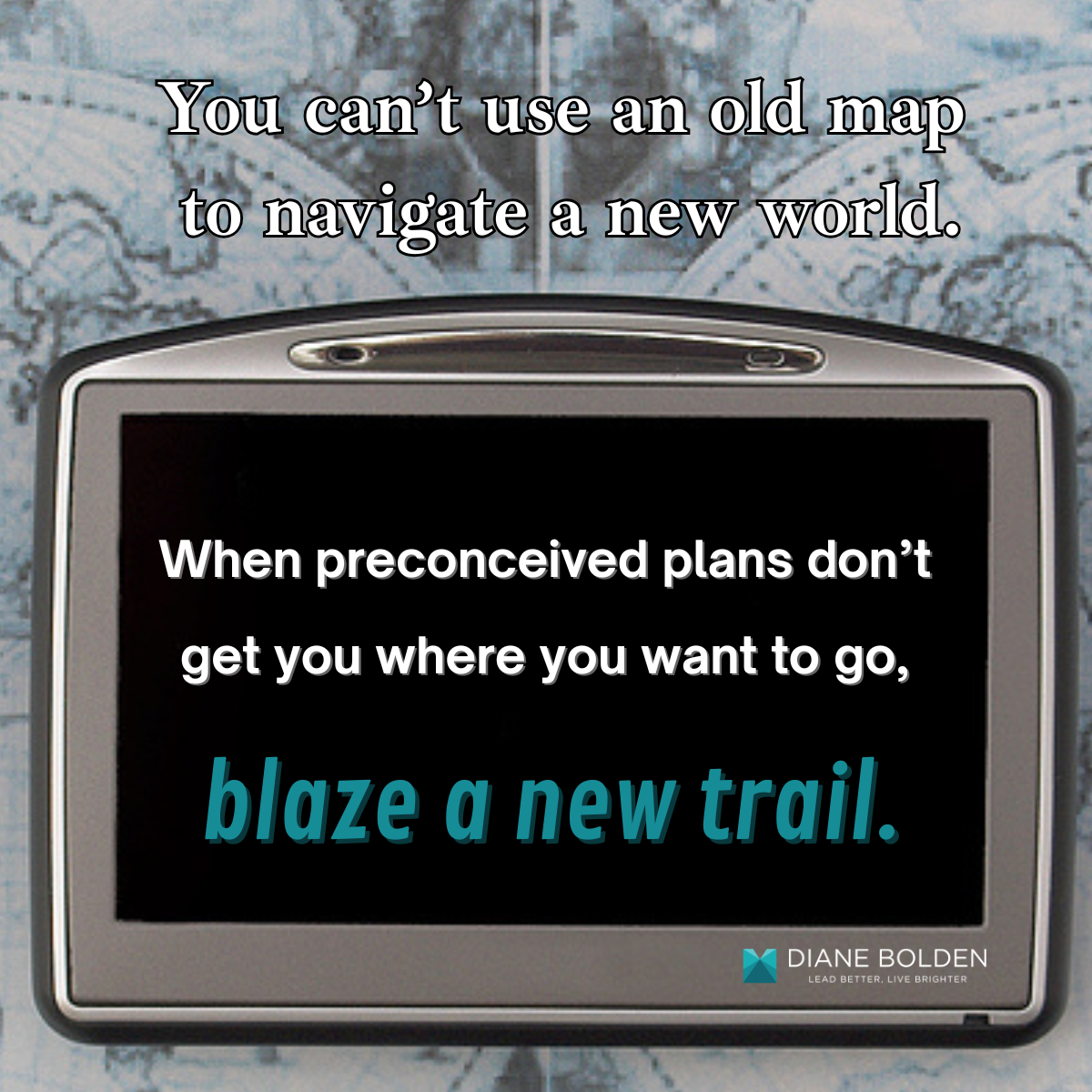
And when your map isn’t getting you where you most want to go, you’ll be much better off blazing a new trail.
The above contains excerpts from my special report, “Why Real Leaders Don’t Set Goals (and what they do instead)”