Share This
All posts by Diane
Why the Mind Can’t Lead Us into the Future – Without the Heart

Victor Hugo once wrote, “The future belongs to hearts even more than it does to minds.” I believe that’s as true in business as it is anywhere else.
I know plenty of people would argue with me. They’d point to current trends that put profits over people, short-term gain over long-term organizational health. To businesses doing quite well despite practices that look, frankly, inhumane.
But we’re talking about the future here. And the future health of anything requires a heart.
The heart is the engine
The heart is the organ that powers every other organ in the human body. The same is true in organizations. You can have the best strategy, the most incredible IP, the most reliable processes, the most advanced equipment, and the most impressive knowledge in the room – but without the hearts of the people using those things in service of other people, none of it sustains itself over the long haul.
Heart is what differentiates real leadership from management and authority – from planning, organizing, executing, controlling. Leadership that carries us into the future puts people first: encouraging commitment rather than demanding compliance, inspiring people toward something they want to be part of rather than something they do out of obligation or fear.
The heart keeps people engaged long after the mind gives out – it’s what lets people tap into strength they didn’t know they had. It’s what allows someone to get knocked down, get back up, and get back in the game. And it runs on fuel that’s not just sustainable, but renewable.
The heart runs on appreciation, compassion, imagination, love. And here’s the strange thing about that particular fuel: using it creates more of it. It’s the only fuel that doesn’t deplete itself.
That’s exactly the fuel we need right now. Fuel that unites instead of divides. Fuel that asks “what’s possible?” instead of “what’s at stake?” Fuel that gives people a reason to get up again, and a reason to believe they’re capable of more. Fuel that tells people they’re vital and indispensable – not despite their differences, but because of them.
Love gets us past our differences to what we all actually care about, and toward accomplishing it together. It doesn’t try to make any one person the hero. It helps each of us find the hero already in ourselves, and in each other.
Why the mind alone can’t carry us anymore
None of this is a knock on the mind. Our minds are impressive machines. But without the heart calling the shots, the mind alone isn’t enough to carry us into the future. The mind runs on logic – it’s like a computer replaying what we’ve done before, warning us what we stand to lose, suggesting a course based on variables it already knows.
And we’re living at a moment where yesterday’s approaches don’t address today’s challenges. Despite every best practice out there, we’re having to learn to intuit entirely new ways of working, leading, and living. We can’t look to solutions that worked in the past to solve problems that look nothing like the ones we face now.
Leadership driven purely by the mind has leaders believing they need all the answers – to navigate every challenge with unshakeable confidence and a definitive solution, to know exactly what to do and get everyone else to do it without question.
But things are changing too fast, and there’s too much uncertainty, for any one person to have all the answers, or to make decisions that meet the needs of everyone who has a stake in them. When the mind is calling the shots, leaders go looking for certainty in a world that doesn’t have any to offer. That has them clinging to solutions that may not work, or putting enormous pressure on themselves to find ones that will. It inflates their sense of responsibility, and it can trigger the kind of ego-driven response that convinces a leader they need to be the hero – which, paradoxically, tends to produce behavior that looks like anything but leadership.
The leadership that takes us into the future will be powered by the heart.
What the research actually shows
The insight required to meet today’s emerging challenges takes a level of presence – a way of intuiting things – that goes beyond what our heads, our linear way of moving through the world, can offer on their own.
Creative work depends on the heart. Making something that hasn’t existed before requires going outside the bounds of the mind and feeling your way into something new. That matters right now specifically because the problems we’re facing need genuinely new solutions.
The heart tunes into something the head can’t reach. It’s attuned to possibility – it dreams, it envisions, it shows us a way forward when every other way has failed.
This isn’t just a nice metaphor. Research from the HeartMath Institute has found that the heart has its own independent nervous system – at least 40,000 neurons, what they call “the little brain in the heart.” The heart actually sends more signals to the brain than the brain sends to the heart.
Negative states – stress, worry, fear, impatience, indecision – create noise that knocks the brain’s neurons out of sync, showing up as energy drain, mental fog, and difficulty focusing, remembering, or deciding anything at all. Positive states – love, kindness, appreciation, gratitude – do the opposite: they create a calming, coordinated cooperation between the heart, brain, and hormonal system that lets us think clearly, solve problems creatively, and make intelligent choices, while even strengthening our immune systems.
The heart generates the strongest electromagnetic field in the human body – measurable from several feet away, and roughly 100 times stronger than the brain’s. Research shows that people in proximity to each other can actually synchronize this way, a kind of social coherence. My own belief is that the ripple effects of thoughts and actions generated by the heart reach even further than that.
Where this leaves us
Victor Hugo wrote that the future belongs to hearts even more than minds. A century and a half later, the research is starting to catch up to what he already sensed. The heart isn’t the soft, secondary organ we’ve been trained to treat it as in the business world – it’s the one generating the strongest signal in the room, the one capable of synchronizing people around something bigger than any single mind could construct alone.
The leaders who shape what comes next won’t be the ones with the most airtight strategy or the most confident answer. They’ll be the ones willing to lead from the organ that never runs out of fuel.
If you’re ready to build that kind of leadership in yourself – not just understand it, but actually practice it – I’m building something this fall for people who want to go deeper than an article can take them. More on that soon.
How to Keep Obstacles From Taking You Down
A few weeks ago, I wrote about the discomfort that shows up when you’re on the verge of something – and how the instinct is almost always to push it down rather than feel it through. This is what that looks like in one very specific, very common situation: getting hit by an obstacle you didn’t see coming.
Do you ever find yourself tripping over obstacle after obstacle? Your day is going fine, you’re in a meeting, and something out of nowhere catches you off guard and spins you up. Later you think, “Why didn’t I see that coming?” or “Why did I say that?” Or maybe it’s someone who triggers you without meaning to. Whatever the obstacle is, it usually takes you down precisely because you didn’t see it coming.
I thought about this recently on a run, when I glanced at a tree branch sticking out of the ground – the same one I tripped over more than a year ago. It was a bad injury. Months of physical therapy before I could run again. And I couldn’t help but think what a metaphor that was for the obstacles that show up in our everyday lives, and how we actually recover from them.
Here’s what I’ve noticed: our natural reaction to hitting an obstacle – especially one we keep hitting over and over – is to slip into judgment. Judgment is when you tell yourself a story about what happened, and the story ends there. We blame the obstacle, or someone else, or ourselves. And once judgment sets in, the way we see the whole situation narrows. It’s tunnel vision. Judgment is like the period at the end of a sentence: this is what happened, period, end of story.
That’s actually the problem. Judgment keeps us from seeing the very things that could help us avoid the same obstacle next time – because by definition, the obstacles that catch us off guard are the things we didn’t see. The last thing we want is a response that keeps us from seeing more clearly going forward.
So if judgment isn’t the useful response, what is?
The opposite. Instead of narrowing our view, we want something that widens it – that helps us notice what we missed the first time. That’s curiosity. If judgment is a period, curiosity is the question mark at the end of the same sentence. Curiosity asks: What more is there than what I’m currently seeing? What can I learn from this? What does this have to teach me?
The quality of the question you ask determines the quality of the answer you get. “Why does this always happen to me?” rarely leads anywhere productive. A more genuine question – one asked with real curiosity – tends to open up something real.
Curiosity and the awareness it brings, together, create insight. And insight is where the real answer lives. Here’s the part that surprised me: getting curious doesn’t just open your mind. It opens your heart, too. And the heart is where creativity lives, where clarity comes from, where you find answers that go beyond what the mind alone can work out.
Why this matters for leadership
Everyone hits obstacles every day. If you, as a leader, get in the practice of choosing curiosity over judgment, you model that for everyone around you. And the more you practice asking yourself powerful questions, the more naturally you’ll ask them of other people too. When someone comes to you with a problem, judgment doesn’t lead anywhere useful – but curiosity does. You can help them ask the same kind of retrospective questions: What did I trip over? What does this have to teach me? What could I do differently next time?
Why we miss the obstacle in the first place
Often, we’re simply preoccupied – by our thoughts, or by emotions we haven’t processed. That’s exactly what happened to me on that run. I was upset about something else entirely, and rather than actually feeling that emotion, I was letting it run me instead. I wasn’t present enough to see the branch.
This isn’t unique to me, or to running. It happens to my friends, my family, the executives I coach – all of us, regularly. That’s part of why I recorded a guided audio to help people get back into a place of power, perspective, and curiosity when emotions are running the show instead of being felt and processed. If that’s useful to you, you can download it free at VergePractice.com.
In any case, I’m glad you’re here. Next time an obstacle catches you off guard, see if you can hold off on the period – and reach for the question mark instead.
The Sign You’re on the Verge of Something
A few weeks ago, I wrote about the cost of trying to look bulletproof. What happens next is what this post is about: what happens once you stop protecting the image and actually let yourself feel what’s been building underneath?
If things have been feeling like they’re coming to a head lately – if there’s an emotion sitting just under the surface that you’ve been managing rather than facing – I don’t think that’s a warning sign. I think it might be the opposite. You may be on the verge of the kind of transformation that can take your leadership to an entirely new level. But only if you stop pushing it down long enough to actually feel it.
I hear a version of this constantly from the executives I coach, and I’ve felt it myself. Many of them come to coaching wanting to improve performance, often because they want to inspire more engagement in the people they lead. But what they’ll admit, quietly, is that they’re not really feeling engaged themselves. What used to work for them doesn’t anymore. They’re hitting wall after wall, feeling stuck, beaten down, exhausted.
And still, they keep pushing through – sucking it up in the name of forward momentum, shutting their hearts down along the way. Frustration, disappointment, discouragement – all of it gets stuffed down, right alongside whatever else is weighing on them personally.
Here’s the part that surprised me most when I first noticed it in myself: the pain of stuffing an emotion down is usually greater than the pain of just feeling it in the first place. And it’s not only the hard feelings that get buried. Joy gets buried too. Connection. Creativity. The ability to see past an obstacle instead of just staring at it.
Worse, shutting your heart down at work doesn’t stay at work. It doesn’t toggle back on the moment you walk in your front door. You end up moving through your whole life – home included – only partially present, with the most vital part of you stuffed down and denied.
That’s no way to live. And it’s no way to lead, either.
When you show up but you’re not really there, you can’t offer the best of what you have. And when you’re not bringing yourself, you can’t inspire anyone else to bring themselves either. Real leadership doesn’t start by changing your environment. It starts by giving yourself back what you’ve been denying.
A simple practice
This doesn’t require an overhaul of your life. It starts with something much smaller: spending a little time in stillness, and letting whatever wants to come up, come up. Not to relive it. Not to dwell in it. Just to notice it, sit with it, and let it move.
Because here’s what I’ve found: when you actually feel an emotion instead of resisting it, it changes shape. Anger, fully felt, often reveals itself as passion – the same energy, redirected into something constructive instead of destructive. Sadness can turn into compassion. Frustration can become the very energy that helps you push past the obstacle in front of you. Loneliness, felt all the way through, often turns into a genuine desire for connection.
None of this takes an enormous amount of time. It takes a willingness to slow down long enough to be with yourself the way you’d be with someone you love.
If you’d like some help getting started
I know this can feel unfamiliar if you’re not used to sitting with your own emotions – I remember what that was like when I first started. So, I recorded a short, guided audio to walk you through the process. You’re welcome to use it as often as you’d like, until you’ve found your own way of doing this.
You can download it here: VergePractice.com
If something in you has been feeling like it’s about to come to a head, don’t rush to shut it back down. That discomfort might be the clearest sign you’re on the verge of something – not a warning, but an invitation. The only way through it is to actually feel it.
Give that part of you a little time and attention, and you’ll find it has more to offer than you expected. Once you do that for yourself, you model the way for everyone around you to do the same. Real leadership inspires real leadership. And it all starts from the inside out.
The Bulletproof Trap
A few weeks ago, I made the case that heart beats mind when it comes to leadership that actually lasts. But knowing heart matters and knowing how to lead with it are two different things. So, what does it actually look like in practice?
It starts with giving up something most leaders have been trained to protect: the appearance of having it all together.
I can’t count how many leaders I’ve worked with over the years who believe that to be credible, they have to seem infallible — rock solid, always with the answer. Newer leaders often stay quiet in meetings because they’re afraid that asking a question will expose how much they don’t yet know. Meanwhile, the very questions they’re not asking, born of real curiosity, are often exactly what the room needs to see a problem with fresh eyes.
On the other end, I meet leaders who have it together on the surface — poised, polished, seemingly unshakeable. And they’re often mystified about why they can’t get their people to bring their best. When I go looking for why, the answer is usually the same: the polish itself is the problem. It’s hard to connect with someone whose “together” persona doesn’t feel like a real person is behind it. And you cannot engage people’s hearts and minds — which was the whole argument last time — without first letting them connect to yours.
Here’s the thing about needing to look bulletproof: almost nobody actually is. Fear, insecurity, not knowing enough — these are about as universal as it gets. And paradoxically, the things we’ve been taught to hide are often what connect us to each other most.
Think about the people who’ve genuinely inspired you — a mentor, a parent, someone in your field you admire. Chances are what moved you wasn’t their achievement. It was what they had to move through to get there: failure, doubt, a setback that could have ended things.
Letting a little more of that be visible does two things.
First, it takes the pressure off you. When you stop needing to look like you have all the answers, you get to actually be present with people — curious about their thinking instead of guarded about your own image.
Second, it gives other people permission. When they see that your steadiness isn’t the absence of fear, but something built in spite of it, it tells them they can find that same strength in themselves — and use it for something bigger than just getting through the day.
This is what it means to bring heart back online: not toughening up, but letting yourself be seen. The leaders who create the kind of engagement I wrote about last time aren’t the ones with the most polished exterior. They’re the ones willing to be known.
If this resonates, the Real Leader Revolution Manifesto goes further into what it takes to lead from that place instead of from behind a persona. You can download it free at RealLeaderRevolution.com.
Why Smart, Skilled Leaders Still Fail – and the One Thing That Can Change That

Last time, I left off with a question: why does any of this – the suffering, the feeling, the processing – actually matter for the work you do all day? Here’s where it leads.
If you get a group of leaders together and predict which of them over the next ten to twenty years will create and sustain success for their organizations, their people, and themselves, only a vital few will make the cut.
You may think the differentiator is experience, education, or intelligence. Or skill – in communication, making decisions, strategic thinking, creating accountability. Or qualities like decisiveness, confidence, resilience, agility, or focus.
Those are all great attributes. But without one critical component, no combination of the others is enough. And that one quality is heart.
The business world is far more partial to the mind than the heart, which is often considered soft and irrelevant to generating profits, expanding market share, achieving operational efficiency – all the hard measures of business success.
But the heart is what fires the accomplishments of the mind – and all the actions that go into creating bottom-line business results. In fact, one of the greatest dangers that leaders face today is over-reliance on the mind at the expense of the heart.
The mind without the heart takes a path that emphasizes power and control, relies on authority to get things done, and prioritizes profits above everything else.
When the mind eclipses the heart, people feel expendable, disillusioned, disconnected, and ultimately disengaged. They lose their connection to their work, to each other, and to themselves.
What that looks like in an organization is people running around with their hair on fire, talking at each other while withholding information, looking over their shoulders, creating silos, hedging their bets, doing only what is necessary to get by. There is no light in their eyes. They show up, but they are not really there.
Performance declines, trust erodes and people burn out.
Leaders who will be able to create and sustain know that when the heart comes online, engagement and performance follow. There is little need to rely on authority to get things done, because people feel connected to the why behind the what. And as a result, they generate the energy sufficient to figure out and accomplish the how.
Many of these leaders are experiencing the fallout of a way of doing business that has long run its course. They know rising to the challenges and opportunities of the future, a new way of living and leading is required. They are awakening to the call to reconnect to the heart – in themselves and each other – and to utilize the power it generates to change the game of business altogether.
Perhaps you are one of them.
If this resonates, the Real Leader Revolution Manifesto goes deeper into what it takes to lead from heart instead of autopilot. You can download it free at RealLeaderRevolution.com.
What Happens When You Actually Let Yourself Feel It
Last time, I left you with a question: what happens once you stop resisting an emotion and actually let it move?
Here’s what I’ve learned, mostly from doing this myself, imperfectly, over and over.
 An emotion, felt fully, doesn’t stay the same shape for long. It starts as a heavy feeling in your gut. A few seconds later it becomes a burning sensation across your shoulders. Then a tightness in your chest. If you sit with it and just breathe – if you don’t reach for your phone, don’t start problem-solving, don’t get up to go do something – it moves through you almost like a wave breaking over you in the ocean.
And if you sit with it long enough, it breaks. It releases. It transforms into something lighter, something brighter – something constructive instead of corrosive.
This is the part most of us never discover, because we don’t stay long enough to find out. We treat the first uncomfortable sensation as the whole story and bail before the wave finishes breaking.
The belly of the whale
There’s an old idea – the hero swallowed by the whale, sitting in the dark of its belly before being released onto shore, changed. It’s a strange image, but it’s a fair description of what this actually feels like. You go into something. It’s dark and uncomfortable and you have no idea how long you’ll be in there. You don’t get to skip that part. But you don’t stay there either – the belly of the whale isn’t the destination, it’s a passage.
Most of the discomfort in this process isn’t the emotion itself. It’s the not-knowing how long the wave will take, and the fear that if you let it in, it’ll never let you out. It will. Emotion, actually felt, is remarkably efficient. It’s emotion resisted that lasts forever, because resistance is what keeps it circling instead of completing.
What’s underneath
Here’s the part that surprised me most: underneath the emotion, there’s energy. Strong, powerful, unharnessed energy that doesn’t disappear when the wave passes – it just changes form. It becomes available for something else. Creativity. Clarity. The ability to see a solution that wasn’t visible five minutes ago, or an opening between two things that looked like a wall.
It also becomes something you can offer other people. Not by narrating your process to them, not by making your feelings their responsibility – but as a kind of steadiness that’s actually earned rather than performed. People can tell the difference between someone who’s calm because they’ve processed something and someone who’s calm because they’ve buried it. One holds space. The other just holds the door shut.
This is why I don’t think of feeling your emotions as a detour from getting things done. It’s closer to maintenance. Skip it long enough, and the exhaustion I wrote about last time – the kind no amount of sleep fixes – is the bill coming due.
A place to start
You don’t need an hour of stillness or a retreat to try this. You need a few minutes and a willingness to notice a sensation without immediately trying to fix it, explain it, or push it away. Where do you feel it in your body right now? Can you stay with that sensation for thirty seconds without doing anything about it?
That’s the whole practice. It’s smaller than people expect, and it’s also the thing most people never actually try.
I’m working on a short, guided version of this – a few minutes, nothing fancy, just something to walk you through it the first few times so you’re not doing it cold. I’ll let you know when it’s ready.
If you’re wondering why this pattern – suppress, perform, go numb – is so easy to fall into in the first place, that’s really what the Real Leader Revolution Manifesto is about. This is one way to interrupt autopilot in the moment. The manifesto goes into where autopilot comes from and what it actually takes to come out of it for good.
In the meantime, there’s a bigger question underneath all of this: why does any of this matter for the work you actually do all day? Turns out, more than you’d think – especially right now. That’s next.
What if You’re Not as Fine as You Look?
Someone I love is suffering. Which means I am suffering.
As I’ve tried to navigate this most unpleasant experience, I’ve become aware of something: more people are suffering right now than I ever realized. Clients. Friends. Family. Neighbors. Strangers in passing. The next time you’re surrounded by people — in a meeting, at the grocery store, scrolling past faces on a screen — take a look around. Chances are someone you see is suffering. Or maybe it’s you.
And suffering has a way of tearing you apart, because despite your best efforts to make everything better, you eventually run into the truth: some things are outside your control.
Here’s what I’ve noticed. Regardless of the cause, suffering brings emotions that are uncomfortable, inconvenient — the kind we’re conditioned to hide. We live in a culture that prides itself on having it all together. Social media rewards the highlight reel. And work asks for a particular kind of performance: leave your problems at the door, put on the happy face, get the job done.
So we suck it up. We push it down. We deny the feeling, deny the reality that we’re suffering at all.
It’s a survival tactic, and it’s socially rewarded. You can put on a semi-happy face, tend to the business at hand, show up, produce. You can muster the energy to keep moving while leaving your heart behind you. You can hold everything and everyone at a polite, boundaried distance.
But it comes at a cost. And the cost is steeper than it looks.
What denial actually costs you
It takes an enormous amount of energy to resist an emotion that’s already welled up inside you. That effort shows up as exhaustion at the end of the day — the kind no amount of sleep touches, because it was never physical to begin with.
What I’m realizing is that our attempts to escape pain wall us off from the very thing that has the power to relieve it. Shutting the door on your heart will, in fact, keep the pain out. But it’ll also keep out joy, connection, inspiration, presence — everything on the other side of that same door.
Something vital departs. The work goes stale. Conversations become droll. Meetings get attended by a version of you that checked out somewhere around the parking lot. You go through the motions, check the boxes, but you yourself are not really there.
And you can’t connect to others when you’re not connected to yourself. People feel the distance — and they tend to meet it with more distance. It becomes a quiet, compounding cycle that alienates the very people you love and lead. Left unchecked, you risk becoming a hollow shell of what you once were: still moving, still producing, but lifeless underneath it.
So is the answer to swing the other way?
Is the fix to run around telling everyone what’s going on — airing every frustration, narrating every hard day, making your suffering everyone’s business?
No. That’s not it either.
The answer is simpler, and considerably less dramatic: it’s to feel what you’re already feeling. Not necessarily at work. Not while you’re on the hook to deliver something. But somewhere in your life, to actually be present with the emotion that’s asking for your attention.
Emotion is, quite literally, energy in motion. It has a charge. It’s trying to get you to notice it — not so you’ll perform it publicly, but so you’ll let it move.
That’s the part most of us skip. We treat emotion like a problem to solve or a weakness to manage, instead of something that simply needs to pass through. And when it doesn’t get to pass through, it doesn’t go away — it just gets buried under the effort of holding it together.
There’s another way through this
What if, instead of walling yourself off from the sadness, the frustration, the tenderness, you let it move through you the way it wants to? Underneath the discomfort, there’s energy — real, unharnessed energy that doesn’t have to just sit there. It can be redirected into creativity, into clarity, into the kind of presence that lets you actually show up for the people around you.
That’s not a small shift. It’s the difference between a leader who’s performing steadiness and one who’s actually offering it.
I’ll be honest — I don’t think feeling your way through something is the whole answer. It’s the doorway. What happens once you actually let an emotion move — what it feels like, what it turns into, and why sitting with it changes its shape entirely — is worth its own conversation. That’s next.
What I’ve Come to See About the Leaders Running on Empty
A while back, I wrote about what it takes to become real — the question at the center of The Pinocchio Principle. The distance between how capable a leader appears and how alive they actually feel.
Since then, I’ve been sitting with that question in a slightly different way.
Because in the intervening years, I’ve watched the pattern deepen. The leaders I coach are more accomplished than ever. And more depleted than ever. They’ve read the books. Been through the workshops. Listened to the podcasts. They know what good leadership looks like. And yet they arrive at coaching sessions with the same quiet exhaustion I have been watching for three decades.
Something is running them. And it is not the workload.
I made a video about what that something is — what I’ve come to see beneath the surface of the leaders I work with, and beneath the surface of my own life during the years I was living out the same pattern.
The video is about sixteen minutes long, and it lays out the whole picture: the invisible modus operandi that runs us underneath our conscious awareness, the false beliefs most of us would never consciously choose but are living by anyway, the five movements that make change actually possible, and — most importantly — the picture of what becomes available when you stop running on the wrong fuel and start running on the right one.
I’ve also put all of it down in a manifesto. It’s called The Real Leader Revolution, and it’s meant to be read slowly. You can download it free at RealLeaderRevolution.com.
Why I’m writing this now
I share the video and the manifesto because they feel like the fullest expression yet of the work I’ve been building for thirty years. The Pinocchio Principle named the question. This new work is my current answer.
Not because I have finished figuring it out — I haven’t. But because I’ve watched enough leaders make this shift that I know it is possible. And I know the map exists.
If you have felt yourself running on empty, and no amount of rest is quite fixing it — this is for you.
If you have wondered why what used to work isn’t working anymore, and no framework or strategy seems to reach whatever the actual problem is — this is for you.
If you have started to suspect that the more you’re looking for is buried beneath the very habits and beliefs that got you here — this is for you.
Watch the video. Read the manifesto. Sit with it.
And if any of it lands, I’d love to hear from you.
Diane
P.S. If you’re new here and want to receive more of this kind of writing, subscribe to my email list — I send thoughtful pieces on leadership, mindset, and the inner work of the outer life, roughly once or twice a month.
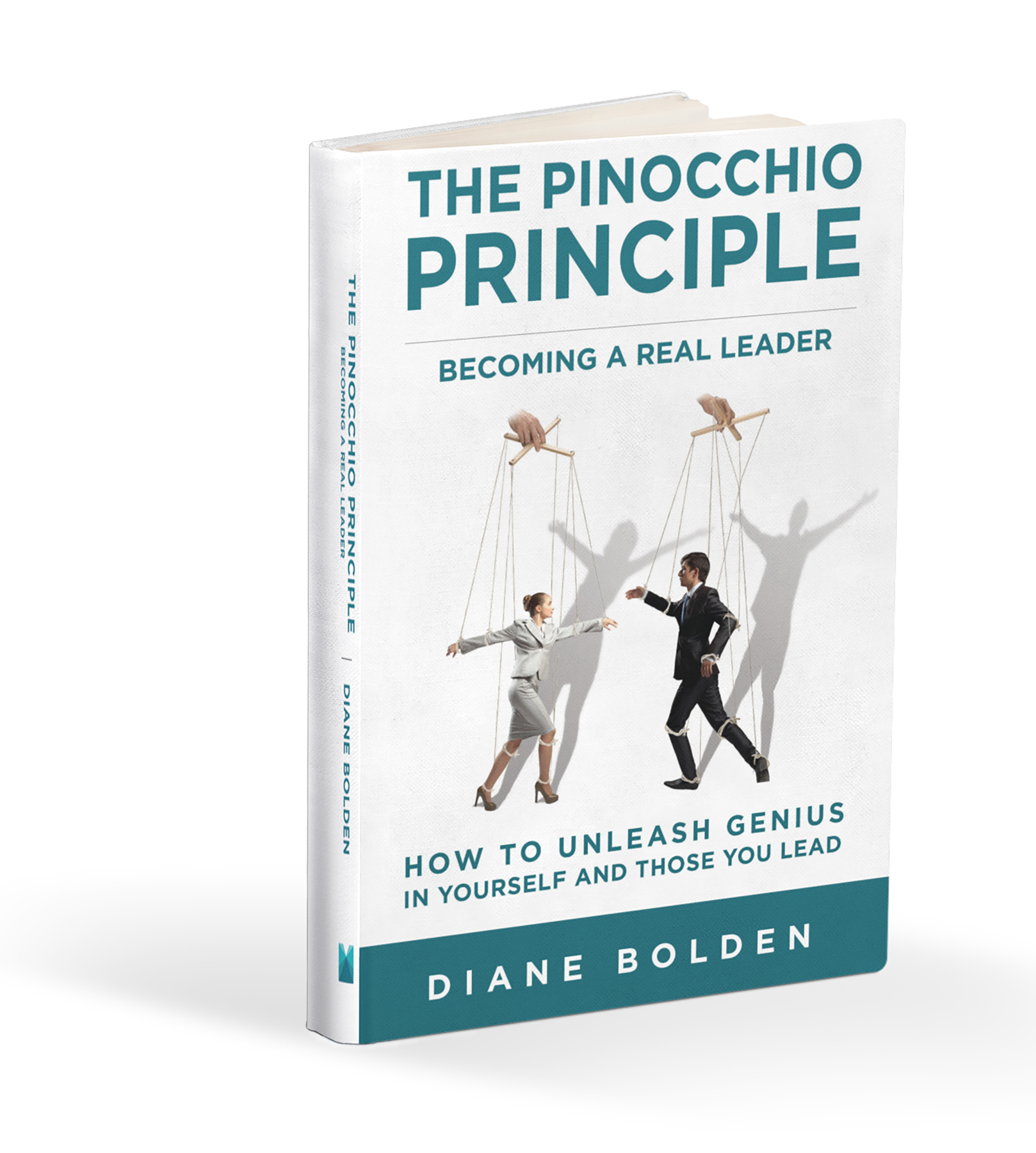
What I Wish I’d Known Before Writing a Book Called “The Pinocchio Principle”
When I tell people I wrote a leadership book called The Pinocchio Principle, they usually assume it’s about honesty.
It’s not.
Or rather — it’s about a different kind of honesty. Not the honesty of telling the truth to others, but the far more difficult honesty of telling the truth to yourself. About who you are. What you want. Where you’ve been performing a version of leadership that looks good from the outside but feels hollow from the inside.
Pinocchio, in the original story, starts out as a puppet — animated but not alive. Capable of movement but controlled by strings he can’t see. And the journey of the story, at its heart, is about what it takes to become real.
That metaphor has never left me. Because I’ve lived it.
How the book began
I didn’t set out to write about Pinocchio. I set out to solve a problem I kept encountering in my work: the gap between how capable leaders appeared and how alive they actually felt.
I had been working in organizational effectiveness and leadership development for over a decade. I’d worked with executives at Fortune 100 companies, facilitated culture change initiatives, designed and taught leadership programs. I had seen every kind of smart, accomplished, well-intentioned leader you can imagine.
And so many of them were exhausted in a way that went deeper than workload. They had achieved what they had worked for — the title, the influence, the results — and found that it didn’t feel the way they thought it would. Something vital was missing.
I recognized that feeling. Because somewhere along the way, I had started living it too.
I was running a consulting practice, raising three kids, trying to do everything well — and I had slowly become a very efficient version of myself who wasn’t sure she was living her own life anymore. I was effective. I was competent. I was, by most external measures, successful.
But I wasn’t what I would call real.
What I discovered
What I came to understand — through my own journey and through the privilege of accompanying hundreds of leaders through theirs — is that the most transformative shift available to any leader isn’t a new strategy or a better system.
It’s a return to themselves.
Not a romanticized, everything-is-easy version of themselves. But the grounded, wise, genuinely engaged version that exists beneath the accumulated weight of expectation, performance, and fear.
I call that version the Genius. And I wrote The Pinocchio Principle as a roadmap for finding it.
The book came out in 2011. In the years since, I have had leaders tell me that reading it gave them permission to want something different. That it named something they had been experiencing but couldn’t articulate. That it started a conversation with themselves they hadn’t known how to begin.
Those conversations are why I do this work. They are, in a very real sense, the whole point.
Why I’m still here
I share all of this not to tell you about a book, but to tell you about a conviction.
I believe the indomitable strength of the human spirit is essential to the future of business — and that it is, right now, largely underutilized. I believe there is a version of leadership that is both more effective and more sustainable than the one most of us were taught. And I believe it begins with the same question Pinocchio was trying to answer:
What does it take to become real?
That question is as alive for me now as it was when I wrote the book. It’s what animates every coaching conversation, every program I design, every piece I write here.
If it’s alive for you too — welcome. You’re in exactly the right place.
Want insights like this in your inbox every week? → Subscribe here.
You can find The Pinocchio Principle: Becoming a Real Leader on Amazon here.
And if you’re ready to go deeper, The Real Leader Academy is where that journey continues.
Start Before You’re Ready: 3 Insights for Stepping Into What Excites and Terrifies You
Can you think of the last time you did something that terrified and excited you at the same time?
If you’re like me, you can probably also think of a few times an opportunity like that revealed itself — and you let it pass by. We tell ourselves we’re not ready. We succumb to the doubt or the fear. And later, we feel the particular ache of recognizing we were ready for more and didn’t allow ourselves to step into it.
This week’s video is about what helps us step forward instead of shrinking back. I share three insights that have made the difference for me, and I imagine at least one of them will land for you too.
The first is about the discomfort of growth — and why feeling unready isn’t the warning sign we tend to think it is. The second is about a trap I’ve fallen into more than once: the belief that we need one more course, one more credential, one more bit of preparation before we’re allowed to begin. (Spoiler: there’s something a workshop can never give you that taking action will.) And the third is about what we can lean on in those moments when confidence simply hasn’t arrived yet.
We don’t grow by waiting until we feel ready. We grow by stepping into the thing that’s calling us — before we’re as prepared as we’d like to be — and discovering that we had what it took all along.
If this resonates and you’d like more tools for leading from the inside out, you’ll find them inside The Real Leader Academy, including the Just In Time Coaching Library — a growing collection of tips and approaches for the real challenges leaders face.