Share This
Category Archives: Pinocchio Principle
Why Smart, Skilled Leaders Still Fail – and the One Thing That Can Change That

Last time, I left off with a question: why does any of this – the suffering, the feeling, the processing – actually matter for the work you do all day? Here’s where it leads.
If you get a group of leaders together and predict which of them over the next ten to twenty years will create and sustain success for their organizations, their people, and themselves, only a vital few will make the cut.
You may think the differentiator is experience, education, or intelligence. Or skill – in communication, making decisions, strategic thinking, creating accountability. Or qualities like decisiveness, confidence, resilience, agility, or focus.
Those are all great attributes. But without one critical component, no combination of the others is enough. And that one quality is heart.
The business world is far more partial to the mind than the heart, which is often considered soft and irrelevant to generating profits, expanding market share, achieving operational efficiency – all the hard measures of business success.
But the heart is what fires the accomplishments of the mind – and all the actions that go into creating bottom-line business results. In fact, one of the greatest dangers that leaders face today is over-reliance on the mind at the expense of the heart.
The mind without the heart takes a path that emphasizes power and control, relies on authority to get things done, and prioritizes profits above everything else.
When the mind eclipses the heart, people feel expendable, disillusioned, disconnected, and ultimately disengaged. They lose their connection to their work, to each other, and to themselves.
What that looks like in an organization is people running around with their hair on fire, talking at each other while withholding information, looking over their shoulders, creating silos, hedging their bets, doing only what is necessary to get by. There is no light in their eyes. They show up, but they are not really there.
Performance declines, trust erodes and people burn out.
Leaders who will be able to create and sustain know that when the heart comes online, engagement and performance follow. There is little need to rely on authority to get things done, because people feel connected to the why behind the what. And as a result, they generate the energy sufficient to figure out and accomplish the how.
Many of these leaders are experiencing the fallout of a way of doing business that has long run its course. They know rising to the challenges and opportunities of the future, a new way of living and leading is required. They are awakening to the call to reconnect to the heart – in themselves and each other – and to utilize the power it generates to change the game of business altogether.
Perhaps you are one of them.
If this resonates, the Real Leader Revolution Manifesto goes deeper into what it takes to lead from heart instead of autopilot. You can download it free at RealLeaderRevolution.com.
What I’ve Come to See About the Leaders Running on Empty
A while back, I wrote about what it takes to become real — the question at the center of The Pinocchio Principle. The distance between how capable a leader appears and how alive they actually feel.
Since then, I’ve been sitting with that question in a slightly different way.
Because in the intervening years, I’ve watched the pattern deepen. The leaders I coach are more accomplished than ever. And more depleted than ever. They’ve read the books. Been through the workshops. Listened to the podcasts. They know what good leadership looks like. And yet they arrive at coaching sessions with the same quiet exhaustion I have been watching for three decades.
Something is running them. And it is not the workload.
I made a video about what that something is — what I’ve come to see beneath the surface of the leaders I work with, and beneath the surface of my own life during the years I was living out the same pattern.
The video is about sixteen minutes long, and it lays out the whole picture: the invisible modus operandi that runs us underneath our conscious awareness, the false beliefs most of us would never consciously choose but are living by anyway, the five movements that make change actually possible, and — most importantly — the picture of what becomes available when you stop running on the wrong fuel and start running on the right one.
I’ve also put all of it down in a manifesto. It’s called The Real Leader Revolution, and it’s meant to be read slowly. You can download it free at RealLeaderRevolution.com.
Why I’m writing this now
I share the video and the manifesto because they feel like the fullest expression yet of the work I’ve been building for thirty years. The Pinocchio Principle named the question. This new work is my current answer.
Not because I have finished figuring it out — I haven’t. But because I’ve watched enough leaders make this shift that I know it is possible. And I know the map exists.
If you have felt yourself running on empty, and no amount of rest is quite fixing it — this is for you.
If you have wondered why what used to work isn’t working anymore, and no framework or strategy seems to reach whatever the actual problem is — this is for you.
If you have started to suspect that the more you’re looking for is buried beneath the very habits and beliefs that got you here — this is for you.
Watch the video. Read the manifesto. Sit with it.
And if any of it lands, I’d love to hear from you.
Diane
P.S. If you’re new here and want to receive more of this kind of writing, subscribe to my email list — I send thoughtful pieces on leadership, mindset, and the inner work of the outer life, roughly once or twice a month.
What I Wish I’d Known Before Writing a Book Called “The Pinocchio Principle”
When I tell people I wrote a leadership book called The Pinocchio Principle, they usually assume it’s about honesty.
It’s not.
Or rather — it’s about a different kind of honesty. Not the honesty of telling the truth to others, but the far more difficult honesty of telling the truth to yourself. About who you are. What you want. Where you’ve been performing a version of leadership that looks good from the outside but feels hollow from the inside.
Pinocchio, in the original story, starts out as a puppet — animated but not alive. Capable of movement but controlled by strings he can’t see. And the journey of the story, at its heart, is about what it takes to become real.
That metaphor has never left me. Because I’ve lived it.
How the book began
I didn’t set out to write about Pinocchio. I set out to solve a problem I kept encountering in my work: the gap between how capable leaders appeared and how alive they actually felt.
I had been working in organizational effectiveness and leadership development for over a decade. I’d worked with executives at Fortune 100 companies, facilitated culture change initiatives, designed and taught leadership programs. I had seen every kind of smart, accomplished, well-intentioned leader you can imagine.
And so many of them were exhausted in a way that went deeper than workload. They had achieved what they had worked for — the title, the influence, the results — and found that it didn’t feel the way they thought it would. Something vital was missing.
I recognized that feeling. Because somewhere along the way, I had started living it too.
I was running a consulting practice, raising three kids, trying to do everything well — and I had slowly become a very efficient version of myself who wasn’t sure she was living her own life anymore. I was effective. I was competent. I was, by most external measures, successful.
But I wasn’t what I would call real.
What I discovered
What I came to understand — through my own journey and through the privilege of accompanying hundreds of leaders through theirs — is that the most transformative shift available to any leader isn’t a new strategy or a better system.
It’s a return to themselves.
Not a romanticized, everything-is-easy version of themselves. But the grounded, wise, genuinely engaged version that exists beneath the accumulated weight of expectation, performance, and fear.
I call that version the Genius. And I wrote The Pinocchio Principle as a roadmap for finding it.
The book came out in 2011. In the years since, I have had leaders tell me that reading it gave them permission to want something different. That it named something they had been experiencing but couldn’t articulate. That it started a conversation with themselves they hadn’t known how to begin.
Those conversations are why I do this work. They are, in a very real sense, the whole point.
Why I’m still here
I share all of this not to tell you about a book, but to tell you about a conviction.
I believe the indomitable strength of the human spirit is essential to the future of business — and that it is, right now, largely underutilized. I believe there is a version of leadership that is both more effective and more sustainable than the one most of us were taught. And I believe it begins with the same question Pinocchio was trying to answer:
What does it take to become real?
That question is as alive for me now as it was when I wrote the book. It’s what animates every coaching conversation, every program I design, every piece I write here.
If it’s alive for you too — welcome. You’re in exactly the right place.
Want insights like this in your inbox every week? → Subscribe here.
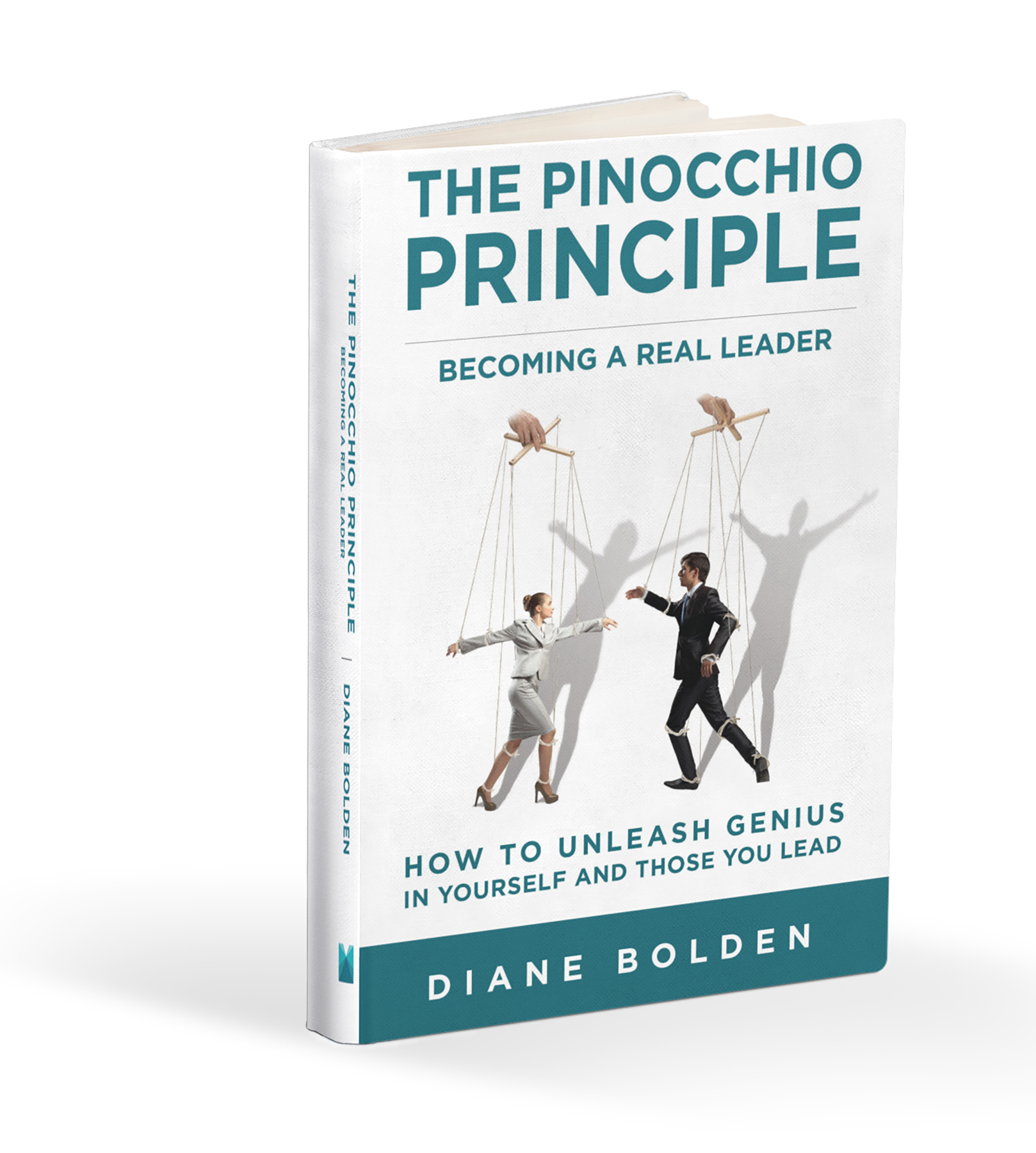
You can find The Pinocchio Principle: Becoming a Real Leader on Amazon here.
And if you’re ready to go deeper, The Real Leader Academy is where that journey continues.
When “Good Enough” Becomes the Enemy of Your Greatest Work
There’s a particular trap that almost exclusively catches high achievers. It doesn’t catch the mediocre or the disengaged — they’re nowhere near it. It catches the capable, the accomplished, the ones who have built real expertise and a track record of results.
It goes like this: you get good at something. Genuinely good. People notice. Requests come in. You deliver. More requests come. You keep delivering. Over time, you become the person everyone turns to for that thing — which feels like success, because in many ways it is.
Until the day you realize that the thing everyone turns to you for is no longer the thing that lights you up.
You’re good at it. Maybe even great at it. But “good enough” and “great enough” have quietly become the ceiling of what you bring to work every day. And somewhere below that ceiling, your most interesting and generative work is still waiting.
The difference between competence and genius
I use the word Genius deliberately — not to mean exceptional intelligence, but to describe the particular quality of contribution that only you can make. The thinking, the perspective, the creative combination of experience and instinct and care that is specific to you and shows up when you’re doing work that genuinely engages you.
Competence is reproducible. Someone else can learn what you know and do what you do. Genius is not. It’s the fingerprint. And it tends to disappear when you’re spending your best energy on things that, while valuable, are keeping you from what you’re actually here to do.
The leaders I’ve worked with who have made this shift — from operating primarily from competence to operating more from Genius — describe it as going from performing their job to inhabiting it. The work feels different. They feel different. And the people around them notice.
What gets in the way
The most common obstacle isn’t lack of clarity about what your Genius is. Most people, when they slow down enough to look, have a pretty good sense of when they’re in it and when they’re not.
The obstacle is permission.
Permission to prioritize the work that only you can do over the work that simply needs to get done. Permission to say “this isn’t the best use of what I bring” — even when you’re good at it. Permission to disappoint the expectations that have accumulated around your competence.
That permission is harder to give yourself than it sounds. But it’s the threshold between a career that is impressive and a career that is alive.
A question worth sitting with
If you set aside everything you’re capable of doing — everything you’ve proven you can deliver — and asked instead: what kind of work makes me feel most like myself? What am I doing when time disappears and the effort doesn’t feel like effort?
That answer is a compass. It won’t tell you to blow up your career or abandon your responsibilities. But it will point you toward the territory where your greatest contribution lives.
And finding ways to spend even a little more time there — and a little less time on what merely keeps you busy — is one of the most important things a leader can do.
Want insights like this in your inbox every week? → Subscribe here.
If this resonates, The Real Leader Academy is designed exactly for this exploration — helping high-achieving leaders reconnect with what makes their leadership most powerful. → RealLeaderAcademy.com
What a Really Bad Day Taught Me About Leadership

I once arrived at a client meeting with coffee in my lap.
I was running late, reached for my coffee while pulling out of the driveway, misjudged the lid, and poured a generous amount of very hot coffee directly onto myself. I didn’t have time to go back inside and change. I arrived flustered, damp, and not exactly radiating executive presence.
In the parking lot, sitting in my car collecting myself before going in, I noticed something interesting: how much worse I was making it.
The coffee was a fact. The spill happened. Nothing about my narrative in that parking lot was going to change it. But what I was telling myself about it — what it meant, what it said about the kind of day I was going to have, what the client would think, whether I could possibly recover — was a story. And it was a story I was choosing to tell, even if it didn’t feel like a choice.
The story underneath the event
This is something I work on with leaders constantly, because it applies to everything. Not just spilled coffee but failed launches, difficult conversations, critical feedback, restructures, disappointments, and the hundred small indignities of a demanding professional life.
Every experience has two layers. The first is what actually happened — the fact, the event, the words that were said. The second is the meaning we assign to it. And while we often can’t control the first layer, we have extraordinary influence over the second.
The problem is that most of us don’t realize we’re operating in the second layer. We experience our interpretation of events as if it were the events themselves. The story feels like reality. And when the story is “this is a disaster” or “I can’t recover from this” or “this always happens to me,” the story shapes everything that comes after it.
What I did instead
In the parking lot, once I noticed what was happening, I tried something different. I asked: what’s actually true here?
What was true: I was late. I had spilled coffee. I was late. The client was waiting.
What was a story: that this meant the meeting was ruined before it started. That I was incompetent. That today was destined to be a disaster.
When I separated the fact from the story, something shifted. Not magically — I was still a little rattled. But I walked into that meeting present enough to actually be useful. And as it turned out, the client barely noticed I was late. What they noticed was that I was fully there when it mattered.
The leadership application
You don’t have to spill coffee to use this. You can use it the moment you notice that your reaction to something feels bigger than the thing itself. That’s usually a sign the story is running.
Ask: What is actually, factually true here? What am I adding to it? And what would be available to me if I set the story down for a moment?
The leaders I’ve worked with who navigate difficulty with the most grace aren’t the ones who don’t get rattled. They’re the ones who notice when they’re rattled — and choose, intentionally, what they do next.
That’s not a talent. It’s a practice. And it starts in the parking lot.
Want insights like this in your inbox every week? → Subscribe here.
I wrote more on navigating the stories that run our leadership in my book The Pinocchio Principle: Becoming a Real Leader.
How to Navigate Change Without Losing Yourself in the Process
Something I’ve noticed about the way most leaders navigate change: they try to power through it.
They treat uncertainty like an obstacle to overcome — something to be solved, managed, or outwaited. And the harder they push, the more exhausted and disoriented they become. Not because the change is too hard. But because they’re approaching it from the wrong place inside themselves.
There’s a version of you that can meet change, challenge, and uncertainty with something that looks a lot like courage and grace. I’ve seen it emerge in leaders who were convinced they didn’t have it. And I’ve watched the same leaders miss it entirely when they tried to force their way through.
The difference isn’t talent. It’s where they’re operating from.
Two ways of showing up
In my work with leaders, I talk about two distinct modes of operating. I call them the Puppet and the Genius.
The Puppet isn’t weak or lazy. In fact, it tends to show up most forcefully in the highest achievers — the ones with the most at stake, the most responsibility, the most pressure. The Puppet operates from fear, from the need to control outcomes, from the accumulated weight of every expectation and assumption about how things should go. When change hits, the Puppet tightens its grip. It defaults to what has always worked. It resists what it cannot predict.
The Genius is something different. It’s the part of you that can stay curious when everything is uncertain. That can ask “what is this situation asking of me?” instead of “how do I make this stop?” It’s the part that trusts your own capacity to navigate whatever comes — not because you have all the answers, but because you’ve stopped pretending you need them before you can move.
Here’s what I’ve noticed: the Genius doesn’t arrive when the change gets easier. It arrives when you stop fighting the change and start getting interested in it.
What this looks like in practice
A client of mine — a VP navigating a significant organizational restructure — came to me exhausted and furious. Everything she had built was being dismantled. Her team was scattered. Her role was unclear. She had a dozen reasons to be angry, and she was right about all of them.
But the anger wasn’t helping her lead. It was keeping her locked in Puppet mode — reactive, contracted, focused on what she was losing rather than what was possible.
What shifted things wasn’t a new strategy. It was a question: “What if this disruption is happening for you, not to you?”
Not as a platitude. As a genuine inquiry. What might this change be making room for? What has the old structure been preventing? What could you do now that you couldn’t before?
She sat with that for a long moment. And then something in her face changed. Not relief exactly. More like recognition.
“I’ve been so focused on what I’m losing,” she said, “I haven’t once asked what I might gain.”
The practice
When you’re in the middle of change that feels threatening, try this: notice which part of you is in the driver’s seat.
Is it the part that is contracted, defensive, focused on risk and loss and what might go wrong? That’s the Puppet. It means well. It’s trying to protect you. But it cannot lead you through what it cannot see.
Or is there a quieter part available — one that is curious, grounded, willing to not know yet? That’s the Genius. It doesn’t need the change to be resolved before it can show up. It shows up precisely because the change is unresolved.
Navigating change well doesn’t mean being unaffected by it. It means choosing, again and again, which part of yourself gets to respond.
Want insights like this in your inbox every week? → Subscribe here.
If this resonates, I explore the Puppet and the Genius at length in my book The Pinocchio Principle: Becoming a Real Leader.
Why Losing Your Passion at Work Is a Leadership Problem (Not a Personal One)
A third of your time on this planet is spent at work.
Let that land for a moment.
Not a third of your workday. A third of your life. Which means if your work feels like a grind – if you’re pushing through it, white-knuckling your way from one obligation to the next, surviving instead of thriving – that’s not just a professional inconvenience. That is the texture of a significant portion of your life.
I’m not going to pretend that work is always meant to feel blissful. Every meaningful endeavor has its hard days, its tedious stretches, its moments of doubt. That’s different from the slow erosion of passion that I see happening in so many high-achieving leaders.
And I want to make a case for why that erosion isn’t just a personal problem – a matter of attitude or perspective or self-care that you can fix with a long weekend. It is a leadership problem. And it has consequences that ripple far beyond you.
The cost you aren’t calculating
Here’s what most leaders don’t realize when they make peace with feeling depleted: the energy you bring to your work is not self-contained.
When you’re running on fumes, everyone around you feels it. Your direct reports feel it in how you show up in one-on-ones: the half-presence, the clipped responses, the sense that you’d rather be somewhere else. Your peers feel it in how you engage in meetings – whether you’re genuinely curious and generative, or just getting through the agenda. Your organization feels it in the quality of your thinking, your decisions, the kind of problems you’re willing to sit with.
Leadership is a transmission, not a transaction. What you carry inside yourself is what you transmit to the people around you. And a depleted leader, however accomplished and competent, transmits depletion.
I’ve seen this play out in organizations again and again. A team whose leader has lost their spark begins to lose theirs. The culture quietly dims. People start doing the minimum required to stay out of trouble rather than bringing their best. Nobody named it as a problem. Nobody pointed to the leader. But the source was there.
Why it happens to the best ones
Losing your passion at work doesn’t happen to lazy or uncommitted people. It happens to exactly the opposite kind of person.
It happens to the leaders who care deeply and have been pouring themselves out for so long that the well has run dry. The ones who made success their identity and then discovered that achieving it didn’t feel the way they expected. The ones who kept saying yes to things that didn’t align with who they really are, because they were so good at executing that the requests kept coming and they felt responsible for saying yes.
This is part of something I call the Curse of Competence. The better you are at something, the more of it you’re asked to do – whether or not it’s what lights you up.
Over time, you can find yourself at the top of a ladder that’s leaning against the wrong wall. Impressive by every external measure. Quietly lost on the inside.
What reigniting actually looks like
I want to be clear about what I’m not suggesting here. I’m not suggesting you quit your job, blow up your career, or make any dramatic external changes. In my experience, the most profound shifts happen from the inside out – in how you relate to what you’re doing before you change what you’re doing.
What I’ve seen work, again and again, is this: when leaders reconnect with why their work matters – not the metrics, not the deliverables, but the genuine human impact – something shifts. When they start bringing more of who they actually are to what they do, rather than the polished, managed version they’ve learned to present, something opens up.
There’s a part of every leader I’ve worked with that is wiser, more creative, and more energized than the version that shows up exhausted and going through the motions. And when that part gets activated – when you stop performing leadership and start being it – the effect on the people around you is immediate and unmistakable.
That’s not idealism. I’ve watched it happen in boardrooms, in hospitals, in classrooms, and in startup teams. It is available to you.
The question I’d ask you
If you set aside what you’re supposed to feel about your work – what you’ve decided is reasonable or realistic or acceptable for someone at your level – what is the honest answer to this question:
Does your work feed you? Or does it deplete you?
If the honest answer is the latter, that’s worth paying attention to. Not to spiral into crisis, but to get curious. Because the version of you that is genuinely energized, engaged, and lit up by what you do doesn’t just feel better – it leads better. It makes better decisions. It draws out the best in the people around it.
And the world needs that version of you more than it needs the depleted one.
If this landed for you, I explore the journey from depletion to what I call your Authentic Genius in my book The Pinocchio Principle: Becoming a Real Leader.
And if you’re ready for a more structured journey, The Real Leader Academy offers programs specifically designed to help high-achieving leaders reconnect with what makes their leadership most powerful — and most sustainable. → RealLeaderAcademy.com
Want insights like this in your inbox every week? → Subscribe here.
The Surprising Secret to Overcoming Inertia (It Has Nothing to Do with Willpower)
I want to tell you about something I discovered one morning while doing yoga in my cold house.
I’d been putting off my practice for days — weeks, if I’m honest. Every morning I’d wake up with good intentions, feel the temperature in the room, and decide that I’d start tomorrow. The conditions weren’t right. I needed to feel ready.
One morning I forced myself to get on the mat anyway.
I did a few slow, stiff movements. Everything felt hard. My body was resistant. My mind was making a compelling case that this was pointless. But I kept going. And somewhere in the middle of it, something shifted. My muscles warmed up. My breath deepened. The things that had felt impossible five minutes earlier started happening on their own.
The room hadn’t changed. The temperature was the same. The conditions were exactly as uninviting as they’d been when I’d been talking myself out of it for weeks.
I had changed.
And I thought: isn’t this always how it goes?
The physics of getting unstuck
There’s a principle in physics that states an object at rest tends to stay at rest — and an object in motion tends to stay in motion. We usually think of inertia as the problem (the thing keeping us stuck on the couch), but the same principle that keeps us still is the one that keeps us moving once we start.
The mistake most people make when they’re trying to overcome inertia is waiting for the right conditions before they begin. They’re waiting for clarity, or motivation, or the perfect moment, or enough time, or the right mood. They think that feeling ready is the prerequisite for starting.
It isn’t.
Readiness is a result of beginning. Not a condition for it.
What this looks like in real leadership
I work with executives who have important projects sitting in a drawer — things they know matter, things they genuinely want to do — that have been waiting for the right moment for months. Sometimes years.
The reason is rarely laziness. It’s usually that the project feels big, and starting feels risky, and not starting feels safer than starting badly.
But here’s what I’ve observed: the leaders who make the most meaningful progress are rarely the ones who waited until everything was perfectly aligned. They’re the ones who took a small, imperfect action and let that action create the momentum for the next one.
They got warm.
The question worth asking
When I’m stuck on something — a conversation I’ve been avoiding, a piece of work I keep circling around, a decision I can’t seem to make — I’ve learned to ask myself a different question than “What should I do?”
Instead, I ask: What’s the smallest action I could take right now that would get me into motion?
Not the perfect action. Not the complete action. Just the one that would move the needle from “still” to “in motion.”
Sometimes it’s writing one paragraph. Sometimes it’s making one phone call. Sometimes it’s simply opening the document and reading what’s there.
The moment you take that action, the game changes. Because now you’re in motion. And motion has its own momentum.
One small thing
Think about something you’ve been wanting to move forward on — a project, a conversation, a change you’ve been contemplating. You know the one.
Now ask yourself: what’s the smallest action I could take on it today? Not to finish it. Not to get it right. Just to get warm.
Then take that action. Before you read another article or have another meeting or check your phone again.
The environment won’t change. But you will.
I explore this idea, and the deeper patterns that keep high-achieving leaders stuck, in my book: The Pinocchio Principle: Becoming a Real Leader.
Want insights like this in your inbox every week? → Subscribe here.
Why Running on Autopilot Is Costing You More Than You Know
There’s a particular kind of exhaustion that has nothing to do with how many hours you’ve worked.
It’s the exhaustion of going through the motions. Of making it through your day – back-to-back meetings, decisions, emails, conversations – and arriving at the end of it feeling like you somehow weren’t really there for any of it.
If you’ve ever driven home and couldn’t remember a single thing about the drive, you know what I mean. Your body showed up. Your autopilot showed up. But you, the thoughtful, intentional, alive version of you, had checked out somewhere around 2 p.m.
I’ve been thinking about this a lot lately, because I keep hearing some version of the same thing from leaders I work with:
“I’m doing everything I’m supposed to be doing. So why does it feel like I’m disappearing?”
That question deserves a real answer.
What autopilot actually costs you
We tend to talk about autopilot as a productivity problem… you’re not getting things done, you’re procrastinating, you’re distracted. And sure, those things show up. But what I’ve observed, both in my own life and in working with executives for over thirty years, is that autopilot is really an identity problem.
When you’re running on autopilot, you’re not actually leading. You’re reacting. You’re executing. You’re managing the inbox of your life. But the deeper, more purposeful part of you – the part that has vision, that asks “why does this matter,” that can read a room and feel what’s really needed – that part goes quiet.
And here’s what makes it so insidious: it happens gradually enough that you don’t notice it happening. One day you look up and realize the last six months were a blur. That you can’t remember the last time you felt genuinely excited about a project. That your best ideas stopped coming.
That’s not a scheduling problem. That’s a signal.
The three signs your leadership is on autopilot
1) You’re doing more, but feeling less. You’re technically more productive than ever – more efficient, more organized, more responsive. But something feels flat. You finish things and feel relief instead of satisfaction. The work has stopped feeding you.
2) You’ve stopped asking the question underneath the question. Leaders operating from their fullest capacity are always curious. They’re asking not just what needs to get done, but why it matters, who is affected, and what’s really going on beneath the surface. When you’re on autopilot, you stop going below the surface. You take things at face value because you’re moving too fast to look deeper.
3) Your relationships feel transactional. Not because you don’t care – you do. But when you’re in autopilot mode, interactions become things to get through rather than opportunities to genuinely connect. People can feel the difference, even if they can’t name it.
What I know to be true
There’s a part of you that is wiser, more creative, and more capable than the version of you that shows up on autopilot. I call it your Genius. It’s not some idealized fantasy of who you could be under perfect conditions. It’s actually more available to you than your autopilot self – it just requires that you show up for it.
The good news is that breaking out of autopilot doesn’t require a sabbatical or a personality transplant. It usually begins with something much simpler: noticing that you’re on it.
That noticing is the first act of real leadership.
Something to sit with this week
What is one thing you keep meaning to get to, one piece of work that feels genuinely important to you, that has been getting pushed to tomorrow for longer than you’d like to admit?
Don’t answer that question in your head. Write it down. And notice how it feels to let it land.
That feeling is information. It’s your Genius, signaling.
Want reflections like this in your inbox every week? Subscribe here
If this resonates and you want to go deeper, I wrote an entire book about the journey from autopilot to authentic leadership: The Pinocchio Principle: Becoming a Real Leader
How to Leverage a Cringe Worthy Moment
A step backward (even a cringe worthy moment) can be used to propel you forward – IF you know how to leverage it. This week’s video will show you how…
Here’s to your success!
Diane