Share This
All posts by Diane
Begin Again – How New Starts Supercharge Your Performance, Relationships, and Results
What if we leveraged the wisdom of “begin again” to the things we do every day? The projects we work so feverishly on? The relationships we nurture? The visions we create? The ideas we cling to long after we’ve realized they’ve outlived their relevance?
Nature shows us there is much to be gained by releasing what has come before to make way for what has yet to emerge. Each season gives way to the next. The brightness of each day is punctuated by darkness of the night, which in turn is dispelled by the light of the morning sun. We have periods of wakefulness followed by periods of sleep.
Each day is an invitation to begin again.
“Begin again” means knowing when it’s time to stop and put something down. Or to create a pattern interrupt – perhaps a point to assess our progress, to push pause, and go do something else for a while.
And then we return with new eyes that see from a wider perspective, and a refreshed mind that has been opened to a wider aperture. We find that we can see things differently as a result of seeing different things.
“Begin again” is about giving yourself credit for showing up and taking a stab at something. It’s refusing to satisfy the perfectionist’s mandate to have everything figured out and perfectly planned and executed and instead to just start moving in a direction (any direction), and see what happens.
Momentum is created and you begin to move. And if you realize you aren’t moving in the right direction, you can use that energy to simply turn and go a different way. “Begin again” is about picking up where you’ve left off with revitalized energy and a renewed focus – one that can take in things you previously screened out or just didn’t originally consider.
“Begin again” means giving yourself another chance, investing in what you could create. It means doing things for the experience itself and learning something in the process. It means approaching something knowing that the outcome you originally envisioned may not be the destination at all – it may just be the thing that got you in the car and willing to start something – anything.
“Begin again” is taking the lump of clay and seeing what it wants to become – giving it form and not getting too attached to what it’s supposed to look like. Realizing that at any point, you can mold it into something new.
“Begin again” is freedom from the tyranny we create when we lock ourselves into a process or a goal or a pursuit that just doesn’t seem to be working or moving forward.
Sometimes the obstacles we face – the hurdles that continue appearing, the walls we keep slamming into, the unforeseen events that interrupt our progress are there for a purpose. They are invitations to stop, do something else, allow insight and wisdom to land, give us new direction, new ideas, new energy – and to simply begin again.
How to Have Greater Influence in Meetings: 3 Tips for Speaking up and Being Heard
We’ve all been in meetings where you have something to say, but you’re just not sure how to go about it. You may open your mouth and wonder later whether you could have said it better. Or you may not say anything at all and then kick yourself for not speaking up.
Either way, you might wonder what it is, exactly, that gets people to really listen to you – and how to frame your thoughts in a way that opens the door to having true influence?
That’s what this week’s video is all about.
You do have something to say, and with the right approach you can say it in ways that people will not only hear, but understand and feel compelled to act on.
For more, check out The Real Leader Academy, where among other valuable resources, you can gain ongoing access to the Just In Time Coaching Library – a growing collection of tips, tools and approaches to help you deal with some of the most common challenges and opportunities executives face.
I couldn’t find what I needed, so I created it
It was summer of 2004. I had 3 kids under the age of 7. I was working full time. And I was under the illusion that I could be all things to all people. It was a “success formula” that had helped me get ahead for the majority of my life, and I had doubled down on it again and again.
But it wasn’t working anymore.
I was the lead on several prime projects – stuff I’d always dreamed of working on. I’d been given a promotion to do high profile work. I was blessed with a happy marriage and beautiful, healthy children who I love more than anything in the world. By all appearances I was successfully juggling a multitude of balls in the air and seemed to have it fairly well handled.
What most people could not see is that I was struggling… working harder than ever but not really getting anywhere.
I was exhausted. My mind felt dull. Everything took longer. Decisions were harder. And the work I once loved began to feel like a giant burden that was sucking the life out of me.
I didn’t know what to do about it.
As a lifelong learner, I sought solutions that would help me out of my funk. The traditional leadership development resources not only failed to deliver but made me feel worse. I became even more compelled to keep digging the hole that I feared would completely swallow me up.
It’s been said that sometimes you need to create what you most want to be a part of.
I didn’t realize what I was experiencing back then was the precursor of what my life’s work would ultimately have me doing. I had to find guidance in less obvious places and learn to mine my experiences for the insights that would ultimately become keys to my freedom.
And since that time, I’ve had the distinct honor and privilege of working with multitudes of high-achieving executives who are having (or are on the verge of) soul sucking experiences just like mine – and those who want to proactively keep that from happening altogether.
Reflecting on what I’ve seen in my own life and those of the people I’ve been blessed to work with over the years has led me to a realization that becomes stronger each and every day…
The time has come for us to find and institute a better way of living, working, and leading.
That truth has guided me in developing my most recent offering, The Real Leader Academy. I filmed a 6-minute video about it that you can check out below. Be sure to watch the last half as that is where you’ll get all the details and a peek inside the Academy.
It is possible to do great work, enjoy your life both on and off the job, and lead in ways that inspire others to rise to new levels along with you.
Here’s to your success!
Diane
P.S. For more details on the Academy, go to www.RealLeaderAcademy.com.
Life is meant for more than checking boxes…
Can you remember the last time you were so excited about something that you could feel the hair on your arms or the back of your neck stand up? Or the giddiness of a five-year-old at the prospect of visiting an amusement park?
Maybe it got you out of bed in the morning or put a little spring in your step.
When the promise of a future state brings a smile to your face or makes your heart beat a little faster, lean in. Give yourself to the dream – and the dream will give itself to you, taking on a life of its own in ways that will surprise and delight you.
Author, philosopher, and civil rights activist Howard Thurman once said, “Don’t ask what the world needs. Ask what makes you come alive and go do it. Because what the world needs is people who have come alive.”
I couldn’t agree more.
Over the last couple years, I’ve been working on a passion project of my own – a career’s worth of seemingly disjointed but synchronistically connected experiences that have come together in delightful ways. You can check it out here.
What is calling to you right now? And how can you make the space necessary for it to reveal itself to you in all its grandeur?
Here’s to pouring some life into your passion projects!

Why SMART Goals are Often Dumb
Goals are something we are encouraged to stick to. But sometimes the goals we set for ourselves no longer match the direction we find ourselves wanting to go.
Early in my career I (like many driven professionals) was prone to setting SMART goals. You know, “Specific, Measurable, Attainable, Relevant and Timebound”. It’s the conventional teaching we have all heard before.
But after time I came to realize that this approach leaves much to be desired – that in fact, it can actually keep us from getting where we most want to go.
When a goal no longer serves you and you stop wanting to pursue it, you may feel as though you’ve failed. However, the real failure might well be what happens when you stick to a goal that is no longer a fit with what you want, who you are, and the person you are becoming.
Getting where you want to go requires that you have an intense desire to get there. The pleasure and satisfaction of your destination — and your journey — needs to be greater than the pain and discomfort you will endure to get there.
What might start out as a very compelling goal may lose its appeal when your priorities change, and your very preferences and passions begin to change and evolve as well. Sometimes goals that were relevant and appropriate at one point in time will no longer serve you at another.
People grow and evolve at a pace that may not be aligned with the time frames identified in a SMART goal. When you lock yourself into achieving a particular goal, it can become a blinder that keeps you from recognizing and acting on a course of action that is far more aligned with who you really are and want to be.
If you are someone who regularly sets goals, take a moment to determine whether your current goals are working for you. Do they reflect what you really want? …how you are evolving as a person? Do they inspire you — or constrain you?
And whether you have set goals or not, consider the essence of what you most want to achieve, create, or become. Perhaps it is not yet concrete, but rather an inkling of something that is calling to you.
There is wisdom in your desire, even if you cannot yet quantify it, break it down in tangible ways, or even articulate it. In fact, sheer inklings and aspirations can become powerful seeds for the most innovative and ground-breaking accomplishments.
If you’d like more on how to gain the clarity necessary to envision and chart a path to your desired future, download my special report, “Why Real Leaders Don’t Set Goals (and what they do instead)”.

Why Preconceived Goals and Plans May Not Get You Where You Really Want to Go – and What to Do Instead.
Have you ever noticed that even your best laid plans can fail to get you where you really want to go?
The reason SMART goals and the plans we create to achieve them often don’t match our desired future is that they are constructed based on an understanding of the present and the past.
Goal setting is a linear way of operating in a nonlinear world.
When you sit down and determine what you want to accomplish, how you’ll measure it and when you will have achieved it, you’re operating on a very simplistic and theoretical understanding of the way things work. You’re likely to assume the road you are traveling will be straight and smooth and that all you need to do is drive a certain speed and a certain course and you will get where you want to go.
But real life isn’t like that.
There are twists and turns. Roads dead end and turn into overgrown brush with no defined trails. What you thought would get you where you wanted to go may turn out to be incredibly inadequate.
If you stick to your preconceived idea of how everything will be when you embark on your journey, you may well end up stuck at a dead end. If you lean on the gas when you’re going around a sharp curve so you can meet your desired timeframe, you may end up flying off a precipice and landing in a ditch.
To succeed, you must abandon the past and immerse yourself in the present.
Navigating complexity requires that you transcend your preconceived idea of how you thought things would be when you started and adjust to the environment you find yourself in. Where you thought there would be one road, there may be five or ten. And a SMART goal won’t give you the insight you need to know which of them to take.
On the contrary, letting go of a misaligned goal or plan allows you to find new paths and blaze trails where none existed. It not only allows you to adjust to your environment, but it also allows you to adjust to your own growth.
Perpetual planning (and trail blazing) is more important than a plan of action because you cannot anticipate the future based on what you know from the past.
By definition, a plan is designed in advance of carrying it out. While you can take your best guess at how things will unfold and what the most fitting course of action is, you will not really know whether it is adequate until you have begun to act.
To harness the power of perpetual planning, get moving and build some momentum. As you begin taking action, you’ll get insight into what needs to happen next. Build regular time into your calendar to assess your progress and your plan, identify next steps and make necessary course corrections.
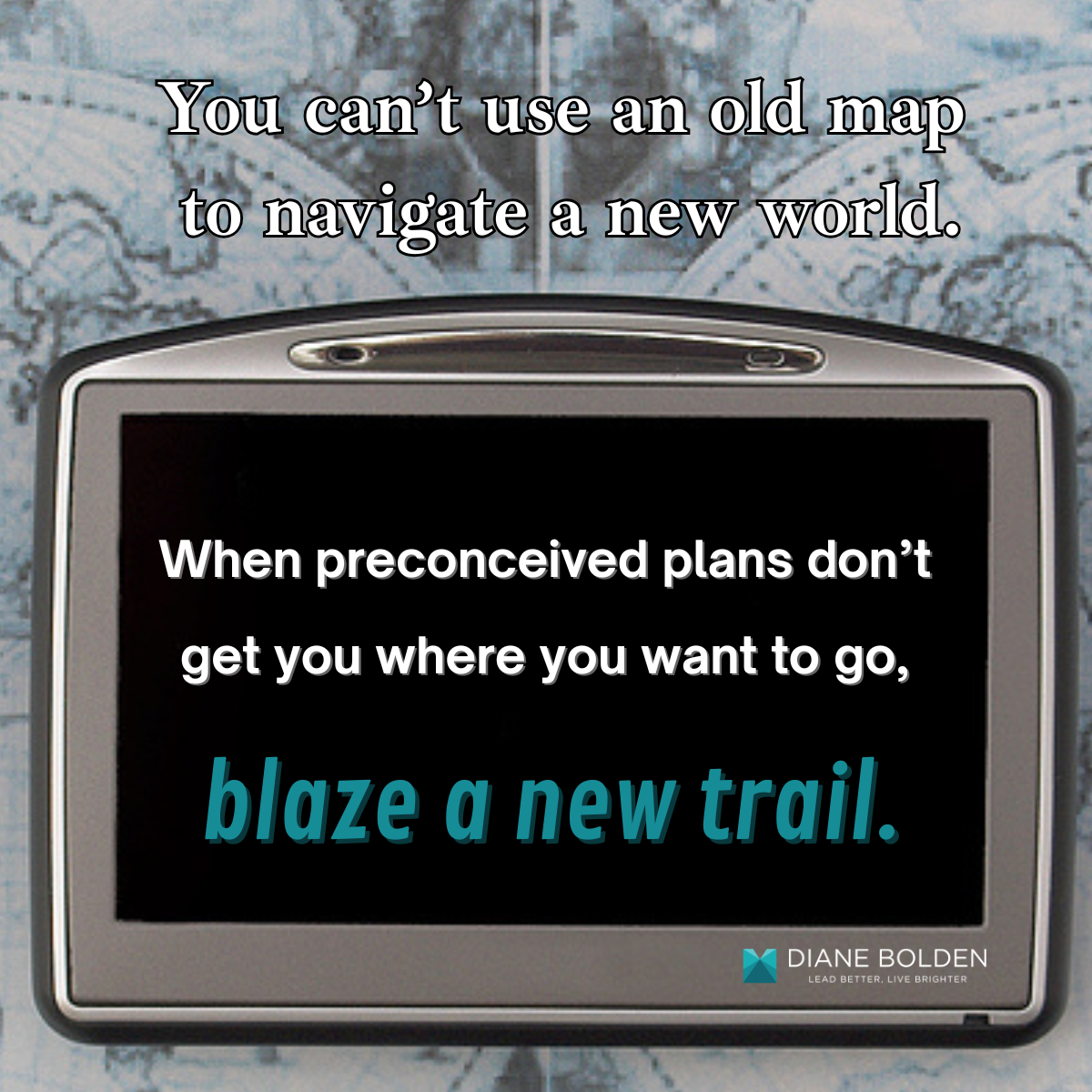
And when your map isn’t getting you where you most want to go, you’ll be much better off blazing a new trail.
The above contains excerpts from my special report, “Why Real Leaders Don’t Set Goals (and what they do instead)”
What if you don’t know what you really want?
Early in my career, I didn’t fully appreciate the power of having a vision for my work and life – and I think a lot of people tend to do what I did. They drift from job to job and go from one opportunity/ recognition/ highly visible project /mandate to the next, taking what life gives them and making the best of it.
When you ask them what they REALLY WANT, they’ll say, “I don’t know. Never really thought about it.”
Or, they may feel they don’t have the luxury of tuning into their vision because they think they just have to do work. Some may feel it hurts too much to visualize that beautiful version of their future because failing to achieve it would be more painful than never visualizing it at all. They don’t allow themselves to go there in fear it would set themselves up for disappointment.
I’ve come to realize that the real disappointment is depriving yourself the joy of embodying your true potential. And in the words of George Eliot, “It is never too late to be what you could have been.”
But how do you go about finding a vision that is true to you?
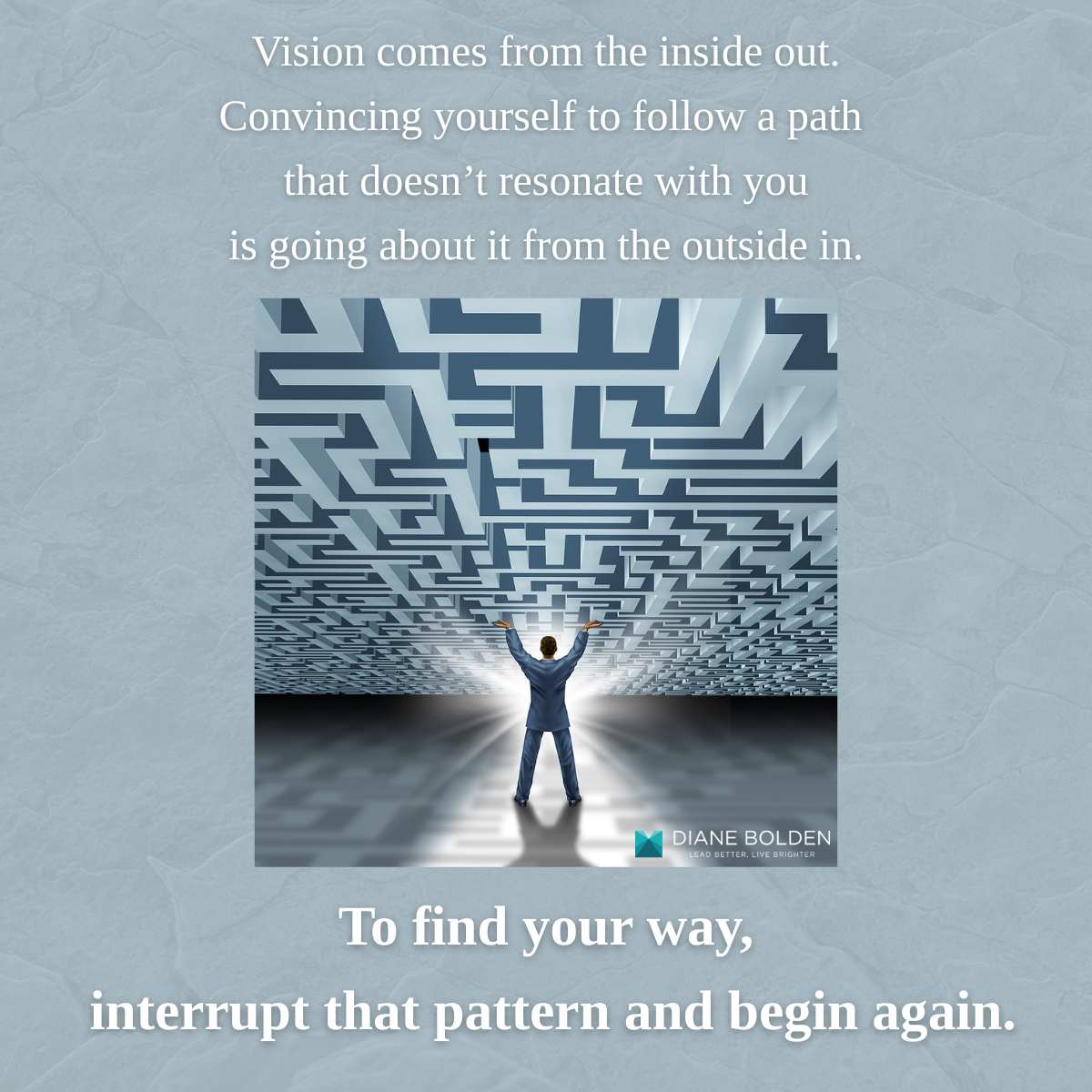
Vision is something that comes from the inside out. Though others may try to impose a vision upon you, it doesn’t become real for you until it strikes a chord from within you. If you’ve spent a lot of time trying to convince yourself to do something that isn’t resonant for you, you may be trying to go at it from the outside in.
So, you need to interrupt that pattern and spend some time tuning into your own desires. Here are three suggestions to help you establish that connection:
- Consider what you find yourself drawn to, enjoying, or dreaming about? What do you want? And what will that give you?
- If it’s easier to think about what you don’t want, you can start there and contemplate what the opposite of that (what you want in its place) would look like.
- Reflect on what your most recent experiences could be preparing you for. Perhaps the hardships you’ve endured have provided insight into what you could do to help others find their way through tough times or to create what you most want to be a part of.
Tuning into your vision doesn’t mean you need to recreate everything in your life or quit your job. On the contrary, it will give you the clarity you need to make the most of your current environment and take action that will bring you more of what you want (and less of what you don’t).
It’ll bring the energy and enthusiasm necessary to move from being a passive participant in your own life to being the hero of your own story – and the kind of leader that helps others do the same.
For more on creating your vision and taking steps to bridge the gap between where you are and where you want to be, download my special report, “Why Real Leaders Don’t Set Goals (and what they do instead)”.
Try Putting Possibilities Before Pragmatics
Think big. Ask yourself what the best-case scenario is.
What opportunities have gone unseized?
What possibilities are waiting to be ignited?
If you could wave a magic wand, what would happen?
Then ask yourself what is within your power to create, influence, or lead the charge for.
You don’t have to have all the answers, or even know all the steps.
You just need to start.
For more on creating your vision and taking steps to bridge the gap between where you are and where you want to be – and to receive updates on an upcoming webinar that’ll help you make the most of 2026, download my special report, “Why Real Leaders Don’t Set Goals (and what they do instead)”.
Do You Dare to Dream?
As children, most of us received mixed messages. You may have been encouraged to follow your heart and give life to your dreams in addition to being conditioned to be practical, hedge your bets, and take the safest route. Over time, many of us have allowed the roar of public opinion – that often tells us our dreams are frivolous, selfish, and unlikely to come to fruition – to silence that small still voice within.
But those among us who have risen against their odds have learned to reverse that process and believe in themselves and their dreams despite the overwhelming evidence around them that would suggest that success is improbable.
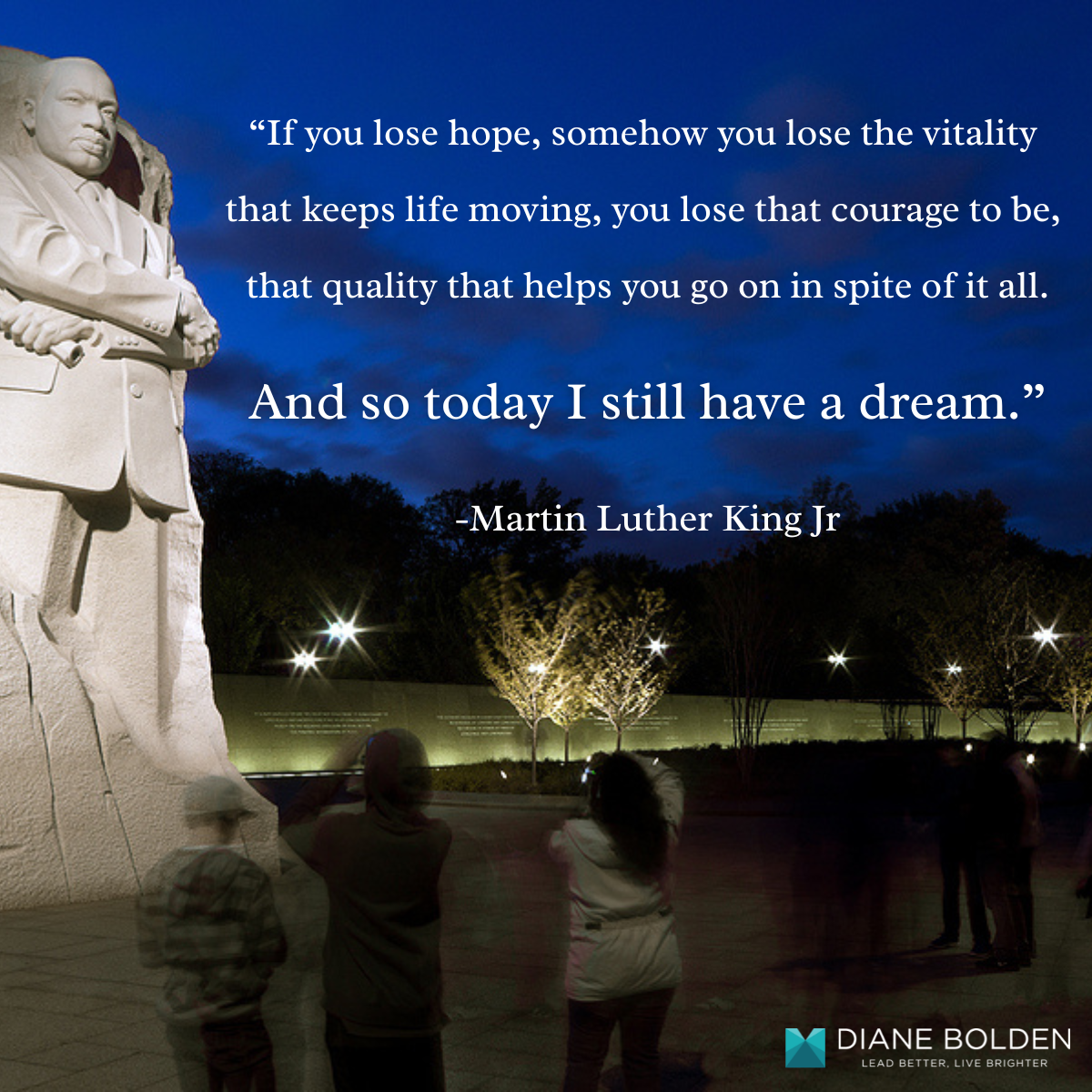
Listen closely to the silent whispers of your heart that beckon you to think bigger and act bolder – and to bust out of old paradigms that feel stale or stagnant.
Do what you can to gain clarity on what they are telling you.
And then take action.
For more on taking steps to bridge the gap between where you are and where you want to be – and to receive updates on an upcoming webinar that’ll help you make the most of 2026, download my special report, “Why Real Leaders Don’t Set Goals (and what they do instead)”.
How to Keep Your Goals from Stunting Your Growth
Ask any executive what their goals are, and they’ll likely describe targets they’re shooting for or milestones they aim to hit along the way. Goals are easy – they’re often prescribed or assigned. They’re logical, analytical, and concrete.
But ask someone what their vision is, and you’ll likely get a whole different reaction.
Visions are amorphous – they require us to go beyond linear thinking to engage the heart. Vision requires us to check in with what we really want and why – to envision possibilities that we may not yet know how to achieve.
And vision is what activates the energy in people and organizations necessary to persevere through the tough stuff in service to something meaningful and compelling.
If you compare a vision to a goal, it may seem like pie in the sky. Visions are dreamy portrayals of what is possible. Goals, on the other hand, are rigid, time-bound, and practically pragmatic. We often place too much emphasis on goals and bypass vision altogether, which leads us to constrain ourselves and put a lid on what we could otherwise conceive and achieve.
What visioning offers that goal setting hinders is the ability to think big. It allows you to transcend what you believe is possible to envision a future without knowing exactly how you will get there.
And that is really important. Because if all you do is what you already know, you will fail to create anything innovative or groundbreaking.
The Wright brothers didn’t know how they would get their creation to fly. NASA didn’t know how to put a man on the moon. Martin Luther King didn’t know how racial equality could be accomplished. In each of these cases, it was a vision that stretched their minds and informed the steps they would take to make their dreams a reality.
Vision provides the guiding principle around which actions organize themselves.
It allows us to break out of our little boxes and illuminates answers and possibilities we may not have otherwise seen. We often find these answers as we go along and realize in retrospect that we never could have anticipated them.
Much like a river flows steadily toward the larger body of water that is its ultimate destination, vision propels us forward to find our way through uncertainty and uncharted territory.
A compelling vision identifies not only what you are moving toward, but also why. The bigger why provides you with inspiration you need to move beyond obstacles and other difficulties that would otherwise lead you to abandon your efforts.
You can find your vision with conscious intention and discernment. And if you are diligent in carving out the time to reflect on what is beckoning to you and give it the space to speak, your vision will find you.
For more on creating your vision and taking steps to bridge the gap between where you are and where you want to be future – and to receive updates on an upcoming webinar that’ll help you make the most of 2026, download my special report, “Why Real Leaders Don’t Set Goals (and what they do instead)”.