Share This
Category Archives: Uncategorized
Be the Light in the Darkness
Sometimes despite our best efforts, things go awry.
Be the source that raises the level of energy of those around you. Utilize Desire, focus and courage to help yourself and others.
Watch this video for tips on becoming the light in darkness for those around you.
If you would like to learn more about building confidence, being authentic, and moving beyond old patterns that keep you from fully enjoying your life, check out my book, The Pinocchio Principle: Becoming a Real Leader, available at Amazon.com or BarnesandNoble.com.
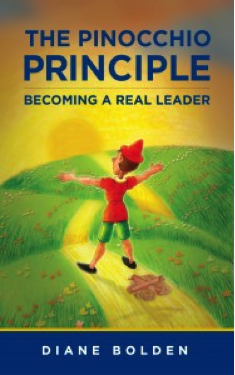
Are you a REAL Leader? What Pinocchio can teach you about becoming one.
 Often when I tell people that I wrote a leadership book called The Pinocchio Principle, they assume it must have something to do with ethics. It’s understandable, since the first thing most of us think of when we hear “Pinocchio” is a puppet whose nose grew when he lied. Pinocchio could easily be used as a metaphor for people who lie through their teeth while their proverbial noses grow. I can see why some might think it is a commentary on the importance of honesty in leadership. And while being truthful to oneself and others is a vital part of being a “real” leader, the reason I picked Pinocchio as a metaphor goes much deeper than his nose.
Pinocchio is the story of a puppet who longs to become REAL.
Like Pinocchio, at our core we too have a burning desire to become real, to bring into creation the greatness that resides somewhere within us. We are born with these impulses — to give form to our distinctive blends of talent, energy, passion and style. We come into the world equipped with far more than we are immediately able to utilize or even comprehend. And though these rich parts of ourselves are always there, they have a way of becoming latent over time.
There are people among us who have found ways to tap that well.
They draw forth bits of the magic we are all capable of. These are the people we love to watch and be around — who do what they do so well that it is an art. As they tap their inner reserves and unleash their own greatness, they inspire each of us to do the same. In this way, they are true leaders.
In Walt Disney’s rendition of Pinocchio, the puppet encounters a blue fairy.
She tells him, “When you prove yourself to be brave, truthful, and unselfish, Pinocchio, then you will become a real boy.” One could imagine what Pinocchio might have been thinking upon hearing these words. What are these things this fairy speaks of? How do I get them? What must I do? How long will it take? Where do I start? With the promise of a dream fulfilled, he endeavors to do whatever is necessary. And the odyssey begins. The twists and turns it takes are trials we can all relate to, and challenges that I believe are a part of our human experience.
The qualities that the Blue Fairy encourages Pinocchio to demonstrate are not things he must acquire.
They are attributes he already possesses. But in order to activate them, he must endure a series of events that allow him to realize these qualities are there and to exercise them accordingly. In order to return to himself — his true self — Pinocchio must endure a journey of trials and tribulations that first lure him away from himself. And the same kind of drama seems to unfold in one way or another for each of us.
Every one of us has within us an animating genius.
This genius yearns to take different forms depending on who we are. Real leaders could be defined as those whose animating genius longs to create something for the greatest good, which is ultimately accomplished for, with and through others. It has a keen ability to look around, see possibilities and utilize resources in a way that brings something into existence that benefits others, whether that is a family, a community, a non-profit organization, a corporation, or the world at large. To accomplish this, leaders have the distinct charge of working with others in a way that brings out their best — that allows those we can impact to find the animating genius within them and apply it in service of accomplishing a common goal.
Before leaders can bring out animating genius in others, they must start with themselves.
Many of us associate the primary meaning of “to lead” as directing something on a given course, or being in charge, and this can be one of the functions of leadership. But the essence of leadership is much more than this. The Merriam Webster Dictionary has the following entry as the first definition listed for the word “lead”: “a: to guide on a way especially by going in advance.”
If one of the essential functions of a leader is to bring out the best in others, this definition would suggest doing so requires that leaders first bring out the best in themselves. This, in and of itself, is the very same odyssey our friend Pinocchio finds himself on: to discover and liberate within himself what is real — divinely inspired genius — and to courageously apply it in a way that is truthful and unselfish.
I wrote The Pinocchio Principle to serve as a roadmap for bringing out the best in yourself and others. My desire is to help people bring to fruition their greatest dreams and visions and better navigate through the perils and possibilities along the way. The book was written to help you:
- Better differentiate what is true within yourself from the conditioning that would have you acting in ways that are inauthentic and self-defeating
- Gain clarity on your unique call to leadership and leverage your experiences to prepare for something bigger
- Explore navigational tools that will help you determine the extent to which you are on or off course and the direction you need to take next on your journey to becoming a real leader
- Recognize and prevent assumptions and beliefs (your strings) that keep you from your greatest work so that you can utilize ego in service to Spirit
- Recognize and steer clear of the elusive promises (Pleasure Island) that divert you from your truest fulfillment
- Face your greatest fears (the belly of the whale) in a transformational way that will reunite you with your own determination, courage and heroism
- Rediscover the power that lies within us all (the fairy’s wand) to create and live our dreams
- Find ways to return to the quiet places within yourself that nurture and inform your greatest visions
The ultimate odyssey is always that of self-discovery. Every challenge, every opportunity gives us a chance to learn more about who we really are and to utilize our inherent gifts in service to something greater than ourselves. When we give ourselves completely to the journey and find meaning in each step along the way, we will truly live. And through our example and the unique contributions we all have to make in the world, we will truly lead.
Image courtesy of africa at FreeDigitalPhotos.net.
The Passion-Profit Connection: Why passion in the workplace is money in the bank
Have you ever noticed that some businesses (and people) make you feel good simply by virtue of coming into contact with them?
Well, I have. There’s a little coffee shop around the corner that I adore. The owner is a guy named Pat. He reme mbers my name, and looks me (and everyone I am with) in the eye when we come through the door. He is always happy to see us. The pictures on the walls have been carefully selected to create an ambiance that is both relaxing and upbeat. The lattes are created by someone who treats his job as his art and presents his creations with pride. The food is delectable. And we inevitably leave happier than we were when we came in.
My all time favorite sandwich shop is run by a married couple who stop to talk to us when we are there. Every once in a while, one of the owners will get a sly grin and give us drinks at no charge. “Today is Diane day,” he will say, slyly grinning as he hands me my cup. They hire people who make us feel special too. They ask about our kids. They crack jokes that make us giggle. We go there every weekend, often because there is no place else we’d rather have lunch. (The sandwiches are killer too.) And there is usually a line that goes all the way out the door, who come for the same reasons.
Should I stay or should I go?
When I walk into some stores and even offices, I feel good as soon as I step into the building. In others, I can’t wait to leave. It is not necessarily a matter of the displays, the furniture, or even the merchandise as it is the energy that is created by the people who are involved in some way with the experience people have while they are there. They infuse passion into their work. They make it a point to truly connect with people. And they bring who they really are to what they do.
We are discerning consumers.
People are beginning to recognize that there is a difference when products and services are derived from passionate people who care deeply about what they do and the impact it makes. Those who are going through the motions to make a buck will find that their customer bases are dwindling as we continue to realize that we can have better experiences somewhere else.
Enthusiasm begets enthusiasm.
When products and services make people feel good, it is often because the people involved in creating and administering them feel good when they do their work. Their work has become more than a means to an end. It is an experience that they have learned to show up and be present for. And they have found a way to make it meaningful not only for themselves, but for every person they come into contact with.
They have taken the notion that work isn’t supposed to be fun and turned it on its head. They’ve found a way to bust out of a paradigm that had them passing the time until the work day was over and living only for the weekends (or maybe they never bought into it at all.) And they may have suffered a mishap or two – the promotion they were hoping for went to someone else, the proposal they toiled on for hours ended up in someone’s trash can, the big sale slipped through their fingers. But they picked themselves up and focused on what they could do from that point forward.
These are the people that create the places, the products and the services I want to be a part of. They are bright eyed and big hearted. They care about others – and themselves too. They are courageous and also vulnerable. They’ve decided to stop playing small and when someone tells them it can’t be done, they do it anyway. They make the world brighter one moment at a time. These people have taken off the masks that keep people from seeing who they really are. No pretense, hype or facades.
And they attract the best and the brightest talent.
It’s is as true in big business as it is corner coffee shops. The movers and the shakers – those who become customer magnets, strategic influencers, and high performing superstars gravitate to workplaces that match their passion and vitality.
These businesses – and the people who work for them – have got it going on. I will gladly pay a premium to experience their energy, enthusiasm and passion. And judging from the masses who eagerly line up at their doors, I am not the only one.
How to Change a Habit That is Hurting You, Part 4
My last three posts How to Change a Habit That is Hurting You, Part I, Part II and Part III, were about the first three steps for changing a habit that is hurting you:
(1) Make a decision, a declaration and a commitment to yourself.
(2) Surround yourself with reminders of what you are moving toward.
(3) Notice how often you engage in the behavior you want to change and what the impact is when you do.
The next step will help you identify the root of the habit you want to change so that you can work with the real source of the issue instead of simply addressing symptoms that will eventually return.
 STEP FOUR: Examine and challenge your assumptions.
Sometimes even though you recognize a behavior that isn’t serving you and you also realize how very much it is hurting you, you still feel compelled to engage in it. Usually this is because your behavior is linked to a limiting assumption or belief. Just as we can engage in behaviors that do not serve us, we can also engage in ways of thinking that are equally hurtful. Action follows thought and assumptions are thoughts that are like the strings on puppets, controlling their every move. When these assumptions are unexamined, they propel us to engage in actions without thinking.
When you examine the assumptions that are linked to a behavior you are trying to change, you may find that though the assumptions are very compelling, they are not very logical and in some cases may be downright erroneous. An assumption underneath an explosion of anger might be something like, “If I don’t get the upper hand here, I’m going to get run over.” An assumption that keeps people from taking bold action could be something like “I don’t have what it takes to do what I really want to do,” or “If I try and fail I’ll be worse off than I am now.”
What most of us don’t realize is that assumptions like these tend to get us into more trouble than they prevent. They also have us acting in ways that reinforce the assumption. In the first case, acting out of a desire to keep from being run over often leads people to run over others and be blinded to constructive alternatives that don’t have them going to extremes. As a result, others respond in ways that are equally aggressive, thus confirming the belief that they have to look out for themselves above all else.
In the second case, if you assume that you aren’t capable of doing what you really want to do, you’ll act with hesitation (if at all), and your wavering will keep you from doing the work you are truly capable of or cause you to make things much harder than they need to be. You may look to your lack of results as confirmation that your assumption was correct, but the real problem is the impact the assumption itself had on your ability to act with confidence.
Identifying these assumptions can be tricky because they often are so engrained that we don’t even realize they are operating. But if you stop to reflect on what it is you are believing about the situation, yourself or others you can begin to become aware of them. Here are some questions that can help shed light on the thinking that could be sabotaging your best efforts:
– What am I believing right now about the situation, myself, or others?
– Is it really true? Can I be absolutely, positively sure that it is true?
– When I believe that thought, how do I tend to act? How do I feel? Is it working for me?
– Who would I be and what could I do without that thought?
– What can I believe that is more true than what I used to believe and will also help me do what I really want to do?
Click here for step five of How to Change a Habit That is Hurting You.
Image courtesy of David Castillo Dominici at FreeDigitalPhotos.net