Share This
Category Archives: Boosting Creativity, Productivity & Effectiveness
What if the setback is actually the springboard?

I used to believe things happened in a linear way – first this, then that; one building block upon another in a specific order; cause and effect.
I’ve since realized that achieving a larger vision or desire often triggers a chain of seemingly disjointed events that is in reality very connected.
It’s like watching a movie of a glass shattering in reverse motion. The pieces come from all directions, seemingly unrelated, to assemble into a perfect whole.
Each piece is absolutely necessary, in and of itself incomplete and incomprehensibly connected to a bigger picture.
There are often ups and downs and unanticipated occurrences. And these seemingly divergent paths are absolutely necessary for us to experience the totality of our vision.
Sometimes we’re faced with trials that prepare us as leaders to help others work their way through those challenges – or to learn something we’ll need to know to flourish in our future endeavors.
We may not realize the significance or relevance of these experiences until much later, when in retrospect we become aware of the distinct reason we needed to endure any given challenge, setback, delay, or what originally felt like an irrelevant nuisance.
These obstacles give us a greater perspective on who we are, a larger appreciation for where we’ve been and where we’re going, and compassion for others who experience the same things we have along the way.
In dealing with these challenges, we realize that we’re far greater than we thought we were. And as leaders, we can help others appreciate and leverage their own chaos as well.
 Taking the time to connect the dots of your experiences (even the disappointing or frustrating ones) can lead to some powerful insights about what life may be preparing you for.
It can also generate the resilience and regeneration necessary to work through those obstacles with greater ease and grace.
What’s irritating you right now?
Perhaps the experience you’d rather put behind you contains the very thing you need to get where you ultimately want to go.
The Pinocchio Principle Unleashed Fast Track program kicking off on September 20 can help you make the most of anything life throws at you – not only for yourself but also in service to others. Here’s what Karen Kurtz of Dolese had to say about it:
 “What I liked most about The Pinocchio Principle Unleashed Program was that it gave me “permission” to take time out of my day to think about leadership, productivity, habits, etc. and really dig inside and reflect on obstacles that were preventing me from moving forward and the tools I could use to overcome them. The program goes beyond simple leadership principles and jargon and really helps you look inward into what you want and what you want to be. I would recommend it to anyone who needs to sharpen their tool belt and reconnect with their true leadership style.”
For more information or to save your spot, go to UnleashtheExtraordinary.com.
Here’s to your success!
Diane
P.S. Attend with a friend or colleague and you’ll both save $500 on the cost of registration.
Do you work for an organization that has a budget for leadership development? Download the business case for completing the program, which spells out seven powerful ways your organization will experience a return on its investment
Feeling constrained at work (and life)?
If you’ve ever felt like you’re at the mercy of your environment, you may be craving more freedom in your work (and your life). Do you ever…
…feel encumbered by everything on your plate and worry that if you slow down for a minute everything could come crashing down?
…experience pressure to achieve stellar success and believe you’re only as good as your last accomplishment?
…get preoccupied with what people – your boss, peers, subordinates, even your customers think of you and exert a lot of energy trying to manage their perceptions?
…feel constrained by corporate politics and compelled to say and do things to keep yourself safe, while holding back on sharing what you really think (or who you really are)?
Most of us occasionally think and act in ways that keep us feeling trapped because it may seem doing so leads to success (or prevents “failure”). But despite your best efforts, that automatic reaction will keep you from what you most want – and eventually suck the life out of you.
There is a wiser, stronger part of you that’ll show you a better way. It’s present and playful, creative and courageous, and capable of achieving extraordinary things.
We’re conditioned to keep this version of ourselves at bay, though it offers our truest source of sustainable fuel. We often don’t even realize what great lengths we go to hold ourselves down.

What would it look like if you let more of this side yourself come out at work?
Imagine a reality where you…
… are less preoccupied and more present, have clarity to efficiently and effectively get the most important things done, and access innovative solutions that would otherwise elude you.
…are buoyed by energy, enthusiasm and confidence rather than overcome with fear and doubt.
…worry less about what people think of you and enjoy stronger, deeper connections with people who are important to you, allowing you to have greater influence and stronger relationships.
…bring more of who you really are to what you do, allowing your organization and everyone around you to benefit from your unique perspective, talents and wisdom – and through your example unleash the talent and passion of people around you.
That is a state of freedom and flow. And it’s entirely within your reach. The first step is simply to envision what that would feel and look like in your life and open yourself to the possibility of achieving it.
If you’d like some support accessing and sustaining that way of working and living, consider joining me in my upcoming program kicking off on September 20.
The Pinocchio Principle Unleashed Fast Track: The Real Leader’s Guide to Accessing the Freedom & Flow of Your Authentic Genius is a seven-week leadership development program designed for high achieving professionals who are ready to reclaim their freedom, unleash their Genius, and through their example pave the way for others to do the same. Registration is now open.
You can read more about it at UnleashtheExtraordinary.com
P.S. Do you work for an organization that has a budget for leadership development? Download the business case for completing the program, which spells out seven powerful ways your organization will experience a return on its investment.
How to Break Out of Overwhelm and Lighten Your Load

Have you ever noticed that your experience directly reflects your state of mind?
When you feel heavy and bogged down, everything you do becomes harder and more cumbersome.
You may think the way you feel is a result of your experiences, and that’s true — the more you have to do, the more overwhelmed you’ll feel. But the reverse also applies — the more overwhelmed you feel, the more you are likely to act in ways that exacerbate it. You might procrastinate, overcomplicate things, or waste energy resisting and worrying.
If you focus on evidence suggesting you’ll never rise above the way you are feeling, you’ll trap yourself in vicious circles where you’ll continue to see what you want to rise above and feel the frustration of being unable to break free.
In fact, your frame of mind with everything you do has a direct effect on whether the experience of doing it will be exhilarating and satisfying or frustrating and heavy.
The stories we tell ourselves have a way of coming true. The way out of the traps we set for ourselves is to start not with our experiences, but our thoughts.
The fundamental shift must come not in what you do, or even how you do it, but what you are thinking, believing and allowing yourself to feel about what you are doing.
To that end, setting an intention or statement of your desired experience can be very powerful. If you want greater freedom and joy, more meaning and satisfaction, and heightened effectiveness, you must align your thoughts around enjoying those experiences before you even start.
And you need to become diligently aware of the degree to which your thoughts stay aligned with your overarching intention. When they drift, you can return to them, remember what you really want, and align yourself with the state you wish to be in again.
In this way, you can break the vicious cycle of allowing your experiences to bring you down in ways that result in more lousy experiences — and begin anew. Your actions align with your thoughts, and you’ll find yourself coming up with creative ways to simplify, get focused on what is most important, and get it done while enjoying yourself in the process – and sharing your joy with everyone around you.
Looking for a better way to lighten your load?
Check out The Pinocchio Principle Unleashed Fast Track: The Real Leader’s Guide to Accessing the Freedom & Flow of Your Authentic Genius, an exclusive 7-week leadership development program designed to help high achieving (and often overextended) leaders minimize pressure and stress so they can access their best work — and enjoy their lives more both on and off the job.
Registration for the fall session is now open! The program will kick off on Friday 9/20 and go through November 1. Visit UnleashtheExtraordinary.com for more information or to reserve your seat.
From DOING to DONE: The Power of Simplicity & Focus
You’ve carved out the time, eliminated the distractions, and sat yourself down to finally do that important work you’ve been meaning to get to. But you just can’t get yourself to start.
Suddenly, all manner of things become more appealing… checking your inbox, thinking about what you’ll eat for lunch (or dinner), reorganizing the piles on your desk.
Before you know it, your time is up, and you feel like you haven’t really accomplished much.
If that sounds familiar, you aren’t alone. I’ve been there too. And I work with executives all the time who have similar experiences.
One of the most common assumptions people have that keeps them from executing is that they won’t be able to do justice to the work in the time they have. And when projects are large, sometimes they don’t even know where to start.
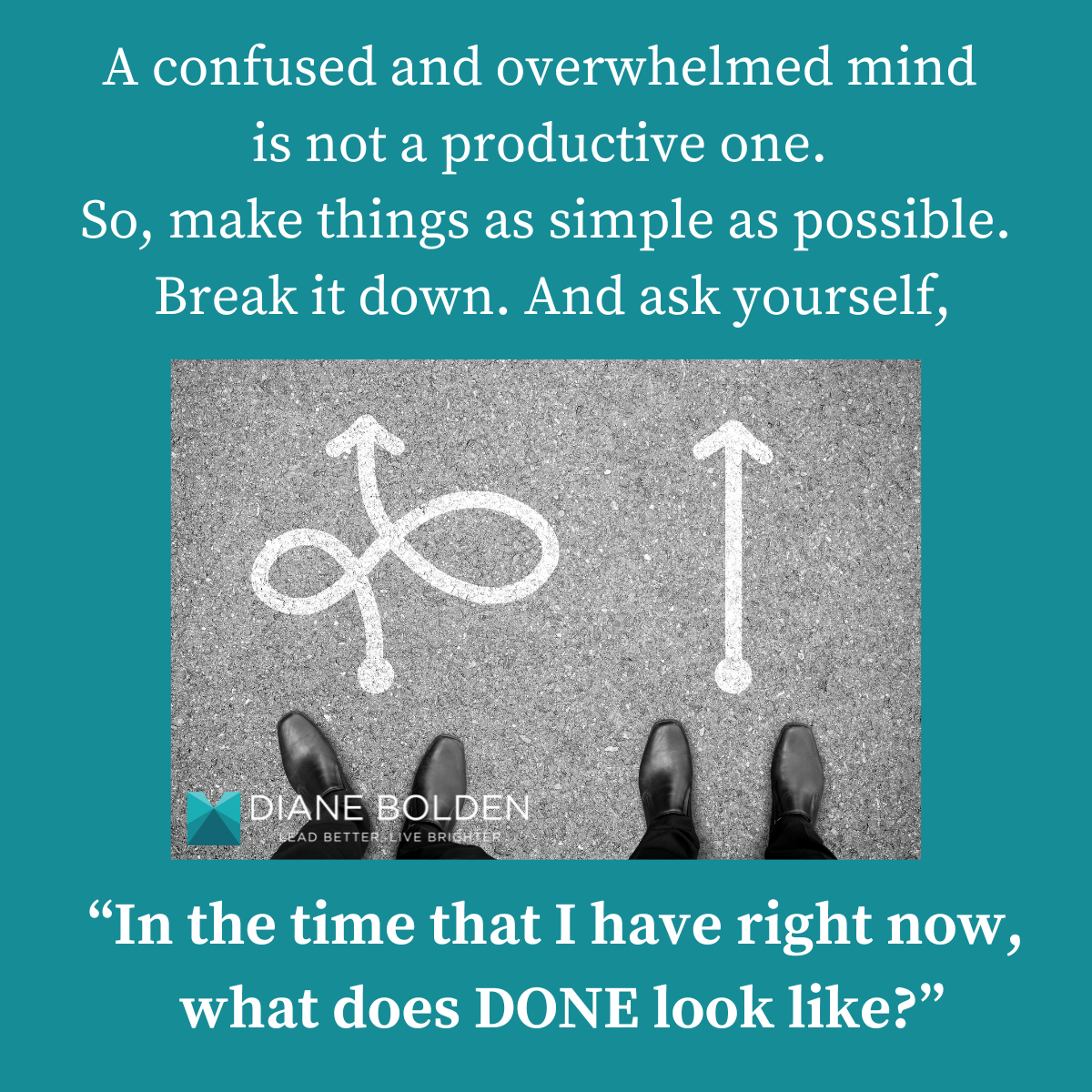
A confused mind is not a productive one. So, see if you can make things as simple as possible.
Break it down.
And ask yourself, “In the time that I have right now, what does DONE look like?”
Maybe you don’t have to have the whole problem solved or project completed. Perhaps you just need to do some research to find the answers to a few questions, make a couple of calls, or break out the steps you need to take moving forward.
If you can make the expectations you have of yourself realistic, you may find yourself more inclined to jump in (and less prone to distraction or derailment).
This is consistent with Victor Vroom’s expectancy theory of motivation, which has been a solid operating principle since the 1960’s. There are three components:
1) The level of perceived satisfaction you’ll have when you achieve a goal.
Check in with your why. What is it about making progress on this thing you’ve set time aside for that is rewarding? How can you make it meaningful to you?
2) Your belief that the effort you put in will allow you to perform.
If your definition of DONE is about moving the needle incrementally forward versus having everything finished (or perfect), you can proceed with greater confidence.
3) The degree to which your performance will allow you reach your desired outcome. If you know the actions you take in the time you have will bring you closer to your ultimate goal, your desire to take that step will increase. (This is why many digital surveys feature progress bars that show how close you are to finishing.)
Never underestimate the power of simplicity. Sometimes you can do more when you focus on less.
Here’s to moving forward!
Diane
Sometimes Falling Back Allows You to Move Forward
Do you ever find yourself falling back into old habits, despite your efforts to break free of them?
When you become aware of a behavior that is no longer serving you, catching yourself engaging in it despite that knowledge can be particularly frustrating.
But I believe it’s worth celebrating. Why?
Because now you are no longer acting on autopilot.
The beauty of a habit is that you can get to the point of doing something without ever having to think about it. That works great when you are trying to take better care of yourself – work out more, eat healthier, do something that allows you to grow in some way.
But when you are engaging in a habit that is not serving you, you are unwittingly sabotaging yourself – UNTIL you realize what you are doing.
When you begin to become aware of a habit that is no longer aligned with what you most want, the awareness in and of itself will begin to free you.
You may fall back into old patterns, but the fact that you realized it – and that it was PAINFUL will reduce the chances you’ll continue to repeat it.
You will have interrupted the automatic nature of the behavior to insert a pause. And in that pause, you can connect to yourself and reaffirm what you most want.
The first step to making a change is awareness. And sometimes that awareness is of what is no longer working. When that awareness is painful, it’ll increase the chances that you’ll make a different choice next time – one that will be far more satisfying.
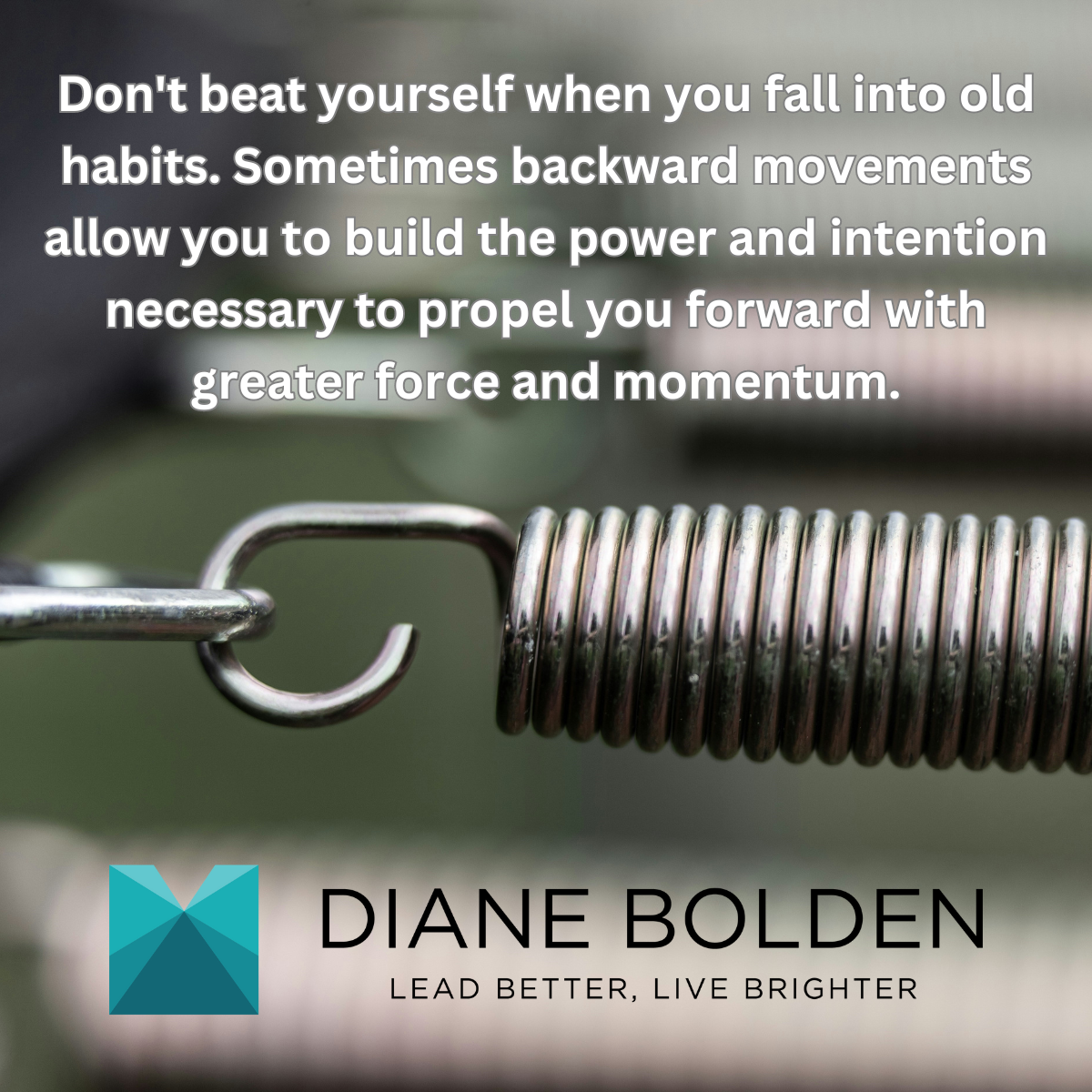
So don’t beat yourself when you fall into old habits. Sometimes backward movements allow you build up the power and intention to propel you forward with greater force and momentum.
Here’s to falling forward!
Busyness Is Not Good Business

Ever feel like you’re running harder than ever but not really getting anywhere? If the road you’re on won’t get you to your desired destination, moving faster won’t do you any favors.
When you put more importance on the tactics than you do on your vision/goal – and cling to a plan without continually reevaluating it, you’ve sacrificed the strategic in the name of the operational.
As an executive coach, this is one of the major challenges I work with executives to overcome. Operational is clean. It has defined edges and finite solutions. You can check the boxes and feel a sense of closure and control with an operational approach.
Strategic on the other hand can be a bit messier. It involves stepping into uncertainty to address challenges and opportunities that are new and unfamiliar.
There is usually no one right answer. It often involves taking steps out of your comfort zone. And it requires that you slow down instead of speeding up, something that most of us tend to resist because slowing down flies in the face of what we’ve been conditioned to do.
To avoid this discomfort, many executives prefer being busy to being strategic. It gives them the illusion of being productive and the burst of adrenaline that is a nice (yet ultimately unsatisfying and addictive) placebo for real progress.
But busyness isn’t going to help you hit the target necessary to advance your business (or your career).
Because until you slow down long enough to assess your environment and allow your intuitive mind to partner with your rational mind, you may not even realize what your true target is, let alone how to get there.
Malcolm Gladwell echoed the wisdom of Albert Einstein his iconic book Blink: The Power of Thinking Without Thinking. He wrote, “The key to good decision making is not knowledge. It is understanding. We are swimming in the former. We are desperately lacking in the latter.”
Knowledge is the product of absorbing information. Understanding is the product of insight. And insight comes from the integration of information with experience, from slowing down long enough to practice reflection and discernment.
So the next time you feel compelled to speed up, try slowing down.
Take some time to check in with yourself to identify what is most important to you right now. Reflect on the changing nature of your environment and see if you can tune into ways to proactively interact with it. Give your very best ideas a chance to land softly in the space between your thoughts.
And when you get those insights, act on them – even (and maybe especially) if they nudge you to move in new directions and do things you haven’t done before.
Don’t be afraid to deviate from your routine or stray from your plan – to strategically blaze a trail into the future you must be willing to break away from the constraints of your past.
Here’s to boldly creating your future!
How to Connect, Communicate & Collaborate with Greater Influence & Impact
Are there people in your office (or your life) that drive you nuts because they insist on doing things so differently than you do?
We’re led to believe we should treat others the way we want to be treated. But if one person’s preferences are another’s irritations, using that approach to connect, communicate and collaborate doesn’t always work very well…
When people don’t say and do things the way you’d like them to, you might believe they are intentionally trying to make you crazy – when in reality they are just operating with a style that is different than yours.
This week’s video will give you a leg up on understanding people’s differing styles in a way that’ll transform frustration into appreciation, collaboration and synergy.
And if you’d like to find out what is likely YOUR most dominant behavioral style, take this complimentary 14-question quiz. Along with your results, I’ll provide you with tips to help you not only understand but also LEVERAGE your unique style to maximize your effectiveness, influence and impact – with others who are both similar to and different from you.
Here’s to your success!
Diane
P.S. If you know of others who might like to learn about their style – and how to best connect, communicate and collaborate with others too, you can direct them to www.LearnYourStyle.com to take the complimentary quiz as well.
Four Questions to Supercharge Your Success This Season
Did you know that this is officially the first full week of fall? Every time of the year brings gifts that you can leverage to improve your work and your life. Four simple questions covered below can help you supercharge your success this season…
Fall marks the transition between the bright and dark halves of the year – and it brings with it opportunities that are easy to overlook in the hustle and bustle of our daily lives.
This week’s video will help you make the most of this auspicious time in a way that’ll help you get where you want to go in the coming months (and year ahead).
For more on how let go of the old to make room for the new, check out How to Soften the Pain of Growth.
Here’s to fall… and to leveraging its gifts to not only finish the year strong, but to setting yourself up for continued success in 2024 and beyond!
FULL TRANSCRIPT:
Hi, Diane Bolden, Executive Coach and Author of “The Pinocchio Principle: Becoming a Real Leader How to Unleash Genius in Yourself and Those You Lead.”
Can you believe it’s fall?
I don’t know about you, but I don’t know where the summer went. It seems like time is such a blur.
That’s why I love the changing seasons because they kind of jar us awake and you can’t help but notice because you can see it and you can feel it. The days get shorter, and the nights are longer. The temperature drops. The leaves start to change colors and fall from the trees, and even the air smells different.
It’s a time of letting go and preparing for regeneration. Animals start to hibernate. The leaves fall from the trees – but also, did you know, that the energy of plants actually moves from creating and growing new leaves and flowers to developing a really strong root system that’ll help it make it through the winter?
Fall perennials that are planted grow really strong roots so that in the spring they can burst forward with vigorous growth and a profusion of flowers.
And we can take our cues from nature also… slowing down long enough to just catch up with ourselves and connect the dots.
I don’t necessarily think we need to hibernate, but just being able to kind of reflect on where you’ve been, where you’re going, what’s most important to you, and how you can take good care of yourself is so important.
Here are four questions that can help you supercharge your success this season.
1) What is it that you’ve already accomplished over the year so far that you’re proud of, that you can celebrate? And what is it that’s calling to you in the future? What’s most important to you? What is it that you really want to focus your time and energy on?
2) What are two or three things you’ve learned this year? Maybe it’s a skill that you’ve picked up, maybe it’s an insight as to what’s been getting in your way and how you might overcome that. Maybe it’s something that you’ve learned about yourself or even life.
3) How can you take care of your own root system? What is it that you need to do in order to strengthen yourself and prepare yourself to move forward with greater boldness, and ease, and momentum, and get where it is that you really want to go in the coming months – and perhaps, even the year ahead?
4) And finally, what is it that you can let go of? What is it that perhaps has run its course, and is no longer serving you? Maybe it’s a habit or a pattern, or something that you’ve done for a really long time that just really isn’t working for you.
Letting go of things can be hard, even when they no longer serve us because they’re comfortable and they’re familiar. I actually wrote an article about that a few years ago, which I’ll put a link to below. It’s called “How to Soften the Pain of Growth.”
But in the meantime, here’s to fall – to all the things that you’ve accomplished and have yet to accomplish; to taking the time to tend to your own root system; and to honoring the passage of seasons within your own work, and your life to supercharge your success this season!
Thanks for watching.
How to Stay Cool When Things Get Hot at Work (and life itself)
There are those days…
You know the ones – when everything seems to hit the fan all at once. Sometimes it’s just work, and other times it happens across other areas of your life too. Maybe it’s a bad day. But it could be a tough week, tough month, tough… year?
In times like that, it’s like someone turned up the heat and left it on full blast far too long (kind of like the record-breaking temperatures we had in Phoenix over the entire month of July).
Everything seems to take more effort than it used to. The pressure increases and your energy declines. It might be so hot that you lose your cool and become impatient with people and things (or yourself) in a way that makes things even worse.
If you can relate to any of this, you’ll likely enjoy my latest article in Brainz Magazine, How to Survive Tough Times at Work – Three Tips to Help You Come Out On Top.
And if you’d like more on how to not only survive but thrive during your most challenging times (both at work and at home), check out The Pinocchio Principle Unleashed: The Real Leader’s Guide to Accessing the Freedom & Flow of Your Authentic Genius. Registration is now open!
This program integrates much of the work I’ve done coaching executive clients over the last 25+ years into a thirteen-week curriculum and is especially appropriate for high-achieving professionals experiencing high levels of stress, pressure, and overwhelm.
The fall session will kick off on Thursday 8/31 and run through 11/16. To maximize individualized attention and group interaction, enrollment will be limited to ten people and will close on Friday 8/18.
Learn more and reserve your seat here. Attend with a friend or colleague and you’ll both get $500 off the registration (email me to take advantage of that.)
Want to talk to a real person to get your questions about the program answered? Click here to schedule a brief call directly with Diane.
Here’s to keeping your cool and performing at your best – even in the hottest of times!
How to Disconnect from Work on Vacation
We all know we need vacations. Time to rest and recuperate, enjoy our loved ones and have some fun. But all too often, being away creates stress for high-performing executives who dread coming back to loads of work that has piled up. How can you disconnect from work on vacation so you don’t spend your time away preoccupied or getting sucked into email and phone calls?
Here are three strategies for accomplishing this:
(1) Make the decision to completely disconnect from work.
(2) Prepare people in your organization to handle things in your absence.
(3) Set and communicate boundaries and expectations in advance.
It’s not uncommon to come back from vacation feeling like you need another vacation. But it doesn’t have to be that way. If you approach your vacation with the same level of thoughtfulness and intention that you do with any project you undertake, you can turn that around. These three strategies will help you create experiences that not only revitalize you and supercharge your performance but also increase the strength and effectiveness of your organization.
Let’s start with the first…
(1) Make the decision to completely disconnect from work.
We all know our electronic devices need to be recharged to work properly. And it’s a no-brainer that they charge more efficiently when we are not using them. However, we often fail to grasp that to replenish our energy, creativity, resilience, determination, and focus – we too need to go offline.
It is often our underlying (and unexamined) assumptions that keep us from truly relaxing.
We are conditioned to believe that the harder we work, the more successful we will be, and that taking our eyes off the ball (even for a day, let alone a week or more) can lead to things spiraling out of control. As a result, many of us have a hard time letting go. We approach our vacations with one foot in and one foot back in the office, checking our phones and becoming preoccupied with work. In this state of mind, it’s easy to get sucked back into anything that appears to be less than optimal.
Few of us realize that this belief itself is the problem, which is why so many struggle with how to disconnect from work on vacation.
It is often the assumption that we can’t afford to let go that leads to most of the stress, pressure, and overwhelm we encounter when we return from our much-needed breaks. Like our cell phones, which are constantly searching for a signal and downloading messages, we too are expending energy even as we try to recharge it. In addition, this belief leads us to become far more susceptible to distractions that take us away from what we are doing at the moment. It also keeps us from doing the preparation necessary to ensure that others can handle things without us while we are away.
Once you realize this underlying belief is the culprit, you can substitute it with a new truth.
Chances are that voice in your head that compels you to check your phone will continue to speak. But when you begin to see the fallacy in that assumption as well as the pain it creates, it doesn’t have as much of a hold on you. You can begin to entertain the possibility that disconnecting will truly serve you (and your organization) and act in ways that make that true. And when you fully commit to a vacation that allows you to go offline, you are better able to prepare in ways that make that possible. This leads to the next strategy…
(2) Prepare people in your organization to handle things in your absence.
Most executives would benefit by delegating and empowering others more in general. Often senior leaders find themselves unable to act strategically because they get bogged down in operational tasks that they really shouldn’t be involved in. So, creating a plan to prepare others to run things in your absence will yield dividends for you (and your organization) long after your vacation is over.
Take some time to identify what is most likely to hijack your relaxation, and plan accordingly.
Identify people in your organization whose skills, experience, and passion are a good match for things you would normally handle yourself. Then take the steps necessary to bring them up to speed and put them in charge while you are away. Create and communicate guidelines that will help them know what to do in situations that would cause you the greatest stress, so they can make solid decisions without you. Taking these steps not only helps ensure consistency and effectiveness while you are away. It also develops key players on your team that, given the right opportunities, can make a bigger impact.
When you return, follow up to help your people integrate what they have learned and build on it.
In addition to increasing their own capability, their fresh perspective may yield insights into how things can be handled more effectively in the future. Additionally, the confidence you place in your staff can go a long way in making them feel valued and appreciated. Implementing this strategy for how to disconnect from work on vacation will allow you to open doors to new levels of performance that benefit your entire organization.
(3) Set and communicate boundaries and expectations in advance.
Most of us are accustomed to setting up automated “out of office” messages in our mailboxes. But we often fail to communicate and manage expectations in advance. As a result, people can feel caught off guard and demanding of your time while you are away. Or, you can feel inclined to respond to something that really isn’t all that urgent out of fear of damaging a relationship or letting a ball drop.
Take the time to talk with others about your intention to completely disconnect from work on vacation.
Make it clear that you do not intend to check email or handle phone calls. Remind them of the guidelines you’ve set on what to do in your absence. And clarify your intention to use this time to replenish your reserves so that upon your return you can more effectively serve them.
When clients believe they will be well cared for and know who in your organization to contact for what, they are much less inclined to interrupt you. If you discuss in advance what things can be done before and while you are gone and what is better delayed until your return, you’ll be able to leave with the peace of mind that everyone is on the same page.
Don’t underestimate the power of your example.
Leaders set the tone in organizations more by what they do than what they say. If you interrupt your vacations to get involved in work, others are likely to feel compelled to follow suit. As a result, the energy of your team wanes, tempers flare, and performance begins to decline. People work harder than ever but don’t seem to get a lot done, or they burn out altogether.
When you apply these strategies for how to disconnect from work on vacation, you’ll exercise true leadership – showing others how to truly revitalize themselves and their performance by modeling it yourself.
If you want to learn to infuse your work year-round with the same freshness and inspiration you feel after a good vacation, consider joining me in the fall session of The Pinocchio Principle Unleashed: The Real Leader’s Guide to Accessing the Freedom & Flow of Your Authentic Genius.
Registration will open next week, on Monday, July 31! Enrollment is limited and priority will be given to existing clients and those on the waiting list (click the link to join now).