Share This
All posts by Diane
3 Fears That Keep Leaders From Playing a Bigger Game

You’ve just been promoted. The excellent work you have been recognized for has landed you a new job with expanded responsibility and significance. Perhaps you lead an organization of other talented professionals who now look to you for guidance and support. Maybe you are a leader of leaders.
The game you were playing just got bigger – and so did the playing field.
And your role has changed. What earned you this promotion will not be enough to allow you to succeed in your new role. In fact, if you continue to do what you did before, you may actually sabotage your newfound success.
You have gone from player to coach — or perhaps manager/owner. And if you jump back into the game, no one will be there to call the shots, to develop the talent, to create a strategy to advance the standing of the team, to gain the supporters and funding that will allow the team to continue to play.
Yet despite these consequences, you — like many leaders faced with similar opportunities — may have difficulty with the transition. You may have fears:
- Fear than no one can do things as well (or better)
- Fear of becoming obsolete
- Fear of failure
Let’s talk about each of these, starting with the first one…
Fear that no one can do things as well (or better)
The problem with this fear is that it is actually well-founded. Chances are, especially if you are at the top of your field, very few will be able to do the job as well as or better than you can. But that doesn’t mean you should be doing it for them — or even along with them.
And yet you will be tempted to. Especially when the stakes are high. Or when things get extremely busy and it seems like targets will not be met if you don’t jump in or take over altogether. You may hover over people, micromanaging them or smothering them with well-intentioned guidance.
But your very fear that things will fall through the cracks may well cause that which you most want to avoid. Maybe not in the short term. In the short term, you may revel in your ability to keep the balls from dropping and save the day. But as more and more begins to be added to your plate, your problem of not having people who are skilled enough to take the baton will be even greater than it was before.
Worse yet, you will have conditioned the very people you need to develop to become dependent on you and quite comfortable performing at much less than their true capacity. In the meantime, the bigger, more strategic work that you have graduated to will be piling up and fairly significant opportunities will pass you by.
Your people may well be on a pretty steep learning curve at the beginning. They won’t get everything right. And they may resist taking on the responsibilities you used to perform. But you need to transition from performer to coach.
Give them opportunities to try things out. Let them make mistakes. Then help them to learn from those mistakes and perfect their craft. And do the same for yourself in your new role.
This leads us to the second common fear that keeps leaders from playing a bigger game.
Fear of becoming obsolete
It’s not necessarily a rational fear. After all, leaders who are on the brink of playing a bigger game have plenty to do. They have a whole new role to fill. But that doesn’t stop people from worrying at some level that if they teach and empower others to do what got them accolades and attention that they will somehow lose their edge and fade into obscurity.
Often when people have performed a certain role or become masterful at a particular skill, it can become infused with their very identity. And until they have performed in their new role for awhile and become accustomed to the different kinds of activities and opportunities that it brings, they are likely to continue to identify with their old role. Which may lead them to wonder, “if I’m not that anymore, who am I?”
This ambiguity and lack of role clarity can send people back to what they know is comfortable and familiar, even when they have outgrown it. And even when going back there isn’t in their best interest (or the best interest of those they lead.)
To counteract this, it is important to fully grasp the opportunities and possibilities that playing a bigger game brings. It allows you to go from being immersed in the game with a view limited from one point on the playing field to seeing the game from several different angles. You can evaluate each player’s contribution and the way they work together.
You can change the way the game is played — and in some cases, even change the rules. But only if you free yourself up from the myriad of tasks that will always be there beckoning you to come back into the operational and out of the strategic. And the lure of the old role becomes even more enticing when you factor in the next fear that keeps many leaders from playing a bigger game.
Fear of failure
When you go from executing the plays to determining what those plays should be, you enter unchartered territory. First off, it is likely something you won’t have a lot of experience doing. And when you don’t have a lot of experience doing something, it is uncomfortable.
You may not be very good at it in the beginning. It will be messy. You will second-guess yourself. And you will likely miss being able to do your work with the same level of confidence and ease that you did before.
It will feel a lot like going from being a senior to becoming a freshman again.
Second, the very nature of being a strategic player will require you to navigate through uncertainty and ambiguity. You will be called on to blaze a trail where none previously existed. While this can be incredibly exciting and invigorating, it can also be somewhat daunting and stressful.
And when the pressure gets high, you may find it incredibly tempting to get sucked back into doing things you shouldn’t be doing anymore. Things you can check off your list and feel a sense of accomplishment from. Things that restore your confidence and give you the illusion of being in control. Things that would be better delegated to others. Or not done at all.
So when that happens, you need to remind yourself that whatever you did that allowed you to rise to new heights wasn’t likely something that always came easily to you. You had to start somewhere and struggle in the beginning before you began to gain competence and confidence. But you stuck with it and gradually got better and better. And you can do that again now.
Leadership is about “going before” others. Your new promotion will require that you wade through your fear, your discomfort, your resistance and your uncertainty to find within you the core of your true potential and act from it. And as you do so, by your very example, you will lead others to grow, expand, push their limits and play a bigger game as well.
Playing a bigger game often brings pressure and anxiety. But it doesn’t have to. You can make a bigger impact without running yourself ragged – and enjoy the process along the way. The Real Leader’s Guide to Freedom & Flow Group Intensive will show you how. Though the spring program is now full, you can get on the waiting list for priority access to the fall program, kicking off in September. For more information, visit The Real Leader’s Guide to Freedom & Flow Group Intensive.
Combating Fear With…Martial Arts?

Though I have been studying and reflecting on the process of working through fear for the better part of my life, my learning came to a head when I was thrown into an environment that provoked a whole spectrum of fear and anxiety. As a martial artist, after learning and practicing basic blocks, kicks, and punches, the time came to take it up a notch and begin to spar.
What does sparring have to do with your life?
What I have learned over the years as I have continued to develop my skill in this area is that sparring is metaphorical for just about any challenge you could possibly be faced with that evokes fear — making a presentation (or any kind of performance), pitching a proposal, going to a job interview, or speaking your mind, just to name a few.
These situations lead you to question whether you have what it takes.
And no matter what the challenge is, there is something at stake — your status, your security, your reputation, your comfort, your pride. However, there is one differentiating factor: with sparring there is a pretty high likelihood that you will get punched in the nose. Literally.
While many lessons come from having positive experiences, much of what I learned about working with fear came through trial and error — a lot of error.
My first error allowed me to learn about focus.
Focus is determined by what you allow to occupy your mind.
When I first started sparring, my focus was on getting it over with. I was fairly preoccupied with a feeling of inadequacy that led me to temporarily forget much of what I had learned over the previous years. Rather than trusting in what I had the ability to do, I became preoccupied by what I did not want to happen — getting hit.
And as a result, I got hit. Hard.
Then, I didn’t want to spar again for a really long time. I took myself out of the game. I allowed the fear to stop me. And my training stagnated. Until the pain of stagnation became greater than the pain of the physical blow.
When I got myself back in the game, my mind shifted from retreat to advance.
Instead of fixating on what I didn’t want, I zeroed in on what I did want. It wasn’t about not getting hit. It was about pushing through the fear. It was about applying what I had learned. It was about having more faith in what I did know than what I didn’t. And it was proving to myself that I had it in me to rise above the challenge.
I threw more punches. I closed the gaps. I began to bob and weave. I learned how to lure my opponent in so I had him right where I wanted him.
But what does that have to do with facing fear off the sparring mat?
Everything. No matter what you do, you have the choice to focus either on what you are moving toward or what you are moving away from. When you are fixated on what you want to avoid, you will hedge your bets. You won’t go all out. You’ll watch the clock. And you won’t really be engaged. You’ll cheat yourself out of the joy of the experience.
When you move toward something, you marshal the forces of desire. You ignite passion. You make what you want more important than what you fear. And this gives you the fuel to do what you really want to do — in spite of the fear.
The second tool for moving out of the grip of fear is presence.
Fear has you consumed with worrying about the future or fixated on something from the past. It keeps you in your head and prevents you from being immersed in what is happening right in front of you.
When I would try to remember a technique or think too much about how to properly execute anything, I’d miss what was happening and get hit. I had no real concept of what was happening, what was coming at me, or what I needed to do to deflect it. I felt as though I was in a blender, at the mercy of the blades and centrifugal force.
Ironically, being in my head kept me in a state of panic that kept me from thinking clearly. In fact, I became so gripped with panic that I forgot to breathe and ended up exhausting myself almost immediately.
In non-sparring environments, being in your head costs you opportunities.
When you are giving a presentation and are so intent on what you prepared that you fail to see that your audience is confused, or bored or irritated, you risk losing them. In a sales setting, being determined to stick to your pitch when your customer has questions that you didn’t plan on can keep you from making the sale.
The irony is that not deviating from what you planned because you are consumed by fear keeps you from being present and often ends up leading to that which you are most afraid of. The antidote? Let go of your preconceived ideas and hold your plans loosely so that you can be present.
When you get out of your head and become present, things slow down.
When I immersed myself in what was happening in front of me while sparring, I realized that every time my opponent would throw a punch he left himself wide open. Rather than worrying about getting hit, I began to look for vulnerabilities. And I learned that I could get him to raise his hands to his face if I threw a few high punches, which would allow me to land a couple low ones while he wasn’t expecting it.
I went from jumping around like a cricket without breathing to moving more deliberately and strategically and conserving my energy. Instead of allowing my opponent to back me into a corner, I learned to pivot and use his own force against him.
In any situation, being present leads to better connections and higher performance.
You will take in more information. You will breathe more deeply, get more oxygen to your brain and access higher creativity. You’ll be more likely to make whoever you are talking to feel more important, because you’ll be more focused on him and not yourself. You’ll think more quickly on your feet and come up with better solutions on the fly.
These insights led me to realize that often what is more important than preparation is practice, which brings us to the third tool: desensitization.
The more you expose yourself to what you fear, the less impact the fear has.
Fear never really goes away. It is a human emotion that is wired into our DNA. While we can’t change the fact that it will be ever present, we can diminish the effect it has on our performance. What allows the fear to diminish, is repeatedly being in the presence of what you fear and realizing that you will be okay.
The first time I got punched in the nose, it was horrible. And though I went to great lengths to keep it from happening again, it did. And when it did, I realized that the memory of it was far worse than the reality.
The more I sparred, the more I began to become confident in my ability to prevent it from happening. And the less my fear kept me from doing what I needed to do.
Many altercations and escalations are the product of untamed fear.
The importance of learning to spar is to develop within the martial artist the confidence to handle a physical fight if necessary — in order to prevent a conflict from escalating to the point that requires any force at all.
And the implication for each of us is that becoming confident in the face of fear allows us to rise to any challenge or opportunity with grace, wisdom and victory. In so doing, we inspire others to follow our lead.
Eleanor Roosevelt urged “Do one thing every day that scares you.”
What would that be for you? Chances are it is connected to something you really want for yourself. As you focus on what you’re moving toward, stay fully engaged in the game and the joy of playing it, and have the courage to repeatedly put yourself in the presence of your fear, the words of Henry Ford will ring true for you as well:
“One of the greatest discoveries a man makes, one of his great surprises, is to find he can do what he was afraid he couldn’t.”
Staying fully engaged without succumbing to fear, pressure and overwhelm can be tricky. The Real Leader’s Guide to Freedom & Flow Group Intensive will give you approaches and methodologies that help you rise to the occasion and not only get better results, but also enjoy yourself in the process. Though the spring program is now full, you can get on the waiting list for priority access to the fall program, kicking off in September. For more information, visit The Real Leader’s Guide to Freedom & Flow Group Intensive.
Moving Toward Mastery: 4 Tips for Overcoming the Beginner’s Dilemma

“Every master was once a disaster.”
I am all too familiar with that awkward, humbling stage that comes with learning something new – when you want to run with the stallions but feel more like a donkey. It’s a universal phenomenon, really. Ralph Waldo Emerson reminds us that, “Every artist was once an amateur.”
We can all learn a lot about our paths to proficiency by looking at the ways in which we have mastered things over the course of our lives – whether it is how to drive a car, play our favorite sport, or take up a new hobby. Upon reflection, I realized how I can transfer my learnings from one arena to the other.
(1) There is power in persistent practice.
Sometimes my yoga instructor demonstrates a pose that evokes a “you’ve got to be kidding” response from me. I always give it a try, and usually the first time I do I look a lot like I feel – completely inept. She managed to work one of those dreaded poses in for several weeks. But I gave it a shot every time, and I have to say it gradually became less awkward. Before too long I was actually able to hold the pose – even if only for a few seconds. And I realized the more I practiced, the better I would get and the easier and more fun it would become.
Isn’t that like life, though? Every day there are things you can sail through and there are those things that require practice and patience before you can feel even the least bit effective. But if you keep at it, one day you will surprise yourself with how far you have come. And everything that led up to that point will be worth it.
(2) Learn from and admire others, but don’t compare yourself to them.
As a novice, you watch people perform so that you can see how things are done. And even as you gain skill, you can still learn a lot from others’ examples. But the minute you begin to compare yourself, you will lose your focus and dilute your effectiveness. This is true regardless of whether comparing yourself to others makes you feel inferior or superior.
When we gauge how well we are doing by comparing ourselves to others, the energy and focus that is required to perform effectively becomes scattered. And if you do not believe you can do something, you will inevitably prove yourself right. On the other end of the spectrum, when you believe you are outperforming others and become a little too smug, your confidence can turn into arrogance, which shifts your focus from what you are doing to how others are perceiving you. And anything that is more focused on appearances than substance lacks foundation and eventually crumbles.
The best of the best gain their confidence from within – as a product of their effort, focus, and the results that come with effort and focus. They don’t need to compare themselves to other to know that they are good – or to learn that they can get even better.
(3) Lighten up and have some fun.
When we get all balled up in knots trying to make things perfect and avoiding every possible misstep, we risk becoming stagnant and playing small. Getting too attached to the results leads us to stiffen up and become consumed with needing things to happen in the exact way we want them to. Without flexibility, we lose our ability to bend and make the necessary course corrections that allow us to ultimately excel. If you ever look at the top performers in any industry, sport, or artistic endeavor you will notice that accompanying their intensity is an ability to relax into their game in such a way that it appears easy and natural. The ability to play at work is another mark of the master.
(4) Replenish yourself regularly.
In our frenetic lives, it is easy to forget about the importance of pausing every once in awhile to make the most of our experiences – whether by giving ourselves a needed break, or simply taking a moment to assess where we are going, to what degree we are still on course, and what, if any, course corrections are necessary. Being willing to invest our precious time into replenishing ourselves in this way pays handsome dividends – and sometimes the times we think we can’t afford to slow down are in fact the times we cannot afford not to.
The speed and effectiveness with which we move toward mastery is a direct result of the way in which we approach our challenges and opportunities. The Real Leader’s Guide to Freedom & Flow Group Intensive is a program designed to help you make a bigger impact while enjoying the process, both on and off the job. Though the spring program is now full, you can get on the waiting list for priority access to the fall program, kicking off in September. For more information, visit The Real Leader’s Guide to Freedom & Flow Group Intensive.
Suffering a Setback? Use it as a Springboard
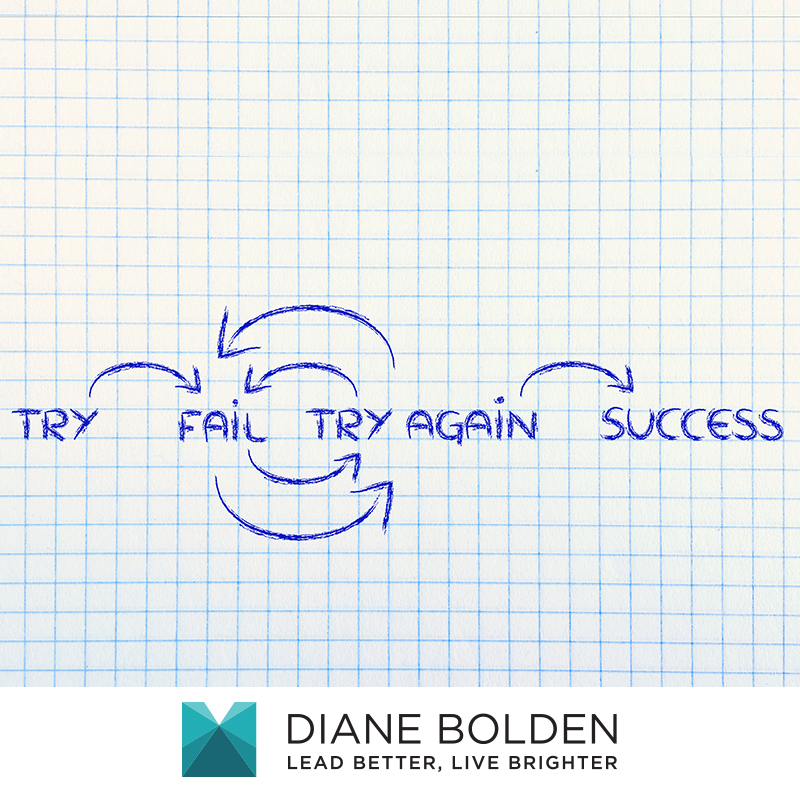
“The spirit, the will to win, and the will to excel are the things that endure. These qualities are so much more important than the events that occur.” ~ Vince Lombardi
Winston Churchill once said, “Success is not final and failure is not fatal – it is the courage to continue that counts.” Thomas Edison offered, “Many of life’s failures are people who did not realize how close they were to success when they gave up.”
Their words lead me to contemplate the very meaning of the words “success” and “failure.” Perhaps they are nothing more than labels we use for experiences that could very well be vital stepping stones. Both words are loaded with judgment that compels us to move closer to one and further from the other. But what if they are simply two sides of the same coin?
Consider the following events in each of these people’s lives:
- It’s been said that Abraham Lincoln failed in business twice, had a nervous breakdown, and was defeated in eight elections.
- Walt Disney was fired by a newspaper editor who thought he lacked creative ideas.
- When he was young, Thomas Edison was told by his teacher that he was too stupid to learn anything.
- Soichiro Honda, the founder of Honda, was turned down by Toyota for an engineering job.
- Before becoming a successful actor, John Wayne was rejected by the US Naval Academy.
- Lucille Ball was dismissed from drama school with a note that read “Wasting her time… she’s too shy to put her best foot forward.”
- Steven Spielberg unsuccessfully applied to film school three separate times.
- Michael Jordan was cut from his high school basketball team.
- Baseball legend Babe Ruth struck out 1,330 times.
- The first novel of best-selling novelist John Grisham was rejected by 16 agents and 12 publishing houses.
- Before going on to sell millions of copies in 27 languages, Robert M. Pirsig’s book Zen and the Art of Motorcycle Maintenance was rejected by 121 publishers.
- Deca recording company turned down the Beatles, with the reason “We don’t like their sound, and guitar music is on its way out.”
This list could continue for pages. What these people have in common is that they didn’t let labels like “success” and “failure” define them. They didn’t allow the events in their lives (or their thoughts and judgments about them) to get in the way of their dreams or what they knew they were capable of. And their courage, perseverance and determination benefitted not only themselves, but countless others – many of whom came generations later.
Another of my favorite quotes is from a woman named Susan Taylor who said, “Seeds of faith are always within us; sometimes it takes a crisis to nourish and encourage their growth.” Using this same wisdom, perhaps what some call “failure” is actually a catalyst – or even a prerequisite – for what others call “success.”
What’s happening in your life right now? What if it is the very experience you need to get where you most want to go?
If you are interested in more tips for transforming your setbacks to springboards, I encourage you to check out The Real Leader’s Guide to Freedom & Flow Group Intensive, an exclusive twelve-week group mastermind/coaching program/online training course kicking off the week of March 20. The program is a blend of online leadership development, small group mastermind, and one-on-one coaching, and is limited to eight people. Sign up today!
Performance Alchemy: How to Combine Inspiration and Motivation to Rocket Launch Your Success

“The key thing to remember is not that we need to be fast but that we are running a race that has no finish line. So the fuel that drives us needs to be made of something substantial — something for the heart that the head can also follow.”
~ Vincent Kralyevich, American film producer, director, author, art director and composer
Have you ever had an idea that made the hair on your arms stand up?
Maybe it’s a dream that beckons to you – one that holds promise for your future and that of others as well. When you think of the possibilities, you may find yourself feeling light, energized, and connected to something greater than yourself.
This is what inspiration feel like.
It is buoyant and powerful. Simple, yet strong. And it is contagious. Inspired action tends to touch others in a way that activates something inside of them as well. It connects them not only to you, but also to themselves. I like to think of inspiration as a pull – like a magnet that draws us toward something and gives us the power to bridge the gap – even if we aren’t sure exactly how to do it. Inspiration is something we receive and it comes to us when we are receptive to it. It requires trust, faith and patience.
Sometimes inspiration gets blocked.
What gets in the way of inspiration is our doubts, fears and faulty assumptions about what we can or cannot do, or what is even possible. These doubts are like layers of stuff that dilute the magnetic force of inspiration. Inspiration still beckons to us, but something stands in our way. This is where motivation comes in. It is something we summon up inside ourselves to get us to overcome the obstacles that are in front of us. And as leaders (regardless of your vocation, title, or role), it is something we often try to summon up in others to get them to do the same.
Motivation often takes the form of the carrot or the stick.
What gets us off the dime when we are balled up in our own fear is the willingness and the will to take action. Where inspiration is the pull, motivation is the push. The word motive is derived from motivation. Our motives can be in service to a higher good, or they can be in service to ourselves alone.
When motivation is aligned with inspiration, miracles can happen.
But when it is not, we will find ourselves feeling out of sync. Inspiration (a higher calling) without motivation (the will to act on it) leaves us feeling stagnant, stuck, and/or unfulfilled. When we refuse to answer our calls to greatness and play small instead, it is often because we have let our fear and doubt get the better of us. Though we may be very busy, we will likely feel as though we are not accomplishing anything of great significance.
Motivation serves us best when it works through obstacles in our own thinking that get in the way of acting on our inspiration.
Motivation without inspiration feels a lot like driving a car without power steering. Or it can be like trying to run through mud. It requires a lot of effort and strength and leaves us feeling exhausted. When motivation serves a higher purpose (that provided by inspiration), the load is lightened and the way becomes clear. But when the object of our desire is one that derives solely from our ego’s need for things like power, prestige, control, approval, or wealth, the push of motivation is not aligned with the pull of inspiration and we stray off course. That’s when things get difficult – we may feel as though we are exerting a lot of effort but not really getting anywhere.
Sometimes motivation and inspiration begin in alignment and then gradually become disconnected.
We start out feeling in sync, making great progress and experiencing a state of flow, and then hit a bump in the road. The bump may be a fear or some other kind of assumption that we need to examine and disempower before we can move on. Or, it may be that we simply need to wait awhile.
The cool thing about inspiration is that it comes from a higher source.
One that sees a bigger picture than we do. Sometimes there will be delays that we do not understand. Our egos can become impatient and steal the show – trying to push through these barriers with sheer force and exhausting us and everyone around us in the process. And once our egos are in charge, things have a way of deteriorating. Our motivation (or motive) mutates from being in service to a greater good to being in service to ourselves – or some ego need.
What do you do when things stall out?
It can be tough to discern what kind of action (or inaction) is required when we encounter an impasse. But if we get quiet, we can tap our source of inner wisdom to find the answers we need. When we purify our motives (motivation) so that they are in service to a higher calling (inspiration) we get back on the path that leads to greatest fulfillment for ourselves and everyone around us. And using motivation to remove the blocks that stand in our way will ensure that we actually make progress on that path and bring our greatness into the world in a way that inspires others to do the same.
My life’s work has largely been around unleashing inspiration in my own work and helping others to do the same.
And I’m so excited about a new program I’m about to launch where I will partner with a very small group (limited to eight people) in a highly transformational process. If you are interested in delving deeper into how you can infuse your life and leadership with inspiration and experience a greater sense of meaning, higher level of performance, and lasting fulfillment, I encourage you to check out The Real Leader’s Guide to Freedom and Flow Group Intensive, an exclusive twelve-week group mastermind/coaching program/online training course kicking off on March 20. Sign up before March 10 and receive a 15% early bird discount!
Why Losing Your Passion for Work is a Bigger Problem Than You Might Think

Has work become a bit of a grind?
You might tell yourself that work isn’t supposed to be fun – that’s why they call it work. But when you spend the majority of your waking hours just getting through the day or counting down to the weekend, you have a bigger problem than you might think.
Most of us don’t start our professions that way, but over the years disappointment, frustration and pressure can lead to disillusionment, disengagement, and burnout. Lack of passion and joy on the job will hit you hard in three major areas:
- Personally
- Professionally
- Organizationally
Let’s take a look at how work becoming a grind affects you personally.
You might think that as long as you can enjoy yourself after five (or six, or seven) and on the weekends, you will be just fine. But when you spend the better part of your day on a kind of autopilot, feeling like you’d rather be somewhere else, it’s hard to keep that negativity from spilling over to the rest of your life.
You may find yourself irritable, preoccupied, exhausted or just brain dead.
And whether you know it or not, that infringes on your ability to fully enjoy the things, experiences, and people in your personal life that you hold most precious.
You may even have a decent paycheck and enjoy a position of influence and status in your organization. But when the work you spend more of your waking hours doing is a continual grind, it’s easy to begin feeling as though life itself lacks meaning and fulfillment.
Perhaps you’ve made the decision (consciously or unconsciously) to put your personal happiness on the backburner in the name of your professional success and upward mobility.
Well, unfortunately lack of passion and joy on the job has a negative impact on your professional effectiveness as well. Let’s take a closer look at that.
Productivity
You can try all you want, but when you are exhausted and overwhelmed you will work very long days spinning your wheels without getting a whole lot done. You may think you just don’t have enough time to finish everything on your plate. And while it is true that time is finite, your real problem is lack of energy.
Creativity and Problem Solving
Lack of energy makes everything take far longer than it should. It blocks you from accessing your creativity, leads you to unnecessarily complicate things, and pushes the solutions to your problems just out of reach. All of this will contribute to a feeling of being unable to get important things done, which will cause you to work longer hours and become even more exhausted.
Influence
If your job requires you to have even the slightest degree of influence over others, consider this: getting someone excited about doing something is largely a matter of sharing your enthusiasm. But enthusiasm isn’t something that is easily feigned. And when you try to fake it, you will come across as being disingenuous, which will keep others from trusting you.
It’s exceedingly difficult to get anyone — whether they are your coworkers, your direct reports, or your customers — to become excited about something you can’t muster up the passion for yourself. And while we’re on the subject of coworkers, direct reports, and customers, let’s talk about the impact lack of passion and joy on the job has organizationally.
If you are a leader of others — whether you know it or not — you are setting the tone for the entire organization.
If you are not feeling emotionally committed, passionate, enthusiastic and connected to your work and the people you partner with to do it, chances are the people you lead will not be feeling it either.
Employee Engagement
Research indicates that as much as 70% of U.S. workers are not engaged. That translates into people who are physically present on the job, but not emotionally or mentally all there. When people are disengaged they go through the motions, doing as little as possible to fly under the radar.
The Cost of Complacency
This complacency causes all kinds of problems, including low quality products and services, plummeting productivity, low creativity and innovation, strained customer relationships, intra and interdepartmental conflict, absenteeism, high turnover, and ultimately low profitability. It does little to attract key talent, and certainly does not contribute to having a competitive advantage in the marketplace.
What does that have to do with you?
Engaged employees are people who feel part of something bigger than themselves — an organization with a shared purpose that has meaning to them. And they want to work for a boss who is turned on and tuned in to the organization and them as people.
If you have no passion or joy for your own work, you will be hard pressed to inspire it in others. In fact, you could end up unwittingly sucking the joy from those who already are engaged, and/or driving them to look for work elsewhere.
In Summary
Losing your passion and joy at work has significant implications for you on three different levels:
(1) Personally. You just can’t turn it on and off like a light switch. If you are feeling a lack of passion and joy at work, chances are good it will translate into your personal life, like a dark cloud that follows you around despite your insistence that you can shoe it away. You deserve more out of life than that.
(2) Professionally. The overwhelm, frustration, and exhaustion you feel is likely keeping you from performing at your best. While you may be working very long hours, your problem is not lack of time but rather lack of energy. Lack of energy is accompanied by lack of creativity, problem solving and influence. Energy comes with passion and joy. And when passion and joy are lacking, your performance will be lacking too.
(3) Organizationally. Just as passion and joy can be contagious, so too is the lack of it. A leader’s lack of passion and joy gets translated into disengagement, both for the leader, and the followers. Disengagement negatively impacts productivity, innovation, customer satisfaction, employee recruitment and retention — and ultimately profitability.
So if you feel like work has become a grind — but not a problem you have the luxury to address right now, think again. It may well be that you can’t afford not to. Rejuvenating your passion and joy on the job is easier than you think. And it doesn’t necessarily mean that you have to find another job.
Consider making reigniting your passion at work a priority.
And if you are interested in receiving some support and guidance, I encourage you to check out The Real Leader’s Guide to Freedom and Flow Group Intensive, an exclusive twelve-week small group mastermind/coaching program/online training course kicking off on March 20. Sign up before March 10 and receive a 15% early bird discount!
Getting Connected: What Intuition and the Internet Have in Common

“Intuition will tell the thinking mind where to look next.” ~ Jonas Salk
Lately, I have been marveling over the wonder that is the internet.
My kids called me “ancient” when I explained that when I was a student, doing a research paper entailed spending hours in a library pouring over books and periodicals to get the required information. They can’t imagine what a world without the internet would be like. And frankly, neither can I. The vast amount of data available at our fingertips at any given moment is truly amazing. Most of us don’t really think all that much about it anymore. We just expect it.
What if you had a faster way of accessing your inner wisdom?
After musing a little more, it hit me that the logical mind is to the library as intuition (or gut instinct) is to the internet. When we are in our heads, using logical, analytical thought it’s a lot like only being able to read the books on a bookshelf, or using a computer that is offline. We only have access to the data that is stored in the immediate vicinity, which can be largely outdated or even obsolete.
And living in our heads often requires quite a bit of time and energy to try to figure stuff out and make things happen just the way we think they should. When it doesn’t, we often get frustrated, try harder to get everything to work, and ultimately feel like we just keep hitting walls. The frustration can lead us to cut ourselves off from our intuition, which like the internet, has access to far greater things than we might realize.
Intuition connects us to a rich source of data we may not otherwise notice.
Accessing our intuition allows us to connect to knowledge that surpasses what we can directly see, feel, hear, touch, or taste. We plug into information that allows us to feel connected to others – to hear beyond the words they are speaking to what they are not saying but feeling. We tap into the realm of possibilities and opportunities and begin to discern what we can do to leverage and act on them. We can also pick up warnings about options that are not in our best interest. When we are in our heads, we miss these things and/or inclined to resist them because they are seemingly irrational or inexplicable.
Connecting to intuition allows us not only to receive data but also to send it.
It’s a lot like doing a search on the internet. When you want to learn about something, you enter a key word and then receive a variety of links that will take you to more information on the subject. Similarly, when you set your intention on something you want in your life – peace, clarity, or a satisfying resolution in some conflict or challenge – you send a signal to the vast field beyond what is in your head that gathers information and energy aligned with that intention and brings it into your awareness. You access an infinite field of creativity and wisdom from which the greatest inventions, discoveries, and creations of our time originated.
We all access intuition in our own way.
For some, it is visual – like seeing a picture or words on a screen or in the mind. Others can get it through audio, perhaps picking up words in a song, a conversation, or even hearing words in their heads. And many of us get a feeling or a strong prompting to do one thing or another. Sometimes our experiences themselves take on increased significance when we begin to recognize that what is taking place has some relation to our inquiry or intention. When we act on these inklings, things have a way of falling into place in such a way that our intention comes to pass.
Unlike the internet, our connection to this greater field is always accessible.
When we consciously rely on it, keeping our thoughts focused on what we want most in life, we will experience a sense of flow, peace, and deep satisfaction that mirrors our state of mind. When we allow our connections to become interrupted with frustration, doubt, anxiety and fear, we tend to draw to ourselves experiences that match those thoughts.
Try it and see for yourself.
The next time you catch yourself feeling anxious or stressed—frustrated about not being able to solve a problem, resolve a conflict, tackle a challenge—make a conscious decision to move from your head to your gut, and then balance the two. Choose what you want to experience and allow that to be your guiding intention. Your intuition will allow you access to ideas and possibilities that are just outside the boundaries of your mind, and your head will help you process and act on that information in a way that brings you what you want.
Accessing your intuition enables you to up level your leadership and your life.
If you are interested in a guided experience that allows you to reconnect to your inner wisdom and strength and find the answers you need to usher in a greater sense of meaning, higher level of performance, and lasting fulfillment, I encourage you to check out The Real Leader’s Guide to Freedom and Flow Group Intensive, an exclusive twelve-week small group mastermind/coaching program/online training course kicking off on March 20. Sign up before March 10 and receive a 15% early bird discount!
How to Create Your Ideal Job

“Whatever you do in this life, take time to sit quietly and let the world tell you what it needs from you. Take a moment to honestly understand what your gifts are – you all have them. The way you choose to live your life brings meaning to your life.”
~ Ann Reed
I’m continually amazed by the number of people who stay in jobs they are miserable doing.
Many rationalize that they must make the best of it, but in refusing to consider the options that are often right in front of them, they may not even realize what the “best” is. When we allow ourselves to stagnate, ignoring the impulses and desires we may have to bust out of our self-created constraints, we also unintentionally block the energy that we could be freeing up in those who surround us, whether they be direct reports, peers, customers, family members, or others. We do not do the world any favors by playing small.
You possess an inborn talent that allows you to do something in a way that no one else can.
When you find this talent and apply it to an area of opportunity or need within an organization, you can create a job for yourself that will reward you with immense satisfaction and fulfillment. You’ll find you can achieve extraordinary results with ease and accomplish things people previously thought were impossible. And you’ll serve a vital function for the organization or community of which you are a part, which will in turn give you a deep sense of meaning and purpose.
The key is to pay attention.
Notice what you do that leads to extreme satisfaction and joy and seems to come naturally to you. It’s easy to downplay our strengths—to rationalize that they are no big deal or that everyone can do what you believe are silly little things as well as you can. The truth is that not only can everybody not do those things with the level of skill and finesse that you can, but also that not everybody would want to.
Creating your ideal job or opportunity is a lot like looking for the perfect candidate for a job.
Except in reverse. When companies look to hire someone, they do well to spend time identifying the specific qualifications the ideal candidate will possess. When creating the ideal opportunity, you are that ideal candidate spelling out the distinct responsibilities and kind of work that would be a perfect match for your talents.
The more specific and concrete the job description and ideal candidate description, the more likely a company will find their key player. And the more specific and concrete your picture of your ideal opportunity, the more likely it will come finding you. The clarity of your vision will compel you to act in ways that make you the ideal candidate and enable you to position yourself as a contender.
Even if all you can start doing right now is entertain the idea that perhaps there is something grander out there for you that is aligned with your talent, interests, and passion, you will begin to mobilize energy in ways you could not before.
The more you can internally make it real for yourself, the more it will outwardly come to be.
As you move toward unleashing your true talent and being open to the opportunities that begin to present themselves to you, you will see the way to lead others—inspiring them to bring out the best in themselves by showing them how it is done.
Interested in more strategies for getting clarity on your ideal work and taking steps to move toward it? Stay tuned for more information on my upcoming online course and group intensive, The Real Leader’s Guide to Freedom and Flow, or click here to get on the waiting list and get first priority (with no obligation) at the limited spots that will soon be available.
How to Overcome the Fallacy of Failure

“What great thing would you attempt if you knew you could not fail?”
~ Robert H. Schuller
I love the above quote because it inspires me to think big.
I often make lists of all the things that I’ve dreamt of creating or being a part of. I encourage my clients to do it too. But when I begin to contemplate actually doing the things on those lists, the concept of failure often creeps in and makes its presence known with a long, dark shadow.
It’s easy to shoot for the moon until the prospect of crashing to the ground enters the picture.
We can dream and scheme all we want, but making our dreams real requires us to act. And doing so brings us nose to nose with what is likely our most formidable opponent: fear of failure.
Failure means different things to different people.
But I think the most fear-provoking thing about the idea of failure that it leads to pain—pain of rejection, embarrassment, loss, financial ruin—not to mention its actual physical variations. The interesting thing about pain is that—thankfully—it is usually finite. It comes and it goes. And though we may not always have any control over whether we experience it, we do seem to have some say in how long it lasts and how uncomfortable it gets.
When I used get immunizations as a kid, I remember getting all worked up…
…before the needle even came close to my skin. And I’ve watched my kids do the same thing—even screaming or howling before contact was actually made. But seconds later, the injections are done before the kids even realize it. They left the exam table and went onto other things without delay—except maybe when one of them needed a little more sympathy and dwelled on the puncture or the blood on the bandage—prolonging the unpleasant experience and making it into something far more painful than it really needed to be.
I think we do the same thing when we anticipate the pain of what we consider to be “failure”.
Our minds have a way of making it far more ominous than it ever is in reality. And if we happen to find ourselves experiencing it, we can also fall into the trap of unwittingly making it more uncomfortable than it needs to be. But we can also use resilience and determination to bounce back and focus on something that will help us move forward in spite of an otherwise unpleasant experience.
I prefer a slight variation of that opening quote that goes like this:
“What great thing would you attempt if you knew there was no such thing as failure?”
Because it really comes down to what your experience—regardless of the way it turns out—has given you, rather than cost you. People who have accomplished extraordinary things in their lives are the first to tell you that they have had more than their share of what many refer to as “failure”. And many will tell you those experiences were, in fact, prerequisites for their success. What differentiates them from those who allowed “failure” to defeat them is that they got back up, figured out what they could learn, and moved forward, equipped with a new awareness, a new understanding, and renewed commitment to their greatest dreams and visions.
I think we all need a shot from time to time.
A shot of humility, compassion, and humor. A shot that will only serve to make us stronger, more determined, and far more resilient than we were before.
What great thing can YOU achieve today, knowing that you simply cannot fail?
Are you interested in more strategies for overcoming the fallacy of failure and strengthening your courage, resiliency, and momentum toward achieving your visions and aspirations? Stay tuned for more information on my upcoming online course and group intensive, The Real Leader’s Guide to Freedom and Flow, or click here to get on the waiting list and get first priority (with no obligation) at the limited spots that will soon be available.
Ringing in the New Year: Why Looking Back is as Vital as Looking Ahead

There is something magical about being at the threshold of a new year.
It is like climbing to the top long staircase to find ourselves on a landing, standing before a large glimmering door just waiting to be opened. As we look down, we realize how far we have climbed to get here. Yet, we cannot help but wonder what lies behind the door.
Often we underestimate the amount of growth we have achieved.
It’s important to take some time to reflect on the unique combination of experiences that have led to both successes and disappointments and what we have learned from them. When we do, we often gain the insight that helps us become aware of what we most need to do from this point forward.
I often work with people who feel they are ready for a change, but aren’t sure what that change should be. They aren’t necessarily miserable in their jobs or other areas of their lives – they just long for something that will fill them up in ways they haven’t been fulfilled in the past.
When I coach people who feel this way, they often want me to tell them what the next best step is – give them the answer, or perhaps a step-by-step process that will lead them to find what they seek. Of course, no person has these answers for another. Our greatest challenge and opportunity is to find them for ourselves.
Each of our lives has a story with perfect order and meaning.
As within a novel or screenplay, each character has a specific relationship to the main character and every scene has some relevance to his growth and evolution. There will be victories and disappointments, as well as twists and turns that transition us from one to another and back again.
We will have occasion to laugh, cry, and experience a myriad of other emotions that are somewhere in between. And as a result of this perfect combination of events and mini-plots, we discover ourselves to be better people.
When we are reading a book or watching a movie, the perfect order is often easier for us to see than it is for the characters enmeshed in the stories we are watching. Yet, the mystery and intrigue, the humor over each misstep, and the courage we see the characters exude to find their way give substance to the story and allow us to leave the book or the theatre feeling moved or inspired in some way.
As you reflect on 2016, can you identify your story’s most pivotal turns? What did you learn from them? Think about your character sketch. What are the endearing qualities you have that make you unique and special? How can you leverage them to build on the previous events to create a story worth telling?
Think also about the people that surround you. In what ways are they helping you grow? What are they teaching you about yourself – whether in joyful or painful ways? And what are the qualities they possess that are similar to and different than yours? How do you compliment each other, and what might it be that you can create together?
You now sit at the threshold of another chapter in your story.
Contemplate what you have already experienced and ask yourself how you might build upon it to add a bit of intrigue and adventure. Identify the ways that you could add a little lightness and humor. Think about the interplay between the characters and how you could spice things up a little.
We have each been given the makings of a beautiful tale. Open your eyes and survey them the way you would the perfectly planned detail of your favorite movie or novel. Give yourself completely to the adventure, the possibilities, and the humor in your life.
Then find a way to revel in the joy of living it.
As you turn the page to your life’s next chapter, consider emphasizing the experiences that help you gain clarity, wisdom, and momentum for years—or chapters—to come. Stay tuned for more insight into those moments and information on my upcoming online course and group intensive, The Real Leader’s Guide to Freedom and Flow. Click here to get on the waiting list and get first priority (with no obligation) at the limited spots that will soon be available.