Share This
Category Archives: My Life
My Personal Career Comeback
 Have you ever had a career disappointment that shook you to your core? I did, and it was early in my career. When it first happened, I was bitter, frustrated and scared. But what I ended up learning from the experience was pivotal to my future. And to this day, I am still grateful.
I know many people out there are enduring all kinds of career shakeups and also know that I am always heartened to hear stories of people who were able to take fairly lousy situations and find a way to benefit from them. It is in this spirit that I share my story with you – (1) The Situation, (2) The Strategy, and (3) Lessons Learned. Please feel free to share your own experiences, advice or questions by clicking on “Add a Comment” above.
THE SITUATION:
My first job after college was at an advertising agency. Having yet to arrive at the realization of what I wanted to do with my life, I took the job because it had elements of what I studied in college: English, business and communication – and because it sounded fun and interesting. I started as an administrative assistant with the promise that it wouldn’t be long before I would be promoted into something a bit more substantive.
Turns out advertising just wasn’t my thing. The work itself didn’t pique much interest in me, but I was intrigued with the organization and the people in it. Turnover was high, morale was low, and the customer was an afterthought. I knew that all that could be changed – that something could be done to allow people to feel more alive in their jobs, to ensure that the customer was happy, that the company was growing and profitable. So I got to work talking to people. I interviewed smart, ambitious entry level personnel, who felt discouraged and overlooked when the jobs they were working toward were filled by people from outside of the company.
I talked to new creative staff and account executives who came in and hit the ground running, knowing little about the agency or its customer. I spoke with seasoned executives who lamented that no one seemed to care about what was most important anymore. I integrated all their insights, ideas and suggestions with my own observations and created a proposal to implement a program that would allow seasoned people to train and mentor newer folks, better integrate with the customer, and grow the business from within.
Knowing little about corporate politics, I went straight to the VP of Operations with my proposal to create the program and allow me to run it. He listened intently, asked several questions, and arranged subsequent meetings with others in the company. It wasn’t long before a position was created. My boss at the time, who wasn’t impressed with my lack of passion for being an administrative assistant or the fact that I went over her head with my proposal (which I never even told her I was working on) was outraged.
She called upon her networks to put a stop to things. A few days later I was told that while the company was going to create the position and launch the program I proposed, because of all the controversy, they could not allow me to head it up. I was crushed. I remember walking across the agency’s glossy floors and out the tall glass double doors of the building, burning with animosity, rage, and frustration at the seeming injustice of it all.
THE STRATEGY:
 In the weeks that followed my indignant resignation, the anger and bitterness gradually released me from its grip and I began to feel a sense of calm clarity. I was onto something here. Maybe there was a way that I could work with corporations, organizations and people themselves to bring out their latent talent and harness it in a way that could contribute to a common goal. I went to the local bookstore and bought a copy of What Color is Your Parachute and dedicated myself to doing the soul searching exercises there and taking action to learn about work and potential opportunities that were more aligned with my core talents, interests and passions.
Somewhere in my search I discovered that in many corporations there was a department called organization development that employed people to do the kind of things I tried to do at the advertising agency, and more of the kind of work that truly excited and inspired me. I began to ask around and find people who actually did these jobs. Some of them were people that friends of mine knew. I began to interview them, asking about how they got started, what they loved and didn’t love so much about their jobs, and what advice they would have for someone like me who wanted to break into the field. At the end of every interview, I asked for the names and numbers of three more people they would recommend I speak with. I ended up building a pretty great network and it wasn’t long before one of the people I spoke with called me with an opportunity to do an internship at a local hospital in their organization development department.
I was thrilled and ended up learning the ropes from incredibly talented mentors who allowed me to take part in projects that were intriguing, challenging and incredibly rewarding. I was an intern for less than a year before I was offered a permanent position doing satisfying and empowering work I didn’t even realize was out there when I was scratching my head back in college trying to answer the question of what I wanted to do with my life. And each subsequent opportunity I have had has helped me further refine and hone what I love to do into a career that lights me up allows me to continue to grow and evolve.
LESSONS LEARNED:
 Among the many things I learned from that experience are the following:
- That defining moment led me on a search that would allow me to find ways to do more of the work that beckoned to me. It launched a chain of events that has led me to learn more about myself and make the most of experiences that would further prepare me for the work that I do now. And I am grateful – so completely and utterly grateful – that it happened, though at the time I thought it was the worst possible thing.
- Sometimes the biggest disappointments are actually precursors to the most amazing opportunities. I learned not to allow my frustration, anger and sadness (even if it is justified) to blind me to what is knocking on my door. I learned to let myself be angry for a short period if I need to and then challenge myself to figure out what positive action to take to get closer to where I really want to be. I try to focus my energy and attention into moving toward something I want rather than away from something I don’t want.
- It’s okay if I don’t know exactly what I want to do with my life. This experience taught me that anything I do will prepare me for whatever I’ll do next. I may not know exactly the kind of work that is my best fit until I see what is out there and notice what excites me and what doesn’t. If I can find a way to love the job I’m in, I will benefit by learning more about myself and developing skills that I will be able to use anywhere I go.
- I realized that I don’t necessarily have to leave my job or the company I work for to do something that I love. If I pay attention to what intrigues me and take action to align my natural curiosities and talents with the unmet needs I see wherever I am, it’s possible that the solutions I propose could land me a whole new role – one that is custom designed for me, even when there are no jobs posted on the company’s internal job board.
- I learned the importance of being willing to take a risk and let go of needing my career to turn out exactly the way I think it should. Even though I initially thought the risk I took ended in failure when I didn’t get the position I helped create, it ended up opening my eyes to opportunities I didn’t even know existed. It prepared me for a career in an organization that was far more aligned with my interests and values.
Future photo by graur razvan ionut from FreeDigitalPhotos.net.
Light bulb photo by Pixomar from FreeDigitalPhotos.net.
Open mind photo by Idea go from FreeDigitalPhotos.net.
For more on Career Comebacks:
The Pinocchio Principle: Becoming the Leader You Were Born to Be 
Skiing Into (and Through) Fear
 Have you ever found yourself in a situation where you suddenly realized you were in way over your head? Maybe you weren’t sure you were ever going to get through it and had no idea what to do. This week’s video post is about an experience I had like that – on the ski slopes. It’s something I remember whenever I find myself in a jam, or consumed by fear or worry. I hope you enjoy it!
Here’s what I said in the video:
A few years ago I had the opportunity to go snow skiing, which I love to do and hadn’t done in years. I couldn’t wait to hit the slopes, and I knew I needed to start slowly because it had been a really long time. So I started off with easy runs and it wasn’t long before I said, “The heck with this, I’m going straight for the black run.”
I picked a run and got to the top of the hill. After pushing myself off and getting about a third of the way down I realized, “Oh my God, this is SO over my head!” There were moguls everywhere. I’m talking about three foot in diameter and about three foot high little hills — all next to each other.
 To make things worse the slope of the hill was almost vertical. It was awful. I got about a third of the way down the hill and realized this was a mistake. I looked up and knew I couldn’t climb back to the top. And just at that moment this fog rolled in — fog so thick I felt like I could grab it and hold it in my hand. I couldn’t see more than three feet in front of me.
I panicked. All I wanted to do was get down the mountain. So I thought, “OK. I’m just going to go for it.” I pushed off and plop, came smacking down to the ground, skis flying in different directions. And then it took me 20 minutes to find them because I couldn’t see anything. I finally got my skis back on and tried it again and thwhap — same thing.
I thought, “I just have to figure this out from where I’m at.” I realized just about all I could see was the mogul in front of me and if I could just ski around the edge of the mogul and bend my legs in such a way that they absorbed the shock, I was able to get around that mogul and stop. Then I could look at the next mogul, ski around the edge of that and stop. I was making some progress. And then I looked down toward the end of the mountain and guess what? Totally wiped out again.
I realized, “If I’m ever going to make it down this mountain I’m going to have to forget about reaching the bottom and take one mogul at a time and trust that I’m going to know exactly what I need to know how to make it — one mogul at a time.”
What I learned from that is to get out of fear you can’t go back into the past, and you can’t get preoccupied with what needs to happen in the future. You have to stay right in the moment and take it one moment at a time. And when you do, you will have everything you need to get through it.
You have everything you need in this moment.
You’ll have everything you need in the next moment too.
BE where you are.
Mountain photo by Sarah Nicholl from Dreamstime.com.
Can You Take a Compliment?
 Do you remember the last time someone gave you praise? Did you let their compliment land? Or did you feel the need to deflect it? This week’s video post was motivated by an observation I had about my own behavior and a surprising insight that came when I stopped to really think about it.
If you like it, pass it on. Tweet
Here’s what I said in the video:
I don’t deserve that. What’s this? This is SO not true. Oh, this isn’t for me – this is for her. What are you giving me this for? I don’t want that! I don’t deserve that.
You think I’m good? I’ll give you ten reasons why I’m not.
Do you have trouble taking a compliment? A lot of us do. You know, we were brought up to thinking that it’s not good to toot your own horn and that you shouldn’t draw attention to yourself. But the thing we don’t realize is that when we don’t take people’s compliments, we’re basically telling them that their opinions don’t matter. Telling them that what they think has little, if any, impact on us and that we really don’t care what they think. Most of us would hate to tell anybody that.
So, the next time someone gives you a compliment, realize, it’s a gift.
Good things are always coming your way. Are you willing to receive them?
Thumb photo by Craig Hill from Dreamstime.com.
On the Brink of Change
 Are you at your wits end in your job, career, relationship, life in general? Experiencing delays, frustration, confusion, and even a little fear? Well, you might be closer to achieving something amazing than you think.
My last post, On the Verge of Transformation, featured an interview with a caterpillar. The above video continues the play by play in the life of a caterpillar, only this time from the inside of the cocoon (or chrysalis, if you want to be technically correct). I hope you enjoy it!
Here’s what I said in the video:
 My daughter has this butterfly pavilion that we’ve been raising butterflies in. It’s been days since all the other chrysalises hatched. In fact, we let nine butterflies go out in the garden the other day. But there’s one that’s still in there, in its cocoon. We look at it every day hoping that we’ll catch it as its just emerging and it’s still in there.
I know it’s not dead because when I push on the side of the habitat, the chrysalis shakes gently, which is something that I learned they do to ward off predators. And, I can’t help but think how often we feel this way: we’re in this cocoon, there’s all kinds of change that’s happening, we’re not really sure which direction is up, and we’re the last one. For some of us, it takes longer than others.
If you’re feeling like you’re stuck in the cocoon, I think it’s probably very uncommon. And uncomfortable.
I read a story about a man who actually saw a butterfly trying to get out of the cocoon and used scissors to try to gently help the butterfly out. The butterfly fell out of the cocoon and it’s body was small and shriveled. It just kind of stumbled around on the ground and was finally just still.
What this man learned later was that to get out of the cocoon, the butterfly has to encounter the resistance. In the act of bumping up and busting out of the cocoon, the butterfly’s body fills up with fluid that it needs in order to spread its wings and be free and to turn into the beautiful creature that it is.
It’s such a great reminder to us that just when we feel things are at their darkest, and everything’s closing in and you just can’t take another minute of it — maybe that’s when we’re the closest to actually being ready to bust out. And maybe instead of thinking of all the resistance as overwhelming and exhausting, we can think of it as that final push we need to give in order to just break through into something wonderful that’s just been waiting for us.
For more on change and transformation:
The Pinocchio Principle: Becoming the Leader You Were Born to Be (book)
Busting Out of the Box (workshop)
On the Verge of Transformation
Taking Your Leap, Part I & Part II
Bridging the Gap Between No More and Not Yet
Crazy businessman picture by Stephane Durocher from Dreamstime.
On the Verge of Transformation
 Do you ever feel like you are in the middle of some kind of transformation, but not yet clear on exactly where you are going and what form things are going to take? Speaking from my own experience, it can be a bit unnerving when you are in the thick of it. You may feel as though you’ll never find your way through.
They say it helps to find inspiration from those who have gone before you. On that note, the above video, On the Verge of Transformation, features an interview with a caterpillar. I hope you enjoy it.
Here is what I said in the video:
These live caterpillars came in the mail the other day. My daughter is going to start a butterfly habitat. And when they arrived they were really little — teeny, tiny things. Just a couple of days ago, they started climbing up to the top. You might be able to see, they are starting to hang from the lid.
And I found myself staring at these guys the other day as they were still caterpillars crawling around, wondering if they had any idea what is going to happen to them — that their whole life as they know it is going to end — and if they felt fear. And I wonder, if I could interview a little caterpillar, what would it tell me if I said,
“Hey, do you have any fear about what’s going to happen to you?”
He’d probably look at me and say “Why would I have fear?”
“Because everything you know is about to end.”
And he’d probably say, “Says who?”
And if I said, “But you have no idea what’s going to happen!”
And he could say, “Neither do you.”
And look, they are totally surrendered. If ever there was a position of surrender, it would be hanging upside down while your entire body dissolves into mucus and nothingness and is completely reconstituted — and then to have to find your way out of the chrysalis all on your own. And yet, they do it all the time. It’s part of nature. And they have no fear.
The thought occurred to me that we are always going through our process all the time too. And we get scared, because we have stories about all the things we are going to lose and all the stuff we are going to suffer at. Yet, maybe we can take a cue from the caterpillar. Maybe I can have a little bit of comfort and faith in knowing that just totally surrendering to the process could result in something fantastic and beyond anything I ever could have imagined.
For more on change and transformation:
The Pinocchio Principle: Becoming the Leader You Were Born to Be (book)
Busting Out of the Box (workshop)
Taking Your Leap, Part I & Part II
Bridging the Gap Between No More and Not Yet
Photo by Colin Stitt from Dreamstime.
The Downside of Going it Alone
 Have you ever come smack up against an old assumption that was just plain wrong? The above video features a story about a painful lesson I learned years ago when I thought I could (and should) do everything on my own. It was probably the most embarrassing thing I’ve ever done that didn’t involve falling down or tripping over something.
Here’s what I said in the video:
Years ago I worked at a hospital and I was teaching classes to help clinical professionals work through all the changes they had to make when managed care hit. These people had a lot of change to make. There was a lot emotion involved. They had to completely reinvent the way they saw patients and did all the things that they had done for years. There was a lot of resistance.
And I remember I got this idea that perhaps it would be helpful for them to see how others have worked through this. So I decided I wanted to make a video and I got approval to make a trip to one of the sister hospitals whose staff had already begun making the transition. I managed to find one of the oldest cameras around at the time. It was so huge, that the VCR tape actually fit in it. You can imagine the contraption and all the gear I had to carry.
I finally got to the hospital. We had a conference room arranged. I managed to coordinate and have all these people show up in this one room. I asked them questions that got on tape their reaction and their coping mechanisms and their pain – and the way in which they were able to take something that turned everything they knew on their head and work through it. It was heart rendering. It was moving. It was beautiful.
I singlehandedly worked the camera, I asked the questions, I tried to zoom in on people’s faces when they talked, and I spent a whole day doing this videoing. I came back and I edited it myself. Granted – I knew nothing about filming and editing videos. I had to use the camera in order to do editing, cutting and pasting with my VCR.
When I got back and had my finished product, everybody crowded around and we put the tape in the VCR and hit play. I was just devastated. It was horrible. And I remember watching it and just feeling my heart sink. Because all those stories that almost brought tears to my eyes as I was filming them – the sound quality was so poor, you couldn’t even hear people talking. The camera was shaky. The editing was horrible. And I was just so embarrassed.
That happened years and years ago when I thought I needed to do everything myself and had a lot of fire in my belly, but for whatever reason, I was very resistant to asking for help. And I learned such a valuable lesson from that. What I learned and how I have benefitted from that experience is that I have allowed myself to let go of the things that I thought I needed to do myself and enjoy working with people that have skills that I don’t, who can get almost even more excited about my ideas than I am — and see things that I didn’t see — to make it richer and allow something to be created that is far better than anything my little mind could ever have imagined.
So here’s my question for you, “What great idea are you sitting on, and who do you need on your team to make it happen?”
Picture by Diomedes66 from Dreamstime
Why I Can’t Promote My New Book Just Yet
A NOTE FROM DIANE:
I almost didn’t post the above video. It’s personal. And it was recorded in a fragile moment. But then I remembered how comforted I have felt by messages from people who were courageous enough to talk about the challenges and frustrations they were working through. And I decided, the hell with it. I’m going to put the video up. If it lifts the hearts of just one or two people, it’ll be worth it.
If you’ve ever been in a spot where, despite having access to an overwhelming amount of information and people that seem to have it all figured out, you just can’t seem to find any answers — know that you are not alone. And please also know, that you too will find your way.
Here is the written version of what I said in the video:
 People have been asking me, What have you done to promote your book? Do you have a publicist? Are you going on tour?
I wrote this book — The Pinocchio Principle: Becoming the Leader You Were Born to Be. It took me six years to write it. It’s been out for three months. And I can’t get myself to promote it. I can’t get myself to do anything with it. And I know that I should.
So the other day, I was watching a webcast from someone talking about how to become a best seller — how to become a trusted advisor. And I began to fill my head with all these things I thought I should be doing. I found myself taking copious notes. And I got to this point where I couldn’t watch it anymore. I had to turn it off. Something got into me and I literally had to go cry. And I cried so hard I almost threw up.
After all that passed, I realized that the reason that I can’t promote my book yet is that I’m looking so hard outside of myself for people to tell me what to do in an arena where I don’t feel like I have the answers. And the irony is that the book I wrote is about how to trust your inner wisdom and how to navigate through your challenges and your uncertainty.
And so when I got done crying I had to start laughing. Because it’s kind of funny that I actually already have the workbook I need. It’s right here [in the book I’ve poured my heart into for the last six years].
The truth of the matter is that this book isn’t really as much for you as it is for me. And before I can really promote it — before I can feel as though it will be of value to people, I need to live it. And that’s what I’m going to do.
For more on finding your way:
A Story About a Bad Day
Ever had “one of those days?” This week’s blog post, A Story About a Bad Day, is about one that I had recently and the valuable lesson I gained through the experience. Below is a written version of what I said in the video.
I was driving to a client appointment while drinking a cup of coffee. Stopping at a light, I wedged the coffee cup into my lap and proceeded to fix my lipstick. The light turned, I stepped on the gas, and suddenly felt the sting of hot coffee, which had spilled everywhere. As I was getting onto the freeway I realized that I was about to go into a meeting looking like I had just peed my pants. So I rolled all the windows down and turned the heat on full blast. When I got to my destination, I slowly and carefully slinked to my seat carrying one bag in front of me and another behind me.
I tried to console myself with the thought that things could only improve from here. Unfortunately, they did not. I came home to meet a refrigerator repair man to find that it would cost more to fix my fridge than buy a new one. Shortly after that I went to lower some blinds which came crashing down when I touched them. I then realized that I had to get my daughter to a group photo where she was supposed to be wearing a t-shirt with a horse shoe transfer ironed onto it. Not knowing which direction the transfer was supposed to go, I quickly pulled it out of the package, and slapped it on the t-shirt to find later that she was the only little girl with the horse shoe pointing down instead of up. AND I had made a permanent horseshoe indentation on the built-in cabinet I just had painted because I was in too much of a hurry to put something underneath it. On my way back, I cut the corner coming into my driveway too short and scraped my car against the retaining wall.
I decided I’d call to see if I could get the blinds fixed. The repair woman asked me to carefully and gently un-wedge them from the wall. At that point I told her I didn’t think I should be doing anything like that today and proceeded to tell her about my day. She started laughing and quickly apologized, commenting that it was good to know other people had days like that. Then I started laughing. And it felt good. We joked that maybe I shouldn’t leave the house — just order pizza and call it a day.
But after I got off the phone I realized that I didn’t need to be afraid to leave the house. In one way or another I had gotten myself into a frame of mind that was affecting my whole day. Whether I was conscious of it or not, I believe I was drawing more experiences to myself that confirmed my belief that it was going to be a crappy day, which is exactly what I was having. Once I lightened up, I was able to let go of that and things got a lot better. And I learned something valuable.
 My experience demonstrates the power our thoughts have over the way we see and experience things in the world, which directly influences the actions we take as well as the results that come of them. I’ve written more about this dynamic in my new book The Pinocchio Principle: Becoming the Leader You Were Born to Be. It is now available on Amazon. For more information or to download an excerpt, go to http://www.PinocchioPrinciple.com.
My Most Embarrassing Moment
This week’s blog post, My Most Embarrassing Moment, features a video about one of those experiences I’d rather not repeat and why the most powerful lesson from it didn’t come to me until years later. Below I’ve expanded a bit on the key messages.
 One of my most embarrassing moments happened while running on a treadmill at a gym. When I went to fix my hair, my foot hit the part of the treadmill that wasn’t moving and I lost my balance. I hit the belt, which was still moving and was catapulted into the middle of the room where other people were working out. Whether it actually happened or not, it felt as though the room went silent and all eyes were on me.
I’m pretty sure I was bleeding. Though I was bruised and in a lot of pain, it didn’t come close to the humiliation and embarrassment I was experiencing. I smiled and nodded as people asked me if I was okay, pulled myself up and somehow hobbled out of there. To this day, I really don’t like to run on treadmills and tend to avoid them.
The lesson I took from that experience is that treadmills would hurt me. But there was a far more powerful lesson that I initially missed. When I fell, I wasn’t in the moment. My head was somewhere else. I wasn’t conscious or balanced and as a result, bad things happened. My belief that treadmills will hurt me and I need to stay away from them is an assumption. A faulty assumption.
 In my new book, The Pinocchio Principle: Becoming the Leader You Were Born to Be, I drew an analogy of assumptions like these to the strings that keep Pinocchio from realizing his dream of becoming real and doing what he really wanted to do. My assumption that I need to stay away from treadmills is keeping me from what could otherwise be a very enjoyable experience, particularly if I don’t have the luxury of running outside. I’ve written a whole chapter about how our assumptions keep us from doing the things we really want to do in our lives and how we can dismantle these strings so that we can live and lead in new, powerful ways.
What’s your treadmill story? Maybe it is something you tried that didn’t go very well and led you to rule out the whole experience and figure you were no good at it. Maybe your story is about a person that reminds you of someone from your past with whom you didn’t have a good experience. In either case, chances are you’re believing things that are not necessarily true and keeping you from something that could be really great.
What would you need to do to be free of that?
Click here if you’d like to order a copy of The Pinocchio Principle, or go to www.PinocchioPrinciple.com for more information.
Become a subscriber at www.DianeBolden.com and receive my free report: Ten Traps Leaders Unwittingly Set for Themselves…and How to Avoid Them.
Though comments are currently closed, please feel free to email me at Diane@DianeBolden.com with your feedback, questions and thoughts. Have a specific challenge you’d like to see a post written about? Let me know. I’d love to hear from you!
Seven Powerful Lessons for Living that I Learned by Writing a Book
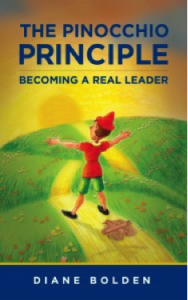 Well, my new book, The Pinocchio Principle: Becoming a Real Leader finally went to print on Tuesday, 1/11/11. The process of writing has been a truly rewarding experience full of highs and lows and as intensely humbling as it has been exhilarating. As I’ve reflected back on some of the things I’ve learned along the way, I was struck by how applicable these lessons are to life in general. And, being a writer and a coach, I feel compelled to share them in the hopes that they will be of value to you — if only in some small way.
Lesson #1: When you commit yourself to something that you want with all of your heart, a series of events is set into motion that allows you to get what you most need. However, some of these events may not necessarily be what you originally wanted.
The idea for writing The Pinocchio Principle floated into my head and onto a page in my journal almost six years ago. I dabbled at it – wrote a little here and there, sometimes in long spurts and other times in trickles. It went back and forth from my desk to my shelf again and again. In the latter part of 2009 I began to feel increasing frustration as I never seemed to have the uninterrupted blocks of time I needed to really concentrate and bring the book to life. Lo and behold, in the coming months I saw some of my largest coaching and consulting contracts come to an end. By January of 2010 my practice had become sizably reduced. I initially experienced frustration, disappointment and sadness. And then I realized that I had been given the gift of time and space. Three months later the first draft of manuscript was finished.
Lesson #2: Everything always takes longer than you think it will (note that it took another nine months for me to get from a first draft to a finished book).
This is actually a fairly well known adage called Hofstadter’s Law. Hofstadtler adds that his law holds even when you take into account Hofstadtler’s law. This is especially true when you are doing something you have never done before. You will not know what you don’t know. And mistakes will be made. If you beat yourself up for them, you will only prolong your suffering — and your delays. However, if you acknowledge and embrace these difficult lessons, you will move forward with far more confidence and lightness. You will also have a lot more fun. And so will everyone else who comes into contact with you and your work.
Lesson #3: Everything you do will be infused with whatever you are feeling when you do it.
Before I fully embraced lesson number two, I would try to power forward in spite of the fact that what I really needed to do was slow down. Anything I wrote in that state felt awkward, forced and completely devoid of the energy and passion I wanted to invoke. And I ultimately ended up having to rewrite those passages anyway. When I learned to reconnect with my intention of wanting my readers to feel uplifted and inspired, the words that fell onto the page came far more easily — and often in ways that uplifted and inspired me as well.
Pay attention to the energy you pour into the projects you work on. If you feel resentful or irritated as you go about your tasks, chances are the project will invoke those same feelings in everyone who comes into contact with it. Choose to infuse your work with love and positive intentions and see if people respond in a different way.
Lesson #4: The paradox of success is that only when you forget about yourself and your ego needs and focus on what you can give to others will you actually find what you seek.
As soon as I began to worry about what others might think of what I was writing (or of me), my writing fell apart. It was as though my left hand was writing while my right hand was grabbing hold of my wrist and keeping it from moving the pen across the page. I became too wrapped up in my own self image and needing to look good, which completely disconnected me from my true purpose. And as a result, the inspiration came to a complete halt. However, as soon as I became conscious of these egocentric thoughts and deliberately refocused myself on wanting to deliver something that would truly help my readers, I was able to get back into the flow.
I believe the same is true with anything we do. As soon as we worry about what others will think of us, we fall flat on our faces and end up experiencing the very things we most fear. When we shift our focus from what we can get to what we can give, we have a far more fulfilling experience — and so does everyone else.
Lesson #5: There is power in partnership.
I couldn’t have written this book without the aid of an unbelievable number of people who may not realize how invaluable their assistance really was. My coach helped me recognize the pitfalls I was stumbling into and guided me gently back onto my path. My editor reworded sentences to make the ideas to become crisper, clearer and more engaging. My husband and a number of clients and friends were kind enough to read passages of my manuscript and give me feedback, and the more eyes I had viewing the pages, the better the work became. Friends who had written their own books shared sage advice that guided me along my path. My designer showed amazing patience as I continue to revise cover after cover. Just as, if not more powerful than help in the mechanics of putting the book together was the support, love and encouragement I constantly felt from everyone along the way. Sometimes just talking through a concept helped me realize what I really needed to say and allowed me to more clearly articulate myself.
If you don’t have people around you who can be a sounding board, a coach, a mentor, a cheerleader – even a shoulder to cry on at times, I highly encourage you to seek people out who can support you in this way and rely on them often.
Lesson #6: Whenever you ask a question, you gain access to the answers you seek.
I actually wrote about this process in The Pinocchio Principle. Whatever you focus your attention on becomes illuminated. If you focus your mind on a question, you will find that the answers you seek begin to appear in various ways, often repetitively. They may come in the form of signs, information that you happen to come across, conversations you find yourself in, and even images that enter your mind. But you must pay attention in order to discern these answers, or you may miss them.
Some of the questions I held in my mind as I wrote The Pinocchio Principle included the following:
- How do you breathe life back into work and truly tap your highest potential? And how can you help others to do the same?
- How can you be who you really are (and succeed) in a world that seems to want you to be someone else?
- How can you successfully navigate through uncertainty (and help others to do the same) when everything around you seems to be falling apart?
- How do you tap into your creativity and inner wisdom in such a way that you are able to find the answers you most need at any moment?
The act of writing The Pinocchio Principle allowed me to find the answers I was seeking in such a way that I realized in the end my truest reward was simply having written it —regardless of whether anyone actually purchased a copy or not.
Lesson #7: Every dream worth pursuing will require you to go beyond what you believe to be your limits and push you out of your comfort zone.
There will be times when you question whether you really have what it takes to succeed. You will have days where you feel as though the work you do comes easily and carries you away in a flow of its own. And you will also have days where you will (literally or figuratively) sit and stare catatonically, immersed in the feeling of being completely, utterly stuck.
I have always believed that we are never given more than we are able to handle. The discovery I made in this process is that sometimes you have to be pushed to your edge to realize just how much you are actually capable of. The frustration, anxiety and doubt eventually do pass, but you may have to sit with them for awhile before they leave. They are like clouds that temporarily block the sun and cast shadows everywhere you look, only to help you better appreciate the bright beautiful light of day that was really there all along.
Click here if you’d like to order a copy of The Pinocchio Principle, or go to www.PinocchioPrinciple.com for more information.
Become a subscriber at www.DianeBolden.com and receive my free report: Ten Traps Leaders Unwittingly Set for Themselves…and How to Avoid Them.
Though comments are currently closed, please feel free to email me at Diane@DianeBolden.com with your feedback, questions and thoughts. Have a specific challenge you’d like to see a post written about? Let me know. I’d love to hear from you!