Share This
Category Archives: Pinocchio Principle
Ever Feel Like Work is a Chore?
A third of your time on the planet is spent at work. Why would you do something that makes you feel… dead before your time?
So many of us feel like work is a chore, which Merriam Webster defines as “an unpleasant but necessary task”. It gets lumped in there with all the other things we dread but make ourselves do anyway – washing dishes, picking up the dog (or cat) poop, taking out the trash.
It’s interesting that Webster’s definition of the word “work’ has a similar connotation: “a task or tasks to be undertaken; something a person has to do”.
So, you could argue that the words “work” and “chore” go hand in hand. And if your previous experiences validate a belief that work is a chore the association will be even stronger. So strong that it leads to a common expectation that work is a necessary evil, a thing to be endured, something laborious and heavy.
Neuroscientific research has shown us that it is often our expectations themselves that shape our experience of reality. And that can keep you stuck in a perpetual loop of believing that work is a chore and a resulting experience that proves it to be true.
Over time, perpetual loops feel a lot like hamster wheels – you’ll expend a ton of energy, feel a lot of frustration, and not really get anywhere.
(And if you are a leader, you may be unintentionally setting that tone for your whole organization.)
But you can turn that all around and change your world for the better. It doesn’t require a lobotomy. And it doesn’t necessarily mean you need to quit your job. This video will give you a glimpse of just how easy that simple shift could be.
If you want more on revitalizing your work from the inside out, consider enrolling in the spring session of The Pinocchio Principle Unleashed: The Real Leader’s Guide to Accessing the Freedom & Flow of Your Authentic Genius. This exclusive 12-week leadership development program is now in its 7th year, with over a hundred happy alumni.
Participants for this video-based, small group coaching program are carefully selected and capped at no more than ten. Registration will open on February 15th, and priority will be given to those on the waiting list. For more information or to be considered for enrollment, go to www.UnleashtheExtraordinary.com.
The Way We’ve Been Working Isn’t Working Any More
Are you familiar with what’s being called The Great Resignation? With resignations and job openings at an all time high, companies are competing to hire and retain top talent. But much of that talent is feeling overwhelmed, overextended and burned out.
Because THE WAY WE’VE BEEN WORKING ISN’T WORKING ANY MORE.
We are at an unprecedented time with regard to work/life integration challenges. Telecommuting allowed us more time at home, but for many it blurred the lines between our work and personal lives, skewing it toward work and leaving many feeling chewed up and spit out.
While it’s becoming clear we cannot go back to the way things were, we must find a way to chart a path that’ll get us where we really want to go – and redesign the way we work from the inside out.
There has never been a better opportunity for leaders to rise up and blaze a new trail. But before they can lead others, they must first do it for themselves. This video was created for those who feel compelled to answer that call.
Are you one of them?
Watch the video to find out, then visit www.UnleashtheExtraordinary.com for more details.
Are You Running Out of Gas?
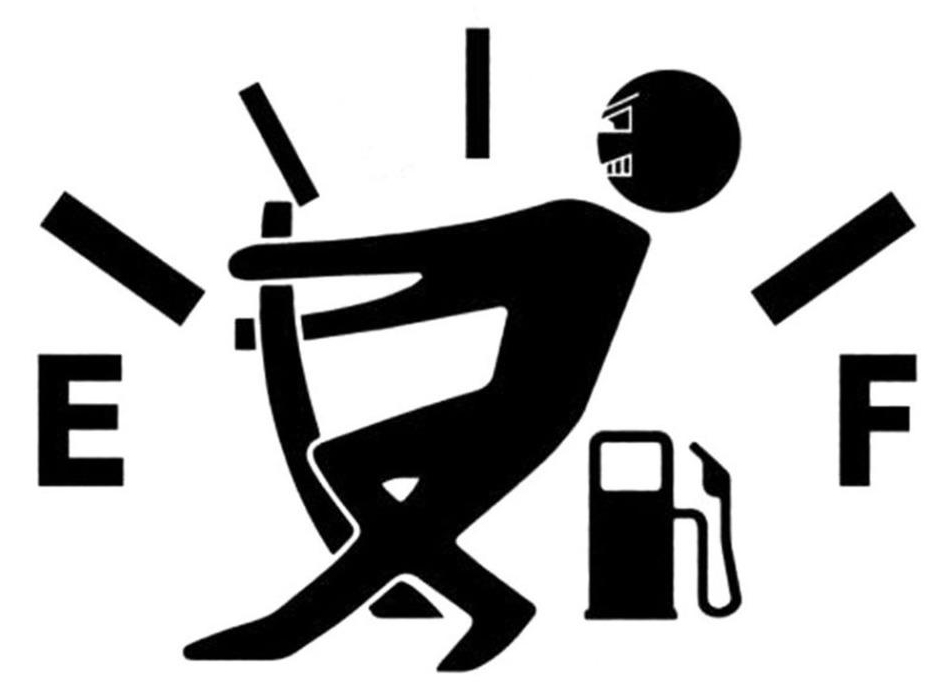
Very few of us would drive for long without a seatbelt, especially with the loud blaring noises most cars make to alert us of the fact that we’ve forgotten to take such an important precaution. But if you ask people how long they’ve driven accompanied by a warning light that tells them they are due for an oil change or a tire rotation or are low on fuel, you’d likely hear a different story.
The same tends to be true in the way we approach our work and personal lives. We readily give our attention, time and energy to the issues that demand our attention – urgent requests, ringing phones, things that are in our faces. But we are all too likely to ignore those subtle little warning signs that indicate we need general maintenance to stay healthy and vibrant enough to make it to our ultimate destinations.
Think about your own life for a moment. Chances are you’re very busy, with a lot on your plate and many things in the pipeline. You are likely juggling many balls – and not just at work. With telecommuting becoming more of the norm, separating your personal and professional life has likely become a bit more challenging, as the line has become more blurred than ever. You may not be spending as much time in your car, but your compulsion to jump on the computer to knock a few things out when you’d otherwise be having personal time has likely taken a huge leap – even more so if your work expands across different time zones. And when you do that, the minutes all too easily stretch into hours.
The tendency of most high achievers who find themselves shouldering an increased load is to double down on their efforts – to work harder, longer, faster. If that is a familiar pattern for you, you know that when you get locked and loaded on a target, you are very likely to dismiss (or completely overlook) the subtle indicators that you are overextending your capacity and putting yourself at risk.
Occasionally though, the stress and overwhelm come to a head and you can’t help but notice them. Just as a car whose oil has become very dirty or whose gas tank is running on fumes doesn’t quite operate as effectively, you too will begin to notice more and more visible signs that something has got to be done to get your system back in optimal working condition.
How does that show up for you?
Do your shoulders gradually creep closer to your ears? Does your breathing get more and more shallow? Do you find yourself clenching your fists? Gritting your teeth? Losing your temper more often than you’d like?
Perhaps it’s more of a gnawing awareness that something’s got to give. You might feel as though you’re not sure you can continue at this pace. You may have a feeling that something is missing, or out of kilter. You could find that the things that used to satisfy you just don’t move the needle anymore like everything is just blending together in a kind of gray mush that you are continually trudging through.
The good news is that this is a state you can definitely do something about.
It’s more a product of LACK of consciousness than anything. This means that when you intentionally make a conscious, deliberate decision that you are ready to do something different, you can – and you will.
This week, I want to share with you some tips that can help you regain your sanity and tend to those little warning signs that you may have been overlooking for a little too long.
Today, we’ll explore a common “success formula” that tends to get people into trouble. This success formula is one that is so ingrained into the fabric of our existence that you may not even be aware of it. It is the conditioning that leads us to believe that the harder we work, the more we do, the busier we are, the more successful/valuable/worthy we will be (pick the adjective that resonates most for you).
It is not without some merit. After all, it is true that most things worth working for do require some degree of effort, and that obstacles often require diligence and increased commitment and grit to overcome.
But this approach, when overdone, can lead to the very burnout that keeps you from operating at all.
While it is true that you need to practice the kind of resilience that will keep you in the game rather than forfeiting the race, the best race car drivers know that you have to make occasional pit stops to make it through the long haul. The best athletes know that their bodies need to rest in order to perform at their best. And the best leaders and executives understand that sometimes you need to slow down in order to speed up.
The assumption that underlies the “success formula” that turns against us is one that leads you to believe you don’t have time to slow down, to be intentional, to gain clarity on where it is you are going and what you need to do along the way. That assumption leads you to overlook the importance of reflecting on where you’ve been and how the journey is going, what’s working and what needs to change, and how you can shift your action in a way that aligns with your desired result. It leads you to keep driving even when your tank is empty, your oil is dirty and your tires are bald. It’ll drive you into a ditch (or worse).
The first step to keeping that kind of programming from derailing you is to become aware that it is in fact operating and to realize what the impact of that programming has been.
Human beings don’t change until the pain of staying the same is greater than the pain or discomfort of doing things differently. But we often don’t recognize that this pain is self-imposed – as a result of the kind of thinking that compels us to keep pushing when we need to take our foot off the gas. Instead, we attribute our exhaustion, frustration, disillusionment, overwhelm, etc. to our circumstances.
But what if it were overuse of the “success formula” itself that leads you to deal with stress in a way that actually makes things more stressful?
Do you believe you can’t afford to slow down?
Is it really true? If you were to insert an hour into your schedule to do something that tends to your well-being, or allows you to gain some clarity or to replenish your energy, would you really be worse off? Do you know others who somehow find a way to do slow down and take breaks every once in a while, or do the things they love – and still manage to perform well (maybe even better?)
When you believe you can’t slow down, you’ll take in information that confirms it and screen everything else out. So if all that comes to mind is what you’d have to lose, see what happens when you get curious about what you’d have to gain.
Just for a moment, think about who you could be if you no longer let that thought dictate your response. Would you be willing to entertain the idea that there may be some things you can do to interrupt that crazy compulsion that has a way of keeping you on a hamster wheel, running faster than ever but not really getting anywhere? Or pushing a big rock up a hill only to have it come rolling back down again and again?
All you need at this point is the curiosity to entertain the thought that perhaps that old “success formula” has some holes in it – and that if you are open and willing to find a better way, the path will reveal itself to you.
In the coming days, I’ll give you some more tips and tools that will help you find it.
If you’d like to more fully explore what your life and work could be like beyond the conditioning that may be holding you back, consider enrolling in the fall session of The Pinocchio Principle Unleashed: The Real Leader’s Guide to Accessing the Freedom & Flow of Your Unique Genius. This thirteen-week leadership development program is ideal for leaders and professionals experiencing high levels of stress, pressure and overwhelm who long to experience more passion, meaning and joy in their work and their lives and especially fitting for those who tend to take a lot on and want to minimize stress, pressure and overwhelm without sacrificing performance.
Public registration will open on September 1. Subscribers to DianeBolden.com are eligible to pre-register – email support@DianeBolden.com for more information.
What to Do When You Just Can’t Get What You Want

Life has a tendency to disappoint at times – sometimes more than others, of course. For many of us, the frequency has increased disproportionately over the last year or so.
We have lost things we valued, endured things we never would have wished for, and weathered the increased tension and anxiety that comes when vital issues (some long buried) surface and come to a head.
We all naturally focus on what we most want – and in times of stress, anxiety and frustration we often feel as though despite our best efforts we just aren’t getting it. You can lose yourself in disappointment and irritation and stay in it for days, weeks, months and even years.
But perhaps there is a way out of it. One that provides you not only what you most need – but has the potential to spill over and benefit others as well.
I saw a profound example of a quite uncommon approach for dealing with frustration, disappointment and grief back when I was an undergraduate.
My roommate had been uncharacteristically gloomy for several weeks. Her usually delightful demeanor had become heavy and dark.
One day when I came home from class, there was an envelope taped to our door. As I looked around the building we lived in, I noticed similar envelopes hanging on other doors. This one had my name on it, handwritten.
I tore it open and found a piece of notebook paper upon which was written one of the most heartfelt notes I had ever read. It was signed “from someone who appreciates you deeply”.
As I read it, I found myself falling into the page while small tears began to collect at the corners of my eyes. The author of the note had recounted things I had done over the last several weeks (many of which I thought were insignificant) that made a difference in that person’s life.
There were kind, warm words of praise and gratitude as well as encouragement and inspiration. Whoever wrote it apparently thought I was special and took the time to tell me why in such a way that it profoundly touched me.
I looked up and saw someone across the hall reading her note and watched as her face began to light up.
When I opened the door to our place, I found my roommate sitting contentedly writing in her journal and sipping a cup of tea. She looked up and smiled for what seemed the first time in weeks.
“Did you get one of these notes?’ I asked her.
“No,” She responded with a grin.
And then it hit me. She was the one who wrote the notes. She didn’t admit it at first, but I finally got it out of her.
“What led you to do this?” I asked her. “It must have taken you hours!”
“I was tired of feeling tired and sad and lonely,” she said. I was sick of my gloomy little world. And I decided that if I couldn’t make it better for myself, maybe I could make it better for someone else.”
She had started with one note. And then she wrote another. And then another. And it felt so good, she said, that she decided she’d just write until she didn’t feel like writing anymore.
That was almost thirty years ago. And it still inspires me.
She taught me more through her actions than I would have learned by reading ten books that day. I don’t think she intended it at the time, or even realized it until she started writing, but the gift she gave to everyone in that building ended up being something that benefitted her just as much as everyone else.
And my guess is that it is still benefitting her and everyone else – because I know it’s still meaningful and significant to me.
Philosopher Jean-Paul Sartre said, “All which I abandon, all which I give, I enjoy in a higher manner through the fact that I give it away. To give is to enjoy possessively the object which one gives.”
Perhaps this is one of the true gifts in giving – that when we get outside of ourselves to touch another human being, it has a way of bringing us gently back to ourselves so that we too receive the gift.
And it holds true even when we think we have nothing left to give.
When our egos get the best of us and we think nothing will ever go the way we want it to, we can transcend a state of wanting by moving into a state of giving.
Think of something you want right now, in this moment. What is it that “something” will give you? Most likely it is a feeling – perhaps a feeling of contentment, satisfaction, prosperity, abundance, or joy.
Now, see if there is something you can do for another person to help them experience those things.
Often when we give to others, we find we already had that which we were seeking. We realize the thing we thought we needed is a means to an end that we have already arrived at. And perhaps this, in and of itself is the true gift of giving.
For more on how to transcend frustration, pressure and stress to get what you really want, check out The Pinocchio Principle Unleashed: The Real Leader’s Guide to Accessing the Freedom & Flow of Your Unique Genius. Though the spring group session has closed, you can join the waiting list to be notified of the next session.
Image by Colin Behrens from Pixabay
Extraordinary Results. Less Effort. More Joy.
The other day I came across a piece of paper that brought back a rather unsettling memory of a pivotal conversation I had long ago, about something that was very important to me. I didn’t realize just what an impact it had on me until I stopped to recall it – and consider all the things that have unfolded in the years that passed.
I filmed a video about it that you can find on my LinkedIn page.

I’d love to hear your thoughts after you watch – you can leave a comment right on LinkedIn. And if we are not yet connected there, hit that blue “Connect” button while you’re at it.
Sometimes it takes a while to embody the things you strive for. The journey may have a lot of twists and turns and ups and downs. But it’s definitely well worth traveling.
If you’d like some support on your journey, there are still a couple of seats remaining in the spring session of The Pinocchio Principle Unleashed – The Real Leader’s Guide to Accessing the Freedom & Flow of Your Authentic Genius kicking off on Wednesday (3/3). It’s a thirteen-week leadership development program that will help you move beyond the conditioning that keeps you from rising to the extraordinary results you are capable of achieving – with less effort and more joy along the way.
I’d love to have the opportunity to work with you.
Here’s to the journey – and the ever-unfolding destination!
Why What Got You Here May Not Get You There – and What to do Instead

Imagine that software you’ve relied on for years stops working for you. You notice your computer has been freezing up a lot and you’ve been experiencing some glitches. At first, it didn’t really bother you. You just made do and went on. But now it’s happening so often that you’re having trouble getting things done.
When you look into the problem, you find you’re not the only one experiencing it. In fact, after receiving numerous user complaints, the company discovered its software was having incompatibilities. Much to your relief, a new version of the program is being rolled out that has fixed all the bugs. And happily, this updated program is now available for you to download.
The same thing happens to each of us. You’re cruising along doing what you’ve always done only to find it just isn’t working so well anymore. You aren’t getting the results you wanted. Or worse, what worked before is actually causing new problems. And despite your best efforts, these problems are throwing a big monkey wrench in things.
Take Shiela as an example.
Shiela is a high achieving executive who has always prided herself on her ability to be the “go to” person for solutions. Her energy and enthusiasm led her to be sought out for plum projects and invited to serve on numerous committees and boards. She happily took these things on and went the extra mile to deliver excellence in everything she did. And her career trajectory was headed ever upward.
But over time, the number of initiatives she was regularly involved in began to wear on her. Her calendar was packed and she hit the ground running each day only to find that her to do list was growing faster than her ability to get things done. She had multiple balls in the air and lived in constant fear that one of them would come crashing down at any moment.
Her solution was to double down on what helped her succeed in the past. She worked more, slept less, and pushed herself beyond the limits of her own exhaustion. And though she was working harder than ever, her performance began to suffer. The work that once energized and inspired her was beginning to feel like an endless grind she just couldn’t rise above. And people began to notice.
Well-intentioned friends and colleagues gave her books and advice, and she did her best to try to institute new approaches, take better care of herself, delegate, prioritize, rely on systems and get support. But when things got tense, she reverted to old patterns of behavior that were deeply ingrained.
Shiela’s old program was interfering with her new one. And this interference was causing major glitches. But those glitches didn’t have to keep her from achieving her desired results. She just had to find the bug that was creating the havoc and take steps to eliminate it.
So how do you find a bug in your program?
Like Shiela, you start by recognizing that you aren’t getting the results you want. And then you work backward. Finding the bug in your program requires that you detach from your actions in such a way that you can observe and evaluate them.
One way to do this is to replay events in your mind to identify any causal factors. You can designate time at the end of the day to mentally review the day’s events and evaluate what went well and what didn’t. You can journal about it. Or you can talk with someone who is an objective third party, like a friend, family member, mentor or coach.
The bug in your program is almost always a knee jerk reaction.
When Shiela replayed her interactions with others, she realized that what she really wanted (and needed) to do when someone asked her to become involved in yet another project, committee or board was to ensure that it was the best fit and use of her time before responding. But she also recognized that before her mental faculty was engaged, she had already pledged her sole support and involvement. And before she knew it, despite her best intentions, she had unwittingly pushed herself further into overwhelm.
She was reacting instead of responding.
Knee jerk reactions are the product of conditioning.
Conditioning is what happens when a behavior becomes so automatic that you no longer need to think about it. And conditioning is good when it leads you to behave in a way that is constructive — like when you practice a new skill over and over again until you can do it without having to remind yourself of each step.
But conditioning that leads you to spring into action when what you really need to do is give a little more consideration to your response can get you into trouble.
There is a neurobiological component to conditioning. Every time you practice something or respond to a stimulus in a certain way, you are creating neural networks in your brain. Neurons that fire together wire together. And the more they fire, the stronger and more automatic their connections (and your behaviors) get. Conversely, when a neural network is interrupted or not used for a certain period of time, these connections begin to weaken.
Once you have identified the bug, you can begin to eliminate it.
Simply being aware of a knee jerk reaction will begin to loosen its grip on you. When Sheila realized she had a tendency to override her true intention by launching into an old undesirable pattern before she even knew what was happening, she also became increasingly aware of the negative consequences that behavior created.
This is not to say that Sheila could instantaneously eradicate her bug and immediately improve her results. On the contrary, she grew increasingly frustrated because now she was not only engaging in problematic behavior — she was doing it even though she knew better. But this awareness is half the battle.
Initially, she didn’t recognize her oversights until after the fact, but with increased awareness and attention Sheila noticed them sooner and sooner. The time it took her to catch herself went from hours to minutes and with continued diligence, she was able to take steps to correct them in real-time. Ultimately, she got to the point where she could prevent herself from engaging in this automatic reaction altogether.
As the bug is eliminated, the program can be upgraded.
Upgrading the program is a matter of replacing an old behavior with a new one. Unlike software upgrades, this one isn’t a matter of a simple download. It requires attention, thought and persistence.
As mentioned previously, neural networks that correspond to old, undesirable patterns of behavior weaken when they are not engaged. And as they weaken, repeated practice allows new neural nets to be formed that support a more desirable behavior.
But doesn’t creating new neural networks require a huge amount of practice?
The interesting thing about the formation of these neural networks is that they do not have to happen in real-time. Research has shown that mentally rehearsing a new pattern of behavior leads to the same growth in neural networks that physical practice does.
As Sheila began mentally reviewing the way she handled herself in conversations, she reflected on what she would have liked to do differently. And then she replayed the scene in her mind with a new, more desirable ending. She continued to do this daily. As she did, she literally rewired her brain.
Doing so allowed her to create and increasingly rely on new neural networks in situations that necessitated a different response. Gradually she was able to replace her tendency to automatically take more and more on with a more thoughtful, respectful response that offered solutions without adding to her overload. She began to recognize opportunities to involve and empower others to do things that would allow them to grow and buy her much needed time to regroup and reengage in a more focused, less frenetic way.
And over time Sheila once again became known not only for getting results but for making a more strategic impact and growing talent within her organization.
Let’s review the process of upgrading your internal programming
• Step One: Find your bug. The first step is to recognize when you have a tendency to engage in behavior that keeps you from getting the results you desire. Most likely this will be a knee jerk reaction that propels you into action before you have a chance to think.
• Step Two: Disempower your bug. Becoming aware of behavior you fall into and the impact it has on your effectiveness ultimately weakens its hold on you because while it still may be automatic, it is no longer unconscious. Though falling into old patterns when you know better is frustrating, this awareness is a sign of tremendous progress.
• Step Three: Substitute a new program for the old one. As your old habits and the corresponding neural nets that lead you to engage in them begin to weaken, you can replace them with new behaviors. The more you practice these new behaviors (whether physically or mentally), the stronger the new neural networks and your new patterns will become. And the less you engage the old behaviors, the weaker and less prominent the old neural networks (and the corresponding behaviors) get.
If you find yourself engaging in behavior that is interfering with your effectiveness, the most important thing to remember is that you are not the program that is running it. You are the programmer. You have the ability to consciously choose the behaviors and the responses you have to any given stimulus.
Though interrupting and upgrading your internal programming takes time, the results will be well worth your effort. And the best part is that you don’t have to lodge a complaint with or rely on anyone but yourself in order to do it.
If you’d like some support in recognizing and overcoming bugs in your programming, consider joining me in the Spring session of The Pinocchio Principle Unleashed – The Real Leader’s Guide to Accessing the Freedom & Flow of Your Authentic Genius. A few seats remain for this exclusive 13-week leadership development program, which kicks off on March 3. If you have questions or would like to chat about whether the program is a fit for you, you can schedule a call directly with me.
Here’s what a previous participant had to say…
“My professional goals were not going the way that I wanted them to and I had a suspicion that I was pounding my head against the wall trying the same tools or switching the tools differently and I just needed a fresh perspective on them. I enrolled in the Freedom & Flow program after receiving encouragement from people who work with Diane who raved about their interactions with her and how impactful she’s been in their life.
One of the things that this course helped me realize is that I always believed the tools that made me successful early in my life and my career would be the same tools that would see me through to the end. The truth is that my toolbox needed more tools, or different tools in it.
This is important for folks that would be thinking about this program, and it was revolutionary for me – what worked for me early in my career isn’t going to work all the time, I can’t say that enough. You need to reexamine. You can’t have the same script for your whole professional career, you just can’t. You have to adjust the script. I’m in leadership positions versus before, I was a follower. I was trying to get somewhere. Now I’m somewhere and it’s different.
I’ve taken a lot of leadership courses. They’re usually big group settings. This is a smaller more intimate group. The one on one calls are terrific and super helpful. Diane is energetic, vibrant, engaged, open-minded, and thoughtful. Her program has helped me better influence and connect to others, decrease my stress, and get much more done. I’m more mindful and have replaced old, ineffective tools with new ones – it feels great, it’s really refreshing.
My message to folks who are considering this course is pretty simple: you will learn new skills, new tools that you haven’t used before which are going to help move you forward. The program is awesome, and I highly recommend it.”
Dr. Tony Sciscione, Director, Maternal-Fetal Medicine at Christiana Care Health System
Are You Operating from Your Genius or Your Puppet?

Last week I posted a video about the story of Pinocchio and the relevance it has as a metaphor for each of us as leaders. As I mentioned in that video, that story is about much more than a puppet whose nose grew when he lied.
It’s the story of a puppet that longs to become REAL. It’s also the story of anyone who feels like they’re trapped by their circumstances – who knows there’s got to be something more than the way things have been going, who doesn’t quite feel ALIVE and may feel like life is beating them down.
Like Pinocchio, we too have a burning desire to become REAL – to access the greatness (Genius) within, to be a part of something meaningful, to make a greater impact as only we can. We’re born with these impulses.
But until we become REAL LEADERS, we function largely as puppets – bound by our conditioning, trapped by our well-worn habits and patterns, operated by external forces pulling our strings, and confined by the programming we’ve inherited or internalized.
And when we exercise the courage to embrace our own journey toward becoming a Real Leader, we free ourselves from those strings and unleash our GENIUS.
What is Genius, exactly?
People often think of genius as an extreme level of intelligence that only certain people have. But it is more than just intellectual capacity. And we are all born with it.
Genius is the masterpiece in the marble – what stands after everything that is not the masterpiece is carved away. It is the life blood of our organizations, our people, our very selves. It is what unites us and makes us strong. It allows us to overcome our most formidable obstacles and rise to our most daunting challenges and promising opportunities.
GENIUS is the power of the human spirit.
How do you know if you are operating from your Puppet or your Genius?
Here are a few indicators that I teach in my thirteen-week signature program, The Pinocchio Principle Unleashed – The Real Leader’s Guide to Accessing the Freedom & Flow of Your Authentic Genius.
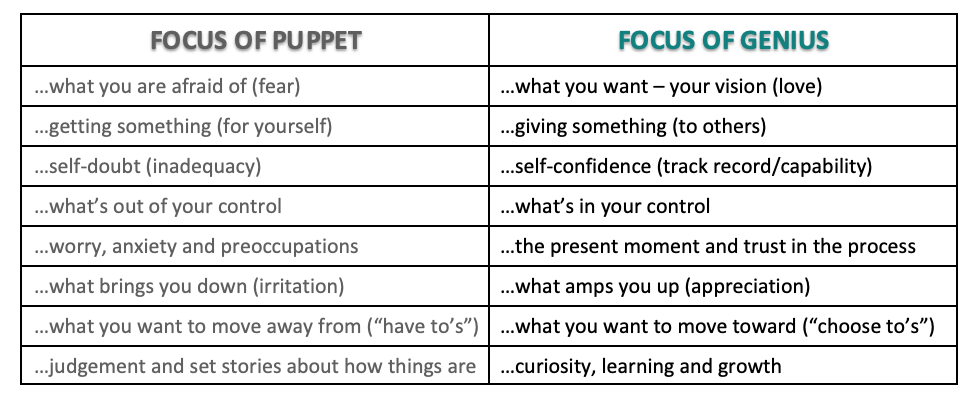
When you are operating from your puppet, you are largely focused on…
- …what you are afraid of (fear)
- …getting something (for yourself)
- …self-doubt (inadequacy)
- …what’s out of your control
- …worry, anxiety and preoccupations
- …what brings you down (irritation)
- …what you want to move away from (“have to’s”)
- …judgement and set stories about how things are
In contrast, when you are operating from your Genius, you’ll see things quite differently:
And when you move from your Puppet to your Genius, you’ll have a very different experience too.
You’ll enjoy:
- the energy and vitality to perform at your highest level without getting beaten down by stress, pressure and overwhelm,
- a renewed passion and sense of meaning that gives you the strength to overcome obstacles and resilience to bounce back from setbacks,
- heightened creativity and ingenuity to find answers to problems that previously stumped you – and to navigate change, challenge and uncertainty with courage, confidence and ease, and
- the ability to create strong connections with people that inspire trust and increase your ability to influence and truly lead.
What can you do to better align with your Genius more of the time?
It all starts with awareness. Most of us do not realize the degree to which we operate as Puppets. Nor do we appreciate the Genius that is waiting in the wings, eager to emerge.
Start by checking in with yourself regularly to determine where your focus is. Notice how you feel when you are operating from Puppet, as well as Genius. Referencing the chart above, ask yourself what you can do to make the necessary shift.
And if you’d like more support on the journey, consider enrolling in The Pinocchio Principle Unleashed – The Real Leader’s Guide to Accessing the Freedom & Flow of Your Authentic Genius. Registration for the spring session, which will kick off in March, is now open. To maximize personal interaction and individualized support, enrollment is limited to 10 people.
You can get more information here. And if you have questions or would like to discuss the program in more detail, you can schedule a call directly with me.
Image by Thomas Skirde from Pixabay.
Do You Suffer the Curse of Competence? How to Keep it from Stealing Your Success.
Many of us are on the verge of entering new, unchartered territory.
Some are having to do that by necessity, as a result of changing circumstances. Others are recognizing – and answering – the call to step out and try something we’ve never done before.
Either way, it isn’t easy. Especially if you are accustomed to (and pride yourself on) being able to do something really well.
Anytime you try something new or different, you will encounter resistance.
To assist you through these vital transitions – and to help you overcome what I call “the curse of competence”, I wanted to share something with you that I teach in my 13 week Pinocchio Principle Unleashed program.
It’s an excerpt from a video on embracing uncertainty and redefining failure. In less than 6 minutes, you’ll gain a whole new perspective that’ll help you move beyond your greatest resistance to create and enjoy the success you are truly capable of.
Interested in enrolling in the spring session of The Pinocchio Principle Unleashed? Join the waiting list to be the first to hear when registration is open.
What Can Pinocchio Teach You About Navigating Change and Unleashing Your Genius?
As I’ve written in recent posts, change is coming at us right now both from the outside in and the inside out.
And change is naturally somewhat disconcerting.
But it can also be liberating and empowering – if you use it as a doorway to rediscover you who really are at your core – to unleash your GENIUS.
When you access your Genius, you’ll not only unlock your highest levels of performance and advance your career, you’ll also enjoy more freedom and fulfillment both on and off the job.
The Pinocchio Principle: The Real Leader’s Guide to Accessing the Freedom & Flow of Your Authentic Genius, my 13 week signature program, is designed to help high achieving executives do just that. The fall session is kicking off on Wednesday, September 30.
I believe it’s more timely now than ever. I filmed a short (5 min) video to tell you why…
You can find all the details about the program here: The Pinocchio Principle: The Real Leader’s Guide to Accessing the Freedom & Flow of Your Authentic Genius. If you have questions or just want to chat about it, you can also schedule a call with me.
But don’t wait long! The fall session will start on Wednesday, September 30 and I intentionally limit enrollment to a small, intimate size so that each person can have the highest level of support and personalized attention.
Here’s to your Genius!
“I shared before that your program was life changing, but I wanted you to know that is even more true now. I was going through some of my session notes and I had written down some of the characteristics when you are operating in your genius, which I wrote down – trust, faith and curiosity. In a time when it would be so easy to be in fear, judgement and anxiety, I have operated in my genius during this time more than ever before at any point in my life. I have you to thank for that and I am truly grateful. Thank you!”
Porsha M. Caddell, Sr. Manager, Customer Service Business Planning, Southern California Edison
Are You a REAL Leader? What Pinocchio Can Teach You About Becoming One

I’m thrilled to announce the re-release of my book, The Pinocchio Principle: Becoming a Real Leader with a brand new cover! In addition to a new image, the revised cover sports a new subtitle: “How to Unleash Genius in Yourself and Those You Lead”.
Often when I tell people that I wrote a leadership book called The Pinocchio Principle, they assume it must have something to do with ethics. It’s understandable, since the first thing most of us think of when we hear “Pinocchio” is a puppet whose nose grew when he lied. Pinocchio could easily be used as a metaphor for people who lie through their teeth while their proverbial noses grow…
And… it’s also easy to see why some might think it is a commentary on the importance of honesty in leadership.
While being truthful to oneself and others is a vital part of being a “real” leader, the reason I chose Pinocchio as a metaphor goes much deeper than his nose.
You see, the underlying narrative is, Pinocchio is a puppet who longs to become REAL.
Like Pinocchio, at our core we too have a burning desire to become real, (authentic, resourceful, truer to ourselves, in better service to others, etc.) to bring into creation the greatness that resides somewhere within us.
After all, you were born with these impulses — to give form to your distinctive blends of talent, energy, passion and style.
We all come into the world equipped with far more than we are immediately able to utilize or even comprehend. And though these rich parts of ourselves are always there, they have a way of becoming latent over time.
Throughout your career, you’ve no doubt come across people who have a special way of tapping into that well of available greatness.
They seem to effortlessly draw forth bits of the magic, access energy reserves, continually improve skills and pursue their passions. These are the people we love to watch and be around — they do what they do so well that it is an art.
As they tap their inner reserves and unleash their own greatness, they inspire each of us to do the same… and that’s what sets them apart and elevates them to the level of “Real Leadership”.
In Walt Disney’s rendition of Pinocchio, the puppet encounters a blue fairy. She tells him, “When you prove yourself to be brave, truthful, and unselfish, Pinocchio, then you will become a real boy.” You can imagine what Pinocchio might have been thinking upon hearing these words. What are these things this fairy speaks of? How do I get them? What must I do? How long will it take? Where do I start?
With the promise of a dream fulfilled, he endeavors to do whatever is necessary. And the odyssey begins. The twists and turns it takes are trials we can all relate to, and challenges that are a part of our human experience.
The qualities that the blue fairy encourages Pinocchio to demonstrate are not things he must acquire. They are attributes he already possesses. But to activate them, he must endure a series of events that allow him to realize these qualities are there and to exercise them accordingly.
In order to return to himself—his true self—Pinocchio must endure a journey of trials and tribulations that first lure him away from himself. And the same kind of drama seems to unfold in one way or another for each of us.
You have — within you — an animating Genius.
This Genius yearns to take different forms depending on the circumstances. Real Leaders could be defined as those whose Genius longs to create something for the greatest good, which is ultimately accomplished for, with and through others.
It has a keen ability to look around, see possibilities and utilize resources in a way that brings something into existence that benefits others, whether that is a family, a community, a non-profit organization, a corporation, or the world at large.
To accomplish this, leaders have the distinct charge of working with others in a way that brings out their best — that allows those we can impact to find the Genius within them and apply it in service of accomplishing a common goal.
However, before you can bring out Genius in others, you must start with yourself.
Many times the primary meaning of “to lead” is associated with directing something on a given course, or being in charge, and this can be one of the functions of leadership. But the essence of leadership is much more than that. The Merriam Webster Dictionary has the following entry as the first definition listed for the word “lead”: “a: to guide on a way especially by going in advance.”
If one of the essential functions of a leader is to bring out the best in others, this definition would suggest doing so requires that leaders first bring out the best in themselves. This, in and of itself, is the very same odyssey our friend Pinocchio finds himself on: To discover and liberate within himself what is real — divinely inspired Genius — and to courageously apply it in a way that is truthful and unselfish.
I wrote The Pinocchio Principle: Becoming a Real Leader to serve as a roadmap for bringing out the best in yourself and others. My desire is to help you bring to fruition your greatest dreams and visions and better navigate through the perils and possibilities along the way. The book was written to help you:
- Better differentiate what is true within yourself from the conditioning that would have you acting in ways that are inauthentic and self-defeating.
- Gain clarity on your unique call to leadership and leverage your experiences to prepare for something bigger.
- Explore navigational tools that will help you determine the extent to which you are on or off course and the direction you need to take next on your journey to becoming a Real Leader.
- Recognize and prevent assumptions and beliefs (your strings) that keep you from your best work so that you can utilize ego in service to something greater.
- Recognize and steer clear of the elusive promises (Pleasure Island) that divert you from your truest fulfillment.
- Face your greatest fears (the belly of the whale) in a transformational way that will reunite you with your own determination, courage and heroism.
- Rediscover the power that lies within (the fairy’s wand) to create and live your dreams.
- Find ways to return to the quiet places within yourself that nurture and inform your greatest visions.
The ultimate odyssey is always that of self-discovery. Every challenge, every opportunity gives you a chance to learn more about who you really are and to utilize your inherent gifts in service to something greater than yourself.
As I teach in The Pinocchio Principle Unleashed: The Real Leader’s Guide to Accessing the Freedom & Flow of Your Authentic Genius program, it’s only when you give yourself completely to the journey and find meaning in each step along the way, that you will truly live.
It’s your example and the unique contributions you make in the world that defines you as a Real Leader.
Now, more than ever, Real Leaders are differentiating themselves from people who simply hold fancy titles or have multitudes of people reporting to them. They exist at all levels of an organization, and they have the ability to transform it in ways that will allow it to achieve unprecedented levels of success.